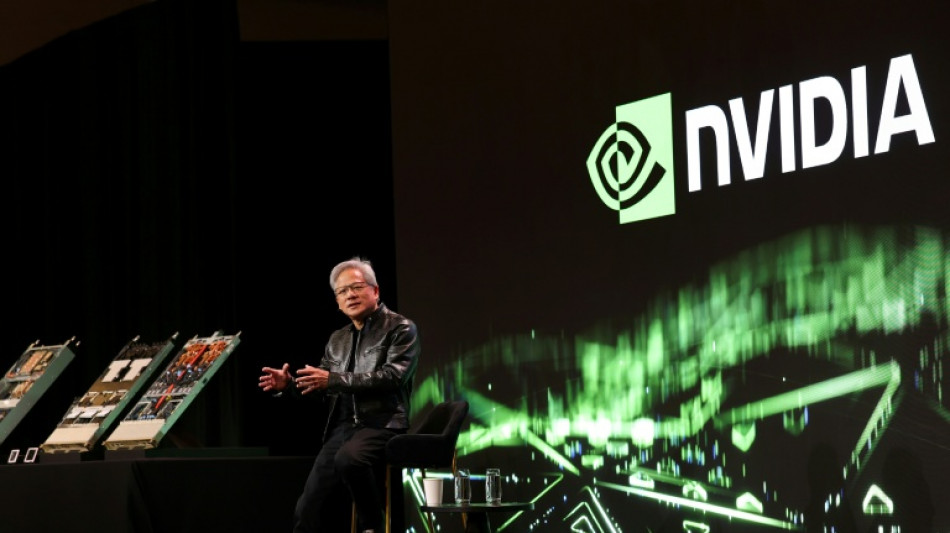
US allows Nvidia to send advanced AI chips to China with restrictions / Photo: Patrick T. Fallon - AFP

 AI 'warning shots' focus Beijing on national security risks
 Philippine tribe in limbo over US-led tech hub

 Saudi-led coalition says Houthis fired ballistic missile at Riyadh

 Cuba works to restore power after another blackout

 Brigitte Bardot widower slams sale of star's belongings

 Indonesia accepts Malaysia's help to tackle wildfires

 Nvidia, OpenAI CEOs to attend Xi dinner at White House
 Cuba hit with seventh major blackout of the year

 Nigeria miners struggled to breathe in cell before 37 died: survivors

 Warren Buffett steps down as Berkshire Hathaway chairman

 Isolated Syrian-Druze city blames Damascus for shortages

 Kerry James Marshall: American 'blackness' painter celebrated in Europe

 Infantino 'must go', says German FA vice-president

 Japan's busiest rail station tests robot bins

 Backpackers fret over Australian visa crackdown

 Bank of Japan hikes rates to 31-year high to battle inflation

 AI doomsday warnings unlikely to slow IPOs but questions linger

 In Brazil's Amazon, the hunt for oil fuels hopes and fears

 Baby orangutans in India expose 'frightening' scale of trafficking

 Oversight Board blasts 'inadequate' Meta safeguards for AI deepfakes

 Harry makes first public appearance since return to UK

 Princess Diana's brother makes new explosive claims against Charles

 Trump admin overhauls key protection for endangered species

 Mbappe draws political fire over Ceuta t-shirt controversy

 Third malaria death in Germany from outbreak tied to Frankfurt airport

The US Commerce Department on Tuesday opened the door for Nvidia to sell advanced artificial intelligence chips in China with restrictions, following through on a policy shift announced last month by President Donald Trump.
The change would permit Nvidia to sell its powerful H200 chip to Chinese buyers if certain conditions are met -- including proof of "sufficient" US supply -- while sales of its most advanced processors would still be blocked.
However, uncertainty has grown over how much demand there will be from Chinese companies, as Beijing has reportedly been encouraging tech companies to use homegrown chips.
Chinese officials have informed some tech companies they would only approve buying H200 chips under special circumstances, such as development labs or university research, news website The Information reported on Tuesday, citing people with knowledge of the situation.
The Information had previously reported that Chinese officials were calling on companies there to pause H200 purchases while they deliberated requiring them to buy a certain ratio of AI chips made by Nvidia rivals in China.
In its official update on Tuesday, the Commerce Department's Bureau of Industry and Security (BIS) said it had changed the licensing review policy for H200 and similar chips from a presumption of denial to handling applications case by case.
Trump announced on December 9, 2025 that he had reached an agreement with Chinese President Xi Jinping to allow Nvidia to export its H200 chips to China, with the US government getting a 25-percent cut of sales.
The move marked a significant shift in US export policy for advanced AI chips, which Joe Biden's administration had heavily restricted over national security concerns about Chinese military applications.
Democrats in Congress have criticized the shift as a huge mistake that will help the Chinese military and economy.
Nvidia chief executive Jensen Huang has advocated for the company to be allowed to sell some of its more advanced chips in China, arguing the importance of AI systems around the world being built on US technology.
The chips -- graphic processing units or GPUs -- are used to train the AI models that are the bedrock of the generative AI revolution launched with the release of ChatGPT in 2022.
The GPU sector is dominated by Nvidia, now the world's most valuable company thanks to frenzied global demand and optimism for AI.
China and the United States are competing for dominance in AI.
H200s are roughly 18 months behind the US company's most state-of-the-art offerings, which will still be off-limits to China.
P.Schmidt--CPN