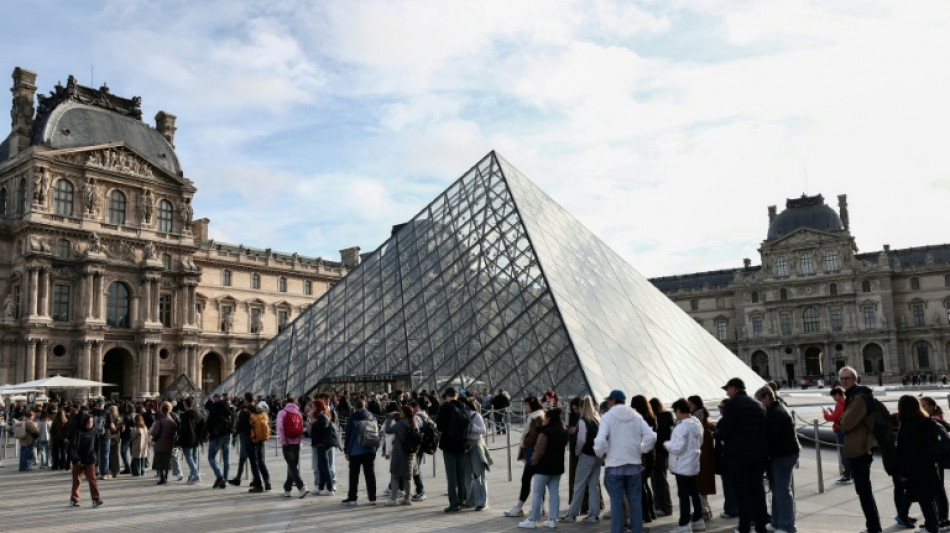
French museum fare hikes for non-European tourists spark outcry / Photo: Thibaud MORITZ - AFP

 AI 'warning shots' focus Beijing on national security risks

 Philippine tribe in limbo over US-led tech hub

 Saudi-led coalition says Houthis fired ballistic missile at Riyadh

 Cuba works to restore power after another blackout

 Brigitte Bardot widower slams sale of star's belongings

 Indonesia accepts Malaysia's help to tackle wildfires

 Nvidia, OpenAI CEOs to attend Xi dinner at White House

 Cuba hit with seventh major blackout of the year

 Nigeria miners struggled to breathe in cell before 37 died: survivors

 Warren Buffett steps down as Berkshire Hathaway chairman

 Isolated Syrian-Druze city blames Damascus for shortages

 Kerry James Marshall: American 'blackness' painter celebrated in Europe

 Infantino 'must go', says German FA vice-president

 Japan's busiest rail station tests robot bins

 Backpackers fret over Australian visa crackdown

 Bank of Japan hikes rates to 31-year high to battle inflation

 AI doomsday warnings unlikely to slow IPOs but questions linger

 In Brazil's Amazon, the hunt for oil fuels hopes and fears

 Baby orangutans in India expose 'frightening' scale of trafficking

 Oversight Board blasts 'inadequate' Meta safeguards for AI deepfakes

 Harry makes first public appearance since return to UK

 Princess Diana's brother makes new explosive claims against Charles

 Trump admin overhauls key protection for endangered species

 Mbappe draws political fire over Ceuta t-shirt controversy

 Third malaria death in Germany from outbreak tied to Frankfurt airport

Should foreign tourists pay more for state-funded galleries than locals, or should art be accessible to all, without discrimination? France is hiking prices for non-Europeans at the Louvre this week, provoking debate about so-called "dual pricing".
From Wednesday, any adult visitor from outside the European Union, Iceland, Liechtenstein and Norway will have to pay 32 euros ($37) to enter the Louvre -- a 45-percent increase -- while the Palace of Versailles will up its prices by three euros.
Americans, UK citizens and Chinese nationals, who are some of the museum's most numerous foreign visitors, will be among those affected, as will tourists from poorer countries.
The French move has few precedents elsewhere in Europe, but is more common in developing countries, where tariffs at sites such as Machu Picchu in Peru or the Taj Mahal in India vary.
Trade unions at the Louvre have denounced the policy as "shocking philosophically, socially and on a human level" and have called for strike action over the change, along with a raft of other complaints.
They argue that the museum's vast collection of 500,000 items, including many from Egypt, the Middle East or Africa, hold universal human value.
While rejecting discriminatory pricing on principle, they are also worried for practical reasons, as staff will now need to check visitors' identity papers.
French academic Patrick Poncet has drawn a parallel between France's move and the policies of US President Donald Trump, whose administration hiked the cost for foreign tourists of visiting US National Parks by $100 on January 1.
The French policy was "symptomatic of the return, as elsewhere in the world, of unabashed nationalism", Poncet wrote in Le Monde newspaper last month.
- 'Not meant to pay' -
Other state-owned French tourist hotspots are also hiking their fees, including the Chambord Palace in the Loire region and the national opera house in Paris.
The government has justified the increases on financial grounds, looking to raise 20-30 million euros annually at a time when it is under pressure to boost revenues and cut spending.
Some of the funds will go towards a colossal plan to renovate the Louvre, which French President Emmanuel Macron announced last year.
Estimated to cost around a billion euros, unions and some art critics have called the project wasteful.
Everyone agrees the Louvre is in poor shape, however, with a recent water leak, structural problems and an embarrassing daylight robbery in October focusing minds.
"I want visitors from outside the EU to pay more for their entry tickets and for that surcharge to go toward funding the renovation of our national heritage," Culture Minister Rachida Dati said at the end of 2024 as she announced the hikes.
"The French are not meant to pay for everything all by themselves," she added.
- European outlier -
It remains to be seen whether the break with European convention by the continent's most-visited country will spur other cultural destinations to follow suit.
Pricing based on age is commonplace in Europe, with access for under-18s free at places such as the Acropolis in Athens, the Prado in Madrid or the Colosseum in Rome to encourage them to visit.
The Louvre will remain free for minors from all countries and Europeans under 26.
Other destinations, such as the Doge's Palace in Venice, offer free entrance for city residents.
Britain has long had a policy of offering universal free access to permanent collections at its national galleries and museums.
But the former director of the British Museum, Mark Jones, backed fee-paying in one of his last interviews in charge, telling The Sunday Times newspaper in 2024 that "it would make sense for us to charge overseas visitors for admission".
The proposal prompted debate but has not been adopted.
A research paper published last year by The Cultural Policy Unit, a British museum think tank, opposed it for both practical and philosophical reasons.
It would reduce entries, lengthen queue times and overturn a centuries-old policy, the report concluded.
"Britain holds its national collections for the world -- not just its own residents," it objected.
X.Cheung--CPN