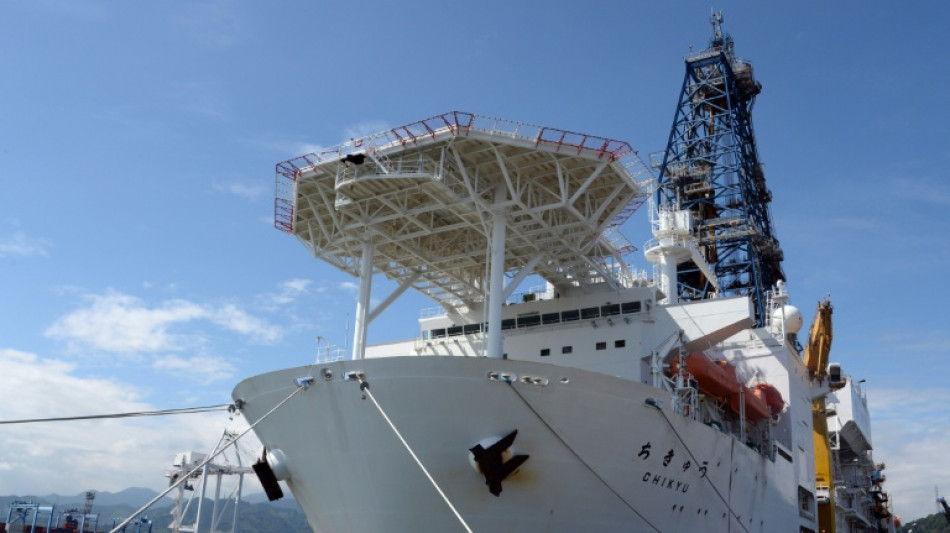
Japan aims to dig deep-sea rare earths to reduce China dependence / Photo: TOSHIFUMI KITAMURA - AFP/File

 AI 'warning shots' focus Beijing on national security risks

 Philippine tribe in limbo over US-led tech hub

 Saudi-led coalition says Houthis fired ballistic missile at Riyadh

 Cuba works to restore power after another blackout

 Brigitte Bardot widower slams sale of star's belongings

 Indonesia accepts Malaysia's help to tackle wildfires

 Nvidia, OpenAI CEOs to attend Xi dinner at White House

 Cuba hit with seventh major blackout of the year

 Nigeria miners struggled to breathe in cell before 37 died: survivors

 Warren Buffett steps down as Berkshire Hathaway chairman

 Isolated Syrian-Druze city blames Damascus for shortages

 Kerry James Marshall: American 'blackness' painter celebrated in Europe

 Infantino 'must go', says German FA vice-president

 Japan's busiest rail station tests robot bins

 Backpackers fret over Australian visa crackdown

 Bank of Japan hikes rates to 31-year high to battle inflation

 AI doomsday warnings unlikely to slow IPOs but questions linger

 In Brazil's Amazon, the hunt for oil fuels hopes and fears

 Baby orangutans in India expose 'frightening' scale of trafficking

 Oversight Board blasts 'inadequate' Meta safeguards for AI deepfakes

 Harry makes first public appearance since return to UK

 Princess Diana's brother makes new explosive claims against Charles

 Trump admin overhauls key protection for endangered species

 Mbappe draws political fire over Ceuta t-shirt controversy

 Third malaria death in Germany from outbreak tied to Frankfurt airport

A Japanese research vessel on Monday began a historic voyage to attempt to dig deep-sea rare earths at a depth of 6,000 metres to curb dependence on China.
Scientific drilling boat called the Chikyu left Shimizu Port in Shizuoka around 9:00 am (0000 GMT) for the remote island of Minami Torishima in the Pacific, where surrounding waters are believed to contain a rich trove of valuable minerals.
The test cruise comes as China -- by far the world's biggest supplier of rare earths -- ramps up pressure on its neighbour after Prime Minister Sanae Takaichi suggested in November that Tokyo could react militarily to an attack on Taiwan.
Beijing claims self-ruled Taiwan as part of its territory and has vowed to seize it by force if necessary.
China has long used its dominance in rare earths for geopolitical leverage, including in its trade war with US President Donald Trump's administration.
Chikyu's voyage, delayed by one day due to bad weather, could lead to domestic production of rare earths, said Shoichi Ishii, programme director at the Cabinet Office.
"We are considering diversifying our procurement sources and avoiding excessive reliance on specific countries," he told reporters at the port as the ship prepared to leave.
"One approach I believe could be pursued is establishing a process to achieve domestic production of rare earths," he said.
Rare earths -- 17 metals difficult to extract from the Earth's crust -- are used in everything from electric vehicles to hard drives, wind turbines and missiles.
The Japan Agency for Marine-Earth Science and Technology (JAMSTEC) has touted the test as the world's first at such depths.
The area around Minami Torishima, which is in Japan's economic waters, is estimated to contain more than 16 million tons of rare earths, which the Nikkei business daily says is the third-largest reserve globally.
These rich deposits contain an estimated 730 years' worth of dysprosium, used in high-strength magnets in phones and electric cars, and 780 years' worth of yttrium, used in lasers, Nikkei said.
"If Japan could successfully extract rare earths around Minami Torishima constantly, it will secure domestic supply chain for key industries," Takahiro Kamisuna, research associate at The International Institute for Strategic Studies (IISS), told AFP.
"Likewise, it will be a key strategic asset for Takaichi's government to significantly reduce the supply chain dependence on China."
The cruise is scheduled to last until February 14.
Recent media reports said Beijing was delaying Japanese imports as well as rare-earth exports to Tokyo, as their two-month-old spat escalates.
China this month blocked exports to Japan of "dual-use" items with potential military uses, fuelling worries in Japan that Beijing could choke supplies of rare earths, some of which are included in China's list of dual-use goods.
U.Ndiaye--CPN