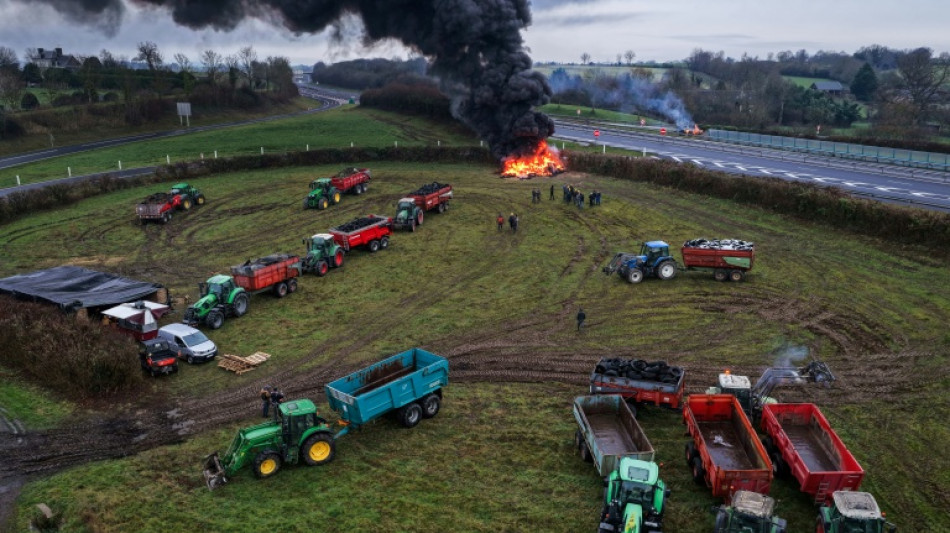
Crunch time for EU's long-stalled Mercosur trade deal / Photo: Damien MEYER - AFP

 AI 'warning shots' focus Beijing on national security risks

 Philippine tribe in limbo over US-led tech hub

 Saudi-led coalition says Houthis fired ballistic missile at Riyadh

 Cuba works to restore power after another blackout

 Brigitte Bardot widower slams sale of star's belongings

 Indonesia accepts Malaysia's help to tackle wildfires

 Nvidia, OpenAI CEOs to attend Xi dinner at White House

 Cuba hit with seventh major blackout of the year

 Nigeria miners struggled to breathe in cell before 37 died: survivors

 Warren Buffett steps down as Berkshire Hathaway chairman

 Isolated Syrian-Druze city blames Damascus for shortages

 Kerry James Marshall: American 'blackness' painter celebrated in Europe

 Infantino 'must go', says German FA vice-president

 Japan's busiest rail station tests robot bins

 Backpackers fret over Australian visa crackdown

 Bank of Japan hikes rates to 31-year high to battle inflation

 AI doomsday warnings unlikely to slow IPOs but questions linger

 In Brazil's Amazon, the hunt for oil fuels hopes and fears

 Baby orangutans in India expose 'frightening' scale of trafficking

 Oversight Board blasts 'inadequate' Meta safeguards for AI deepfakes

 Harry makes first public appearance since return to UK

 Princess Diana's brother makes new explosive claims against Charles

 Trump admin overhauls key protection for endangered species

 Mbappe draws political fire over Ceuta t-shirt controversy

 Third malaria death in Germany from outbreak tied to Frankfurt airport

The EU is expected Friday to give a long-delayed go ahead to a huge trade deal with South American bloc Mercosur championed by business groups but loathed by many European farmers.
Country representatives will vote on the divisive accord in Brussels, likely paving the way for it to be inked in Paraguay next week, more than 25 years after negotiations were launched.
The European Commission sees the deal as crucial to boost exports, support the continent's ailing economy and foster diplomatic ties at a time of global uncertainty.
"It's an essential deal, economically, politically, strategically, diplomatically, for the European Union," commission spokesman Olof Gill said on Thursday.
But Brussels has failed to win over all of the bloc's nations.
Leading the opposition is key power France, where politicians across the divide are up in arms against a deal attacked as an assault on the country's influential farming sector.
President Emmanuel Macron confirmed late Thursday that France will vote against the treaty, saying France's political forces were "unanimous" in their rejection of the deal.
Paris and its allies seemed short of a blocking minority, but the vote could go down to the wire.
The deal would create a vast market of more than 700 million people, making it one of the world's largest free trade areas.
Part of a broader push to diversify trade in the face of US tariffs, it would bring the 27-nation EU closer together with Brazil, Paraguay, Argentina and Uruguay, removing import tariffs on more than 90 percent of products.
This would save EU businesses four billion worth of duties per year and help exports of vehicles, machinery, wines and spirits to Latin America, according to the EU.
"This is the biggest free trade agreement we have negotiated," EU trade chief Maros Sefcovic said Wednesday after 11th-hour talks to allay the concerns of some member states, describing it as a "landmark" pact.
- 'Enormous benefits' -
Germany, Spain and others are strongly in favour, believing the deal will provide a welcome boost to their industries hampered by Chinese competition and tariffs in the United States.
"We have in our hands the opportunity to send the world an important message in defence of multilateralism, and to reinforce our strategic position in a global environment that is more and more competitive," Brazilian President Luiz Inacio Lula da Silva said in December.
But France, Poland and Ireland oppose it over concerns that their farmers would be undercut by a flow of cheaper goods, including meat, sugar, rice, honey and soybean, from agricultural giant Brazil and its neighbours.
The pact needs to be green-lit by at least 15 of the European Union's 27 member nations representing 65 percent of the EU population.
Italy is widely believed to hold the decisive vote.
Having demanded and obtained a last-minute delay in December, Rome struck a more positive note this week, saying the accord offered "enormous benefits".
Failure to sign off on the deal could spell the end of it: Brazil last month threatened to walk if the EU kicked the can down the road.
- 'Parmesao' no more -
Over the past months, the commission has been at pains to reassure farmers and their backers that pros outweigh cons.
It has made a series of concessions, including plans to set up a 6.3 billion euro ($7.3 billion) crisis fund and safeguards allowing for the suspension of preferential tariffs on agricultural products in case of a damaging surge in imports.
Sefcovic has stressed the accord is expected to boost EU agri-food exports to South America by 50 percent, in part by protecting more than 340 iconic European products -- from Greek feta to French champagne -- from local imitations.
"We will no longer have 'Parmesao' competing with Parmesan cheese," Italian agriculture minister Francesco Lollobrigida said on Wednesday.
Still, French farmers rolled into Paris on tractors and their Belgian colleagues blocked major roads across the country in a show of anger against the signing on Thursday.
Ignacio Garcia Bercero, a former top EU trade negotiator now with Brussels-based think tank Bruegel, said the deal's advantages were self-evident.
"Even more important is the geopolitical signal of EU readiness to reinforce relations with Latin America," he told AFP. "Failure to sign will condemn the EU to irrelevance and fundamentally undermine its external credibility".
P.Petrenko--CPN