Dancing isn't enough: industry pushes for practical robots / Photo: Patrick T. Fallon - AFP

 AI 'warning shots' focus Beijing on national security risks
 Philippine tribe in limbo over US-led tech hub

 Saudi-led coalition says Houthis fired ballistic missile at Riyadh

 Cuba works to restore power after another blackout

 Brigitte Bardot widower slams sale of star's belongings

 Indonesia accepts Malaysia's help to tackle wildfires

 Nvidia, OpenAI CEOs to attend Xi dinner at White House

 Cuba hit with seventh major blackout of the year
 Nigeria miners struggled to breathe in cell before 37 died: survivors

 Warren Buffett steps down as Berkshire Hathaway chairman

 Isolated Syrian-Druze city blames Damascus for shortages

 Kerry James Marshall: American 'blackness' painter celebrated in Europe

 Infantino 'must go', says German FA vice-president

 Japan's busiest rail station tests robot bins

 Backpackers fret over Australian visa crackdown

 Bank of Japan hikes rates to 31-year high to battle inflation

 AI doomsday warnings unlikely to slow IPOs but questions linger

 In Brazil's Amazon, the hunt for oil fuels hopes and fears

 Baby orangutans in India expose 'frightening' scale of trafficking

 Oversight Board blasts 'inadequate' Meta safeguards for AI deepfakes

 Harry makes first public appearance since return to UK

 Princess Diana's brother makes new explosive claims against Charles

 Trump admin overhauls key protection for endangered species

 Mbappe draws political fire over Ceuta t-shirt controversy

 Third malaria death in Germany from outbreak tied to Frankfurt airport

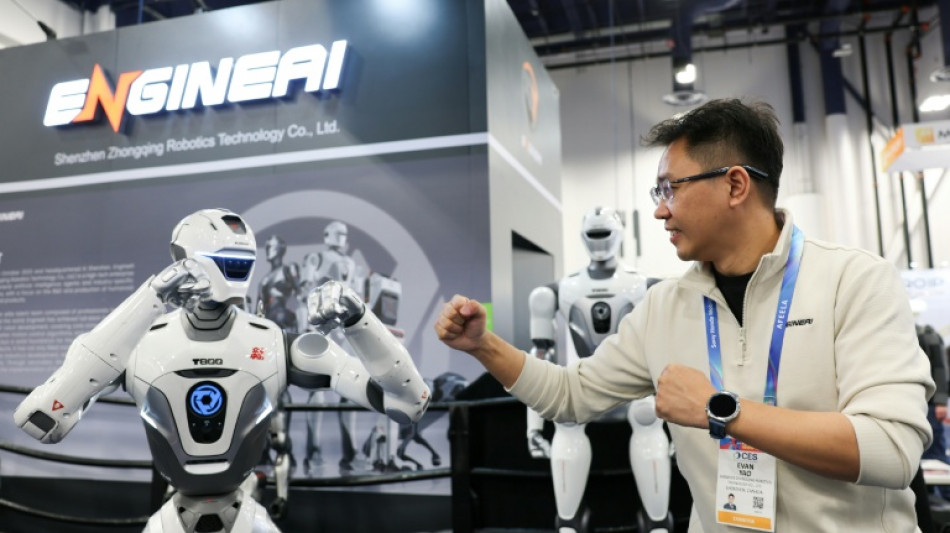
Humanoid robots danced, somersaulted, dealt blackjack and played ping-pong at the Consumer Electronics Show this week, but some in the industry are impatient for them to become more useful, not just a promise of things to come.
As robots take their usual spotlight at the annual CES gadget fest, insiders caution that making them truly like humans will take several more years and require lots of training.
To become autonomous, humanoid robots need AI that translates what is seen and heard into actions, which is beyond the scope of today's large language models that power tools like ChatGPT.
Training a large language model relies on massive amounts of data -- mainly vacuumed up from the internet -- that is of little use when it comes to human-like robots seeking to be useful in the kitchen or on a factory floor.
"If you want (robots) to learn embodied things, you have to put them inside a body," said Henny Admoni, an associate professor at the robotics institute at Carnegie Mellon University.
Humanoid Guide founder Christian Rokseth, who specializes in the technology, likened the situation to locking a child in a room and expecting it to learn about the world.
Even if the pace of development accelerated last year, particularly on the hardware side, Rokseth expressed a degree of impatience about innovation.
"They've shown robots dancing and doing kung fu; now show us that they can be productive," Rokseth said.
EngineAI founder Evan Yao told AFP that the Shenzhen-based company is working with tech titans such as Amazon and Meta to give its creations AI brains.
"We are trying to simulate humans, but the robots will never become human," Yao told AFP as one of his robots kicked in his direction.
"Because a human is emotional and much more."
Nearby, Yiran Sui was part of a Robotera team whose humanoid robot, developed for researchers, is training to complete the Beijing marathon a few months from now.
- Factories first? -
According to the Consumer Technology Association that runs CES, the robotics industry is showing dynamism and potential.
It projects the global market will hit $179 billion by 2030.
The bulk of that growth is expected in factories, warehouses and other business operations, where robots -- not necessarily humanoid ones -- work in controlled environments.
But for Artem Sokolov, founder of the Humanoid robotics startup based in London, humans work in factories so robots copying their bodies can thrive there too.
South Korean automotive giant Hyundai used CES to unveil a humanoid robot called Atlas, created in collaboration with Boston Dynamics, that it plans to test in factories.
Given the training limitations, industry trackers advise caution when it comes to companies claiming to have humanoid robots that can operate without flesh-and-blood managers overseeing them.
"There has been a ton of new companies claiming that they are developing autonomous humanoid robots," Admoni told AFP.
But "these systems tend to be teleoperated; you have a person in a suit or using controllers and every movement of that person is then translated into the robot."
To solve the training problem, new startups are using methods such as having people wear cameras and haptic gloves while doing chores at home, according to Rokseth.
"To make robots general machines, they need to be let out in the real world," Rokseth said, not just assembly lines or warehouses.
M.P.Jacobs--CPN