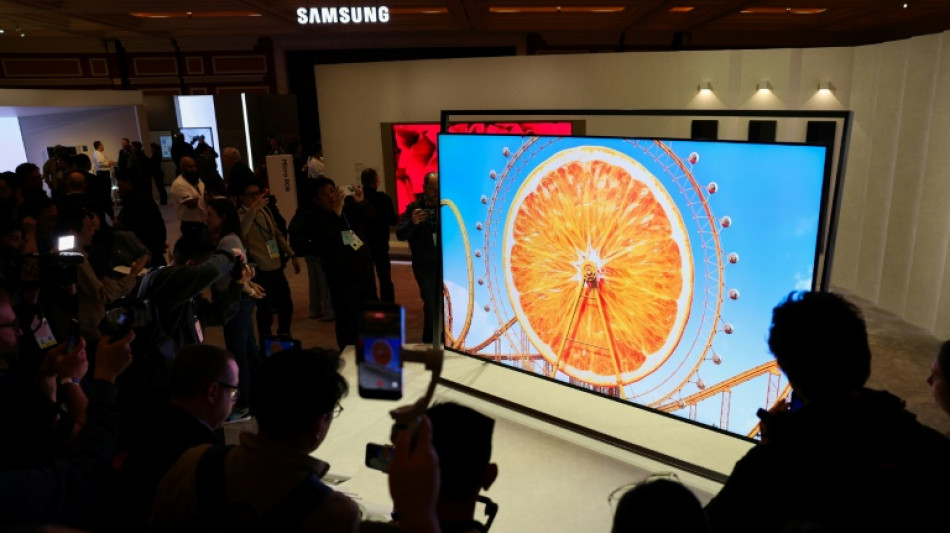
TV makers tout AI upgrades at CES, as smartphone threat looms / Photo: Patrick T. Fallon - AFP

 Multi-Asset Trading Venue Monochrome Exchange Announces IEO of Its Native Token, $MCR

 Data centre command hub keeps AI up and running

 Leo XIV, first US pope transcends his restrained style

 France's debt climbs to highest since 1978: ministry

 Thousands protest inaction over climate crisis in Switzerland

 UK actor Naomi Watts honoured at Spain film festival

 Trump signs bill authorizing sweeping Russia sanctions
 Anthropic picks Accenture for in-house AI safety evaluation

 Hushing and hedging: US companies retreat on climate

 Crisis-wracked Volkswagen warns of 10-bn-euro hit to profits

 Shakira to cap off world tour with Madrid 12-gig run

 Isolated Syrian-Druze city shortages

 UNESCO can be 'moderator' in AI debate: chief to AFP

 Russia seizes assets of Nestle, French firms

 Anthropic says AI systems moving towards building themselves

 Asian stocks boosted by falling oil, yen weakens after BoJ rate hike

 Afghan medical students in Pakistan hope court stops college expulsions

 Australia to detain tourists who overstay visa, minister says

 Asian stocks track Wall St rally as oil prices drop

 Prized Mexican relic returns on loan, two centuries on

 'In our lane': Fed's Warsh defies Trump but still fighting for credibility

 Trump admin makes major cut to endangered species protections

 GM delivers first components for US interceptor missiles

 Travis Scott and Keith Richards feature on GTA VI soundtrack

 King Charles warns tech bosses of 'existential dangers' of AI

A century after Scottish inventor John Logie Baird demonstrated the first mechanical television system, TVs face mounting competition from a much more recent invention: smartphones.
But with a suite of new models boasting massive screens, richer imagery and artificial intelligence enhancements -- on display this week at the Consumer Electronics Show in Las Vegas -- manufacturers don't plan on TVs being relegated to the dustbin of history.
The proportion of daily viewing on TV sets declined from 61 percent at the start of 2017 to 48 percent late last year, according to market tracker Ampere Analysis. Smartphone viewing, meanwhile, nearly doubled over that same period to 21 percent.
"This is the battle between big screens, which are traditionally for older people who grew up around televisions, and younger people who have either a phone, tablet, or laptop on which they're doing their consumption," said Patrick Horner, leader of TV research at Omdia.
He said that in China, seen as a trendsetter in the global market, young consumers are shunning large-screen televisions in favor of smartphones or tablets.
Around the world, television ownership is constant or declining, with average selling prices also holding steady or dropping, according to Horner.
One way for TV makers to protect or increase revenue when unit sales don't rise is to get people to buy ever larger and smarter screens, at a higher price.
- TVs get personal -
Those massive screens once again starred at CES, with producers touting AI to personalize experiences and sharpen picture quality.
Also in the spotlight was "Micro RGB" technology that dramatically ramps up picture quality using ultra-precise control of colors in LED displays.
Samsung Electronics, the top TV seller for 20 consecutive years, unveiled what it billed as the world's first 130-inch Micro RGB TV and spoke of packing AI into its products.
"We will embed AI across every area, every product, and every service," Samsung device experience division chief executive TM Roh said during a media event.
Hisense, LG, Samsung, Sony, and TCL were also at CES.
AI is being used to improve picture and sound quality, as well as help people find shows they want or ask questions about what they're seeing.
"I am really curious to see if most brands at CES can actually prove their new AI devices live up to their claims," said Forrester principal analyst Thomas Husson.
- Amazon vs Walmart -
Behind the scenes, e-commerce titans Amazon and Walmart are shaping the future of television as they vie for dominance -- not in selling TVs, but in advertising and e-commerce.
"This is really a knockdown, drag-out fight between Amazon.com and Walmart," Horner told AFP.
Walmart closed a $2.3 billion deal to buy TV maker Vizio in late 2024, as a strategic response to Amazon boosting sales through advertising on its Fire smart TVs and devices, often through its Prime Video streaming service.
"Amazon was putting advertisements on television programming for things that Amazon sold," Horner said. "So now Walmart is going to be putting advertisements on your television for things that Walmart sells."
And the profit margin on selling ads dwarfs the markup on selling TV hardware.
Walmart is expected to sell more than a million of its "Onn" brand TVs monthly and use an operating system it acquired with Vizio to pump advertising to viewers.
"Televisions are no longer about making profit from TV hardware," Horner said. "They're an ad delivery device being inserted into your living room to boost e-commerce sales."
D.Avraham--CPN