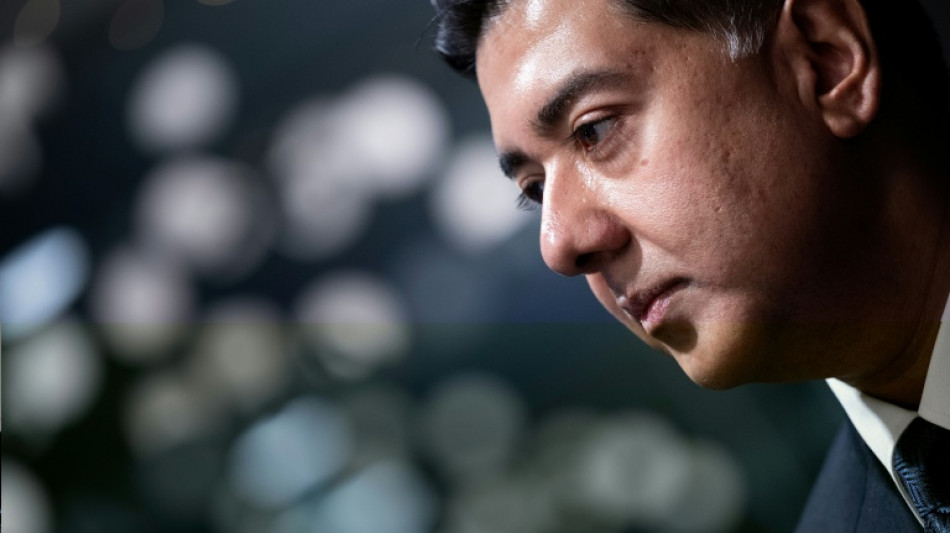
Tech campaigner decries US 'punishment' after visa sanctions / Photo: Brendan Smialowski - AFP

 Multi-Asset Trading Venue Monochrome Exchange Announces IEO of Its Native Token, $MCR

 Data centre command hub keeps AI up and running

 Leo XIV, first US pope transcends his restrained style

 France's debt climbs to highest since 1978: ministry

 Thousands protest inaction over climate crisis in Switzerland

 UK actor Naomi Watts honoured at Spain film festival

 Trump signs bill authorizing sweeping Russia sanctions
 Anthropic picks Accenture for in-house AI safety evaluation

 Hushing and hedging: US companies retreat on climate

 Crisis-wracked Volkswagen warns of 10-bn-euro hit to profits

 Shakira to cap off world tour with Madrid 12-gig run

 Isolated Syrian-Druze city shortages

 UNESCO can be 'moderator' in AI debate: chief to AFP

 Russia seizes assets of Nestle, French firms

 Anthropic says AI systems moving towards building themselves

 Asian stocks boosted by falling oil, yen weakens after BoJ rate hike

 Afghan medical students in Pakistan hope court stops college expulsions

 Australia to detain tourists who overstay visa, minister says

 Asian stocks track Wall St rally as oil prices drop

 Prized Mexican relic returns on loan, two centuries on

 'In our lane': Fed's Warsh defies Trump but still fighting for credibility

 Trump admin makes major cut to endangered species protections

 GM delivers first components for US interceptor missiles

 Travis Scott and Keith Richards feature on GTA VI soundtrack

 King Charles warns tech bosses of 'existential dangers' of AI

British tech campaigner Imran Ahmed on Friday decried a US visa ban as "punishment" for his organization's work combating disinformation and holding major online platforms accountable, telling AFP that Washington's actions amounted to "tyrannical behavior."
Ahmed, a US permanent resident, heads the Center for Countering Digital Hate (CCDH), a nonprofit watchdog that researches the harmful effects of online disinformation. He was among five European figures whom the State Department recently said would be denied visas.
The department accused the group of attempting to "coerce" tech platforms into censoring Americans' viewpoints, a charge they reject. The European Union and several member states strongly condemned the US sanctions.
The US announcement came after the International Fact-Checking Network said last month it was "deeply concerned" by reports the State Department had instructed staff to deny visas to people engaged in fact-checking and content moderation.
AFP spoke with Ahmed after he sued President Donald Trump's administration in a New York court.
The interview was edited for length and clarity.
QUESTION: How do you interpret the US visa restrictions over "censorship" concerns?
ANSWER: This appears to be a punishment for my advocacy and for the research that CCDH does, looking into social media platforms, looking into AI platforms, identifying harms, informing the public, and then urging lawmakers and regulators, both in the US and globally, to take action.
Governments are the only entity that can censor people with the threat of overwhelming force. A nonprofit speaking -- that's the opposite of censorship. That's what the First Amendment is there to protect -- our ability to speak, without fear or favor. However, in this instance, it does appear that I'm being punished precisely for my speech, which would be an act of censorship.
QUESTION: How do you seek to challenge the visa ban?
ANSWER: What we've done initially is take up a restraining order against the government to prevent them from taking any action against me, detaining me or arresting me, and that's important, because previously, when the Trump administration has sought to cancel green cards for legal permanent residents, it has arrested them through ICE (US Immigration and Customs Enforcement). It has sent them hundreds or thousands of miles away from their friends, family and support networks. And we wanted to make sure that did not happen in this instance.
The first Trump administration was under no obligation to award me an extraordinary ability visa, and it did. My green card (permanent residency) has been given to me because I'm married to a US citizen and I have American children now, and they have to abide by both the law and the constitution in how they treat me as a legal permanent resident, and that's precisely why we've gone to court.
QUESTION: Why has disinformation research emerged as a political lightning rod?
ANSWER: We do vital research that shows the potential harms of online platforms, and we know that that puts the noses out of joint for some very powerful people.
In the past, we've been sued, for example, by Elon Musk, which was unsuccessful for him. And so we expect this kind of scrutiny from big tech. What we didn't expect was that the combination of big tech and big money means that the government itself is now seeking to punish us for our speech.
QUESTION: Musk, who owns the platform X, has praised the US sanctions, saying: "This is so great." What personal toll have the sanctions taken on you?
ANSWER: I think it takes a sick mind to celebrate a father being taken away from their children, or to call it great. Organizations like CCDH have done studies showing that the hate speech after Elon Musk took over that platform soared.
That kind of research is vital. It's a crucial part of American discourse. Advertisers have the right to know where their content is appearing next to and they have a right to take decisions as to where they place their adverts. That is fundamentally the freedom of association.
I have two jobs. I have one which is to continue to ensure that the watchdog brief of CCDH continues, and the second job is to make sure that we do not accept governments behaving in this sort of way. This is tyrannical behavior, and we need to ensure that we're standing up against it.
M.García--CPN