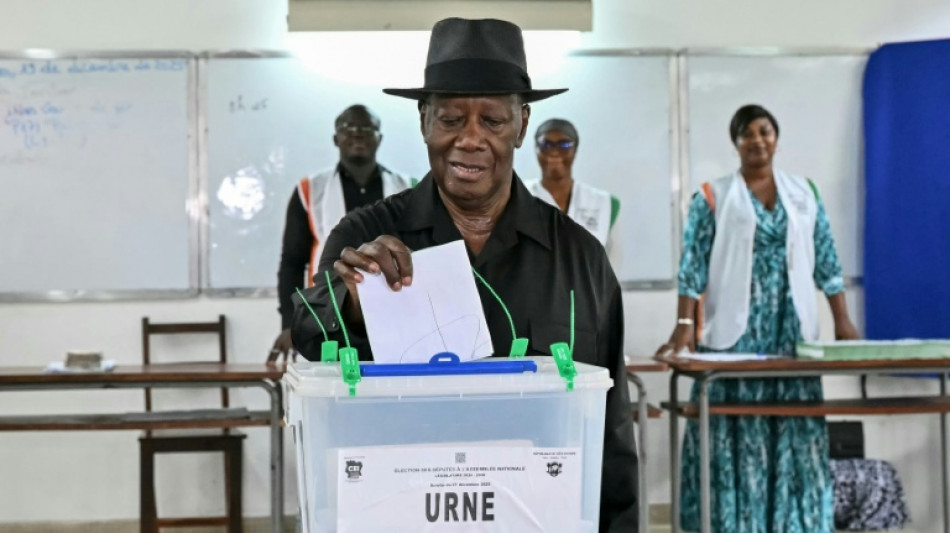
I.Coast ruling party's dominance leaves opposition on brink / Photo: SIA KAMBOU - AFP/File

 Multi-Asset Trading Venue Monochrome Exchange Announces IEO of Its Native Token, $MCR

 Data centre command hub keeps AI up and running
 Leo XIV, first US pope transcends his restrained style
 France's debt climbs to highest since 1978: ministry
 Thousands protest inaction over climate crisis in Switzerland

 UK actor Naomi Watts honoured at Spain film festival

 Trump signs bill authorizing sweeping Russia sanctions

 Anthropic picks Accenture for in-house AI safety evaluation

 Hushing and hedging: US companies retreat on climate

 Crisis-wracked Volkswagen warns of 10-bn-euro hit to profits

 Shakira to cap off world tour with Madrid 12-gig run

 Isolated Syrian-Druze city shortages

 UNESCO can be 'moderator' in AI debate: chief to AFP

 Russia seizes assets of Nestle, French firms

 Anthropic says AI systems moving towards building themselves

 Asian stocks boosted by falling oil, yen weakens after BoJ rate hike

 Afghan medical students in Pakistan hope court stops college expulsions

 Australia to detain tourists who overstay visa, minister says

 Asian stocks track Wall St rally as oil prices drop

 Prized Mexican relic returns on loan, two centuries on

 'In our lane': Fed's Warsh defies Trump but still fighting for credibility

 Trump admin makes major cut to endangered species protections

 GM delivers first components for US interceptor missiles

 Travis Scott and Keith Richards feature on GTA VI soundtrack

 King Charles warns tech bosses of 'existential dangers' of AI

Ivory Coast's ruling party has further cemented its power after another crushing victory in parliamentary elections at the weekend, two months after President Alassane Ouattara won re-election for a fourth term.
With the opposition all but out of the picture, Ouattara's party now boasts nearly 80 percent of seats in parliament, largely controls the Senate and dominates municipal and regional councils, in one of west Africa's fastest-growing economies and the world's top cocoa producer.
- Electoral dominance -
Supporters of the Rally of Houphouetists for Democracy and Peace (RHDP) put its success down to a dynamic economy and stability in a troubled region under Ouattara's watch since coming to power in 2011.
William Assanvo, a researcher at the Institute for Security Studies (ISS), said the party's dominance was the "result of discipline, organisation and the substantial resources made available to the candidates".
Francis Akindes, a teacher and researcher at Bouake university, said for decades people especially in rural areas were told to elect those close to power in order to secure infrastructure.
"And that’s enough to mobilise some voters," he said.
Critics point, however, to low turnout rates -- 35 percent in Saturday's parliamentary election and 50 percent for the presidential poll -- as well as opposition leaders being excluded from the race for president.
- Collapse of opposition -
Since the 1990s, Ivory Coast has been split between pro-Ouattara support in the north, supporters of ex-president Laurent Gbagbo in the south and west and the leading opposition force the Democratic Party of Ivory Coast (PDCI) in the centre.
But the RHDP has extended its power in recent elections beyond its traditional stronghold.
Support for the PDCI, the country's oldest party, slumped in the legislative elections, while it did not put up a presidential candidate in October after its leader Tidjane Thiam was barred from standing.
Thiam, an ex-Credit Suisse banker, has been outside of Ivory Coast since March, saying he fears arrest if he returned.
"This absence of leadership is a problem for the party," a PDCI official said, speaking on condition of anonymity.
Assanvo, of the ISS, pointed to "divisions" in the party which have contributed to its weakening position.
Gbagbo's party has not fared much better. It has no deputies in parliament after it boycotted the ballot.
"The policy of the empty chair is a grave mistake. The opposition parties are going to experience internal crises," said Akindes from Bouake university.
The opposition has denounced the arrest of its members -- two PDCI lawmakers won election on Saturday even as they were in prison -- while the government says the courts and legal system are independent.
- Who comes next ? -
Ouattara, who turns 84 years old on Thursday, kicked off his fourth presidential term -- and under the constitution, his last -- vowing "generational" change.
But no clear successor has yet emerged.
His vice president Tiemoko Meyliet Kone is seen as a technocrat and has a low public profile.
Veteran leading party figures include the powerful defence minister and brother of the president Tene Birahima Ouattara, National Assembly president Adama Bictogo and ex-prime minister Patrick Achi.
But younger RHDP ministers, such as Mamadou Toure, 50, and Amadou Kone, 59, command support in the central cities of Daloa and Bouake.
All were comfortably elected on Saturday as MPs.
"It’s still a bit early, but in two years' time a clash of titans will unfold. Everyone will push their own agenda and the battle will be fierce," Akindes predicted.
Assanvo said that Ouattara was currently a unifying figure for his party but despite its overwhelming dominance, it faced "its own challenges when it comes to succession".
A.Leibowitz--CPN