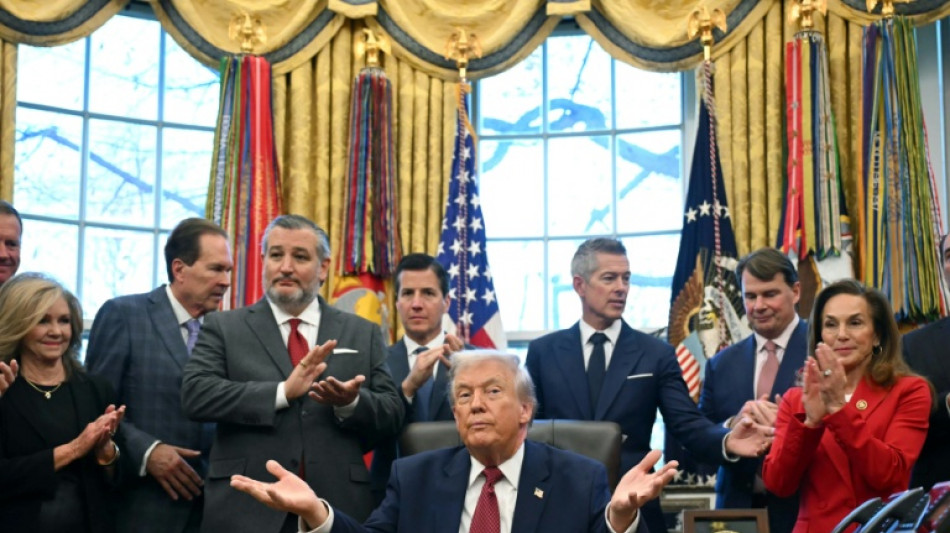
Trump scraps Biden's fuel-economy standards, sparking climate outcry / Photo: ANDREW CABALLERO-REYNOLDS - AFP

 France's Macron, Canada's Carney announce closer ties

 AI 'warning shots' focus Beijing on national security risks

 Philippine tribe in limbo over US-led tech hub

 Saudi-led coalition says Houthis fired ballistic missile at Riyadh

 Cuba works to restore power after another blackout
 Brigitte Bardot widower slams sale of star's belongings

 Indonesia accepts Malaysia's help to tackle wildfires

 Nvidia, OpenAI CEOs to attend Xi dinner at White House

 Cuba hit with seventh major blackout of the year
 Nigeria miners struggled to breathe in cell before 37 died: survivors

 Warren Buffett steps down as Berkshire Hathaway chairman

 Isolated Syrian-Druze city blames Damascus for shortages

 Kerry James Marshall: American 'blackness' painter celebrated in Europe

 Infantino 'must go', says German FA vice-president

 Japan's busiest rail station tests robot bins

 Backpackers fret over Australian visa crackdown

 Bank of Japan hikes rates to 31-year high to battle inflation

 AI doomsday warnings unlikely to slow IPOs but questions linger

 In Brazil's Amazon, the hunt for oil fuels hopes and fears

 Baby orangutans in India expose 'frightening' scale of trafficking

 Oversight Board blasts 'inadequate' Meta safeguards for AI deepfakes

 Harry makes first public appearance since return to UK

 Princess Diana's brother makes new explosive claims against Charles

 Trump admin overhauls key protection for endangered species

 Mbappe draws political fire over Ceuta t-shirt controversy

President Donald Trump announced Wednesday a reset of Joe Biden's fuel-economy standards, arguing it will lower US car prices -- but critics warned it would worsen climate change and leave drivers paying more at the pump.
Trump was flanked in the Oval Office by the CEOs of Ford and Stellantis and a senior General Motors official, a show of buy-in from Detroit's "Big Three."
"My administration is taking historic action to lower costs for American consumers, protect American auto jobs and make buying a car much more affordable," the US president said.
"Today is a victory (for) common sense and affordability," Ford CEO Jim Farley chipped in.
Environmentalists quickly pushed back, saying the windback stood out even among Trump's many anti-green actions because of its outsized impact on car-dependent America.
"Trump is taking a wrecking ball to the biggest single step any nation has ever taken to combat oil use, global warming pollution, and helping save consumers money at the gas pump," Dan Becker, an activist with the Center for Biological Diversity, told AFP.
At stake are the Corporate Average Fuel Economy (CAFE) standards, created in 1975 in response to the Arab oil embargo, which require vehicles to achieve the "maximum feasible" mileage per gallon.
Under the proposed rule, the administration would roll back past and planned efficiency increases, targeting a fleetwide average of 34.5 miles per gallon by model year 2031 -- "no better than what American cars are getting today," said Becker, noting CAFE figures overstate real-world mileage by roughly 25 percent.
Trump's Department of Transport argues that Biden officials improperly factored in electric and hybrid vehicles, saying the standards would be unattainable for gasoline-powered cars and would effectively force a shift in the market.
Gina McCarthy, a former senior official under Biden and Barack Obama, countered the move would not only worsen climate change but harm the auto industry by slowing its shift to electric vehicles.
"The rest of the world will continue to innovate and create cleaner cars that people want to buy and drive, while we're forced to sit in our clunkers, paying more for gas, and pumping out more tailpipe emissions."
- Trump EV fight -
Trump has railed against what he calls an EV "mandate" -- a stance that puts him at odds with his on-again, off-again billionaire ally Elon Musk, the Tesla CEO whose company still dominates the US EV market.
Republicans in Congress have repealed clean-energy tax credits in a major tax and spending bill, and targeted California's ability to set its own vehicle-emission limits.
Throughout 2025, GM and other US automakers have curtailed or pushed back new EV plant capacity.
But whether savings from reduced EV investment will filter through to consumers remains unclear.
While the shift away from EVs does allow automakers to delay or forego billions of dollars in new investments, some funds are being steered into new initiatives to add US carbuilding capacity in light of Trump's tariffs.
"Meeting high fuel economy standards has been challenging for the auto industry and has added to vehicle cost," Charlie Chesbrough, an analyst with Cox Automotive, told AFP.
"However, consumers like fuel-efficient vehicles. This year traditional hybrids are up double digits from last year while gas vehicles are basically flat," he added.
"Since most consumers don't have transportation alternatives available, people fear high gas prices. And good MPG is a way to mitigate that risk."
X.Wong--CPN