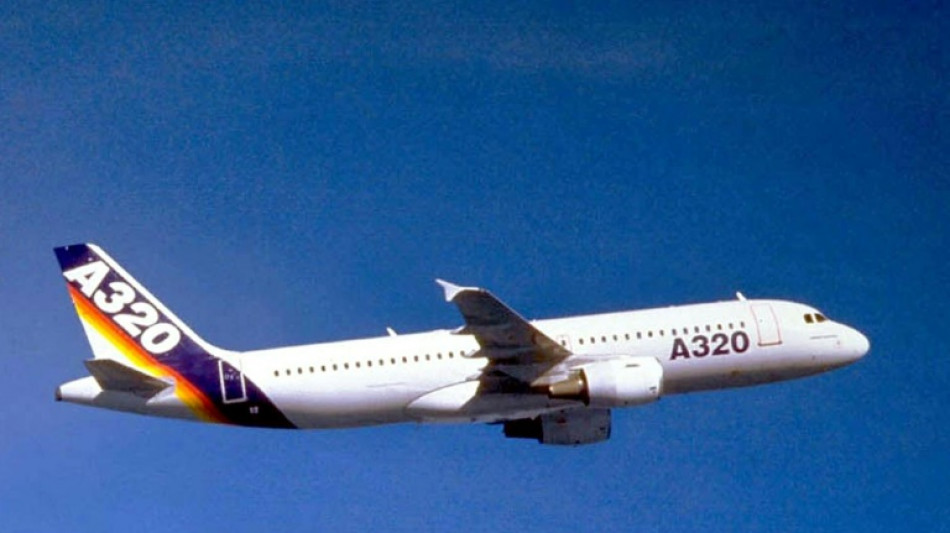
Air travel faces disruptions over A320 software switch / Photo: PASCAL PAVANI - AFP/File

 Asia stocks rise on AI, US-China trade talks optimism

 Multi-Asset Trading Venue Monochrome Exchange Announces IEO of Its Native Token, $MCR

 Data centre command hub keeps AI up and running

 Leo XIV, first US pope transcends his restrained style
 France's debt climbs to highest since 1978: ministry

 Thousands protest inaction over climate crisis in Switzerland

 UK actor Naomi Watts honoured at Spain film festival
 Trump signs bill authorizing sweeping Russia sanctions

 Anthropic picks Accenture for in-house AI safety evaluation

 Hushing and hedging: US companies retreat on climate

 Crisis-wracked Volkswagen warns of 10-bn-euro hit to profits

 Shakira to cap off world tour with Madrid 12-gig run

 Isolated Syrian-Druze city shortages

 UNESCO can be 'moderator' in AI debate: chief to AFP

 Russia seizes assets of Nestle, French firms

 Anthropic says AI systems moving towards building themselves

 Asian stocks boosted by falling oil, yen weakens after BoJ rate hike

 Afghan medical students in Pakistan hope court stops college expulsions

 Australia to detain tourists who overstay visa, minister says

 Asian stocks track Wall St rally as oil prices drop

 Prized Mexican relic returns on loan, two centuries on

 'In our lane': Fed's Warsh defies Trump but still fighting for credibility

 Trump admin makes major cut to endangered species protections

 GM delivers first components for US interceptor missiles

 Travis Scott and Keith Richards feature on GTA VI soundtrack

Air passengers have been warned of potential travel disruptions following an Airbus alert on Friday that up to 6,000 operational A320 aircraft may require upgrades.
The European plane-maker instructed its clients to take "immediate precautionary action" after evaluating a technical malfunction onboard a JetBlue flight in October.
"Intense solar radiation may corrupt data critical to the functioning of flight controls," Airbus stated, adding that "a significant number of A320 Family aircraft currently in-service" may be affected.
Replacing the software will take "a few hours" on most planes but for some 1,000 aircraft, the process "will take weeks", a source close to the issue told AFP.
The European Union Aviation Safety Agency (EASA) said in a statement Airbus had informed it about the issue.
"These measures may cause short-term disruption to flight schedules and therefore inconvenience to passengers," EASA said, adding that "safety is paramount".
The faulty software, the Elevator and Aileron Computer (ELAC), is made by Thales.
The aerospace and defence giant told AFP that "the feature in question is part of software that is not Thales's responsibility".
The Airbus statement did not specify which company had designed the software.
"Airbus acknowledges these recommendations will lead to operational disruptions to passengers and customers," it said, apologising for the inconvenience.
On October 30, a JetBlue-operated A320 aircraft encountered an in-flight control issue due to a computer malfunction.
The plane suddenly nosedived as it travelled between Cancun in Mexico and Newark in the United States, and pilots had to land in Tampa, Florida.
US media quoted local firefighters saying that some passengers were injured.
JetBlue has not yet responded to AFP's request for comment.
Its competitor, American Airlines, said it had already begun updating software following Friday's alert, and expects "the vast majority" of approximately 340 affected aircraft to be serviced by Saturday.
United Airlines told AFP it had not been "affected" by the incident, without providing further details.
Produced since 1988, the A320 is the best-selling airplane globally, with Airbus selling 12,257 of the aircraft by the end of September compared to the sale of 12,254 Boeing 737s.
J.Bondarev--CPN