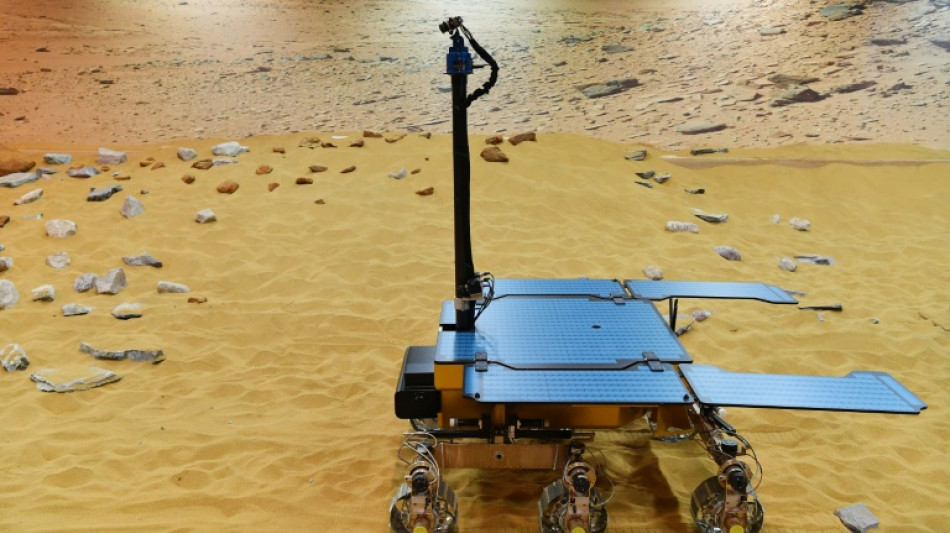
NASA confirms support for delayed European Mars rover: ESA / Photo: BEN STANSALL - AFP/File

 Asia stocks rise on AI, US-China trade talks optimism
 Multi-Asset Trading Venue Monochrome Exchange Announces IEO of Its Native Token, $MCR

 Data centre command hub keeps AI up and running

 Leo XIV, first US pope transcends his restrained style

 France's debt climbs to highest since 1978: ministry

 Thousands protest inaction over climate crisis in Switzerland

 UK actor Naomi Watts honoured at Spain film festival

 Trump signs bill authorizing sweeping Russia sanctions
 Anthropic picks Accenture for in-house AI safety evaluation

 Hushing and hedging: US companies retreat on climate

 Crisis-wracked Volkswagen warns of 10-bn-euro hit to profits

 Shakira to cap off world tour with Madrid 12-gig run

 Isolated Syrian-Druze city shortages

 UNESCO can be 'moderator' in AI debate: chief to AFP

 Russia seizes assets of Nestle, French firms

 Anthropic says AI systems moving towards building themselves

 Asian stocks boosted by falling oil, yen weakens after BoJ rate hike

 Afghan medical students in Pakistan hope court stops college expulsions

 Australia to detain tourists who overstay visa, minister says

 Asian stocks track Wall St rally as oil prices drop

 Prized Mexican relic returns on loan, two centuries on

 'In our lane': Fed's Warsh defies Trump but still fighting for credibility

 Trump admin makes major cut to endangered species protections

 GM delivers first components for US interceptor missiles

 Travis Scott and Keith Richards feature on GTA VI soundtrack

NASA has confirmed that it will contribute to Europe's Martian rover Rosalind Franklin, which is scheduled to launch in 2028 after repeated delays, the European Space Agency said on Wednesday.
The rover aims to be the first on the red planet capable of drilling up to two metres (6.5 feet) below the surface to search for extraterrestrial life.
However, the mission relies on several elements from NASA, which US President Donald Trump has targeted with steep budget cuts since returning to the White House in January.
ESA director general Josef Aschbacher said he had received "a letter from the NASA administration to confirm the contributions" of the US space agency to the mission.
"That is good news," Aschbacher said on the sidelines of the ESA's ministerial council meeting being held this week in the German city of Bremen.
The mission was originally intended to launch in 2020, but suffered several setbacks.
In 2022, it was suspended after the ESA ended cooperation with Russia -- the agency's main partner for the mission -- following Moscow's invasion of Ukraine.
The ESA then turned to the United States for help.
Aschbacher said NASA was contributing to three of the mission's elements: the launcher, radioisotope heater unit and braking engine.
The braking engine had been confirmed some time ago, but the other two elements will be a relief for the ESA.
NASA is also providing "one instrument to analyse traces of possible life on Mars," Aschbacher added.
The rover, which is named after British scientist Rosalind Franklin, is planned to touch down on the Martian surface in 2030.
P.Schmidt--CPN