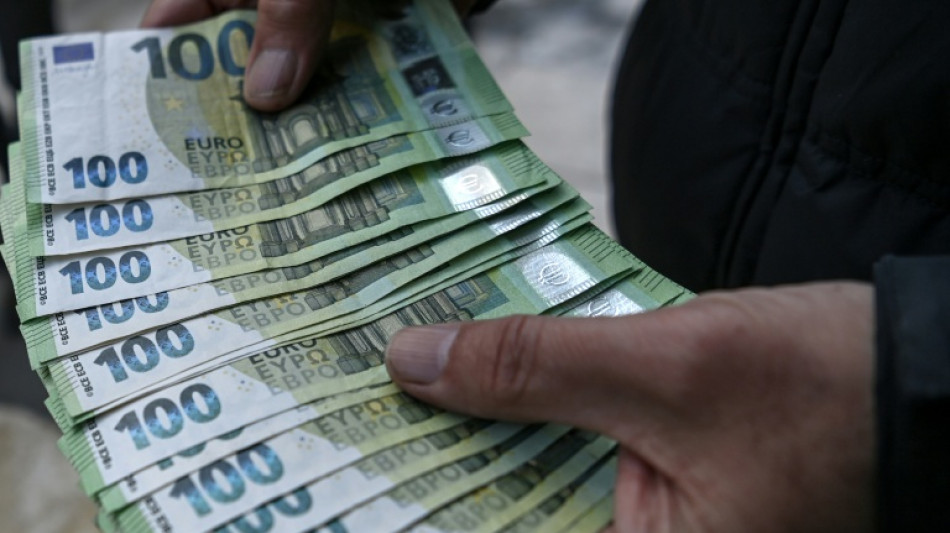
EU gives Germany free pass over defence spending / Photo: Ozan KOSE - AFP/File

 Asia stocks rise on AI, US-China trade talks optimism
 Multi-Asset Trading Venue Monochrome Exchange Announces IEO of Its Native Token, $MCR

 Data centre command hub keeps AI up and running

 Leo XIV, first US pope transcends his restrained style

 France's debt climbs to highest since 1978: ministry

 Thousands protest inaction over climate crisis in Switzerland

 UK actor Naomi Watts honoured at Spain film festival

 Trump signs bill authorizing sweeping Russia sanctions

 Anthropic picks Accenture for in-house AI safety evaluation

 Hushing and hedging: US companies retreat on climate

 Crisis-wracked Volkswagen warns of 10-bn-euro hit to profits

 Shakira to cap off world tour with Madrid 12-gig run

 Isolated Syrian-Druze city shortages

 UNESCO can be 'moderator' in AI debate: chief to AFP

 Russia seizes assets of Nestle, French firms

 Anthropic says AI systems moving towards building themselves

 Asian stocks boosted by falling oil, yen weakens after BoJ rate hike

 Afghan medical students in Pakistan hope court stops college expulsions

 Australia to detain tourists who overstay visa, minister says

 Asian stocks track Wall St rally as oil prices drop

 Prized Mexican relic returns on loan, two centuries on

 'In our lane': Fed's Warsh defies Trump but still fighting for credibility

 Trump admin makes major cut to endangered species protections

 GM delivers first components for US interceptor missiles

 Travis Scott and Keith Richards feature on GTA VI soundtrack

Germany will escape EU punishment for breaking the bloc's budget rules because of a defence spending exemption, the European Commission said on Tuesday.
Germany's public deficit is expected to be above three percent in 2025, but it will not be punished because it is "fully explained by the increase in defence spending", the EU executive said.
Under the budget rules, a state's debt must not go higher than 60 percent of national output, with a public deficit of no more than three percent.
But earlier this year, Brussels allowed states to splash out up to 1.5 percent of national output on defence for four years without fear.
Germany was among 16 states including Denmark and Poland to seek exemptions.
Berlin usually calls for budgetary discipline in the European Union but with Europe facing greater threats from Russia and fears of the bloc falling further behind China and the United States, it has itself pivoted on spending.
German Chancellor Friedrich Merz this year relaxed strict debt rules and unleashed a spending blitz on infrastructure and defence in a bid to revive the eurozone's traditional powerhouse after two years of recession.
Now the commission said it expects Germany's deficit -- the shortfall between government revenue and spending -- to reach 3.1 percent this year.
While Berlin was set to escape censure, Brussels said it will formally propose opening an excessive deficit procedure for Finland because its deficit is also higher than the rules allow, and it is only "partly explained by the increase in defence spending".
The EU has already opened similar procedures against Austria, Belgium, France, Hungary, Italy, Malta, Poland, Romania and Slovakia.
Such action kickstarts a process forcing a country to negotiate a plan with Brussels to get their debt or deficit levels back on track.
Meanwhile, France is respecting the commitments it made to Brussels to reduce its high public deficit, the commission said, although it added its "assessment is surrounded by considerable uncertainty".
France is under pressure to pass a spending bill by the end of the year to rein in its deficit and soaring debt, but efforts have been hampered by a political deadlock.
D.Goldberg--CPN