Rising from the ashes: Mogadishu's building boom / Photo: Eden EZRA - AFP

 Asia stocks rise on AI, US-China trade talks optimism
 Multi-Asset Trading Venue Monochrome Exchange Announces IEO of Its Native Token, $MCR

 Data centre command hub keeps AI up and running
 Leo XIV, first US pope transcends his restrained style
 France's debt climbs to highest since 1978: ministry
 Thousands protest inaction over climate crisis in Switzerland

 UK actor Naomi Watts honoured at Spain film festival

 Trump signs bill authorizing sweeping Russia sanctions

 Anthropic picks Accenture for in-house AI safety evaluation

 Hushing and hedging: US companies retreat on climate

 Crisis-wracked Volkswagen warns of 10-bn-euro hit to profits

 Shakira to cap off world tour with Madrid 12-gig run

 Isolated Syrian-Druze city shortages

 UNESCO can be 'moderator' in AI debate: chief to AFP

 Russia seizes assets of Nestle, French firms

 Anthropic says AI systems moving towards building themselves

 Asian stocks boosted by falling oil, yen weakens after BoJ rate hike

 Afghan medical students in Pakistan hope court stops college expulsions

 Australia to detain tourists who overstay visa, minister says

 Asian stocks track Wall St rally as oil prices drop

 Prized Mexican relic returns on loan, two centuries on

 'In our lane': Fed's Warsh defies Trump but still fighting for credibility

 Trump admin makes major cut to endangered species protections

 GM delivers first components for US interceptor missiles

 Travis Scott and Keith Richards feature on GTA VI soundtrack

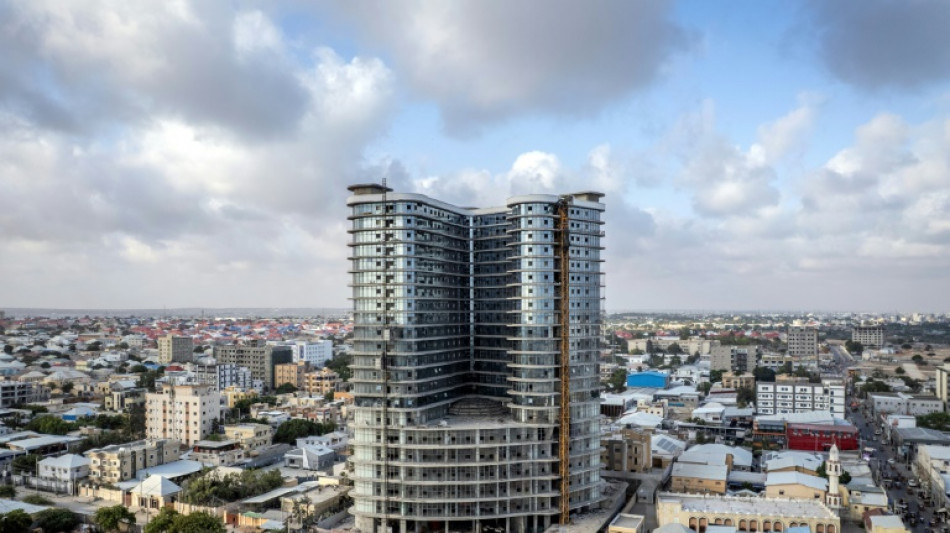
Mogadishu is rising, literally, from the ashes of decades of war. Pavements remain scarred by bullet holes and ruined buildings still line many streets, but the city's cacophony is now one of construction, not destruction.
The east African nation saw civil war in the 1990s mutate in the 2000s into an Islamist insurgency that still threatens much of the country.
Almost 70 percent of Somalia's population is defined as "multidimensionally poor" by the United Nations -- tracking education, health, living standards, services and inclusion.
But for the first time in decades, the three million inhabitants of the capital Mogadishu -- relatively well-protected from the conflict still raging just a couple of hours outside the city -- are witnessing a building boom.
Masonry, metal girders and piles of sand are everywhere along the pavements.
As builders toiled on a new multi-storey building on the main shopping street, Makkah Almukarramah Avenue, resident Habib Farah pointed out its big glass windows.
It is a new phenomenon in the city, he said, because for the first time in decades "they are not afraid of shattering".
- Securing investment -
The construction business is largely unregulated, and reliable statistics are rare -- but in June Mogadishu's mayor told the BBC more than 6,000 buildings had been constructed in five years.
The government says the improved security is thanks to a new system of checkpoints.
As dusk fell, AFP watched as security officers searched each car, tuk-tuk and truck that approached Jazeera checkpoint, 10 kilometres (six miles) from Mogadishu.
Cars that have been out of the city for more than 20 days are refused entry, since that is the amount of time they estimate it takes to rig a well-hidden explosive into a vehicle.
The government says insurgent attacks in Mogadishu fell 86 percent from 2023 to mid-2025.
Some still slip through: militant group Al-Shabaab launched an audacious attack on a jail in October with cars disguised as security vehicles. Accounts differ on how many prisoners were freed.
There has also been an effort to make security forces more professional, including a complaints system for people forced to pay bribes.
Soldiers previously demanded money at every checkpoint and "would hit you with the muzzle of their guns", said taxi driver Abdullah Dhiblawe, 38, but the situation has much improved.
National Security Advisor Awes Hagi Yusuf insisted Mogadishu was "very secure".
"The people of Mogadishu, they have already invested in Mogadishu and they (will) secure their investment," he told AFP.
- Capital from Somali diaspora -
Problems still loom.
Al-Shabaab has retaken some 200 villages in a surge around the capital this year, and Western donors are growing tired of funding the war, limiting a key source of revenue.
The Somali diaspora, however, is still providing vital cash flow.
Remittances were worth almost 15 percent of GDP in 2023, according to the World Bank, and nearly doubled over the following year, "indicating expanding commercial activities", said the Somali National Bureau of Statistics.
"The diaspora brings capital and know-how, while local businesses are scaling with bank financing," said Mohamed Gheedi, CEO of Premier Bank, the first to introduce MasterCard to Somalia.
Investment has channelled into real estate, fintech, trade and infrastructure in "a fast-growing, underserved market", he said.
- Gentrification -
As in many growing cities, gentrification and inequality are a growing problem for the poor, however.
Wealthy officials and foreigners may enjoy increased security and living standards, but "that is completely different from the day-to-day experience of people in other parts of the city", said Mahad Wasuge, from think tank Somali Public Agenda.
Tensions are high enough to erupt into armed confrontations: in August several people were killed in southern Mogadishu after security forces clashed with residents who were being forcibly evicted.
People are being moved away "from the schools, from the hospitals, from just basic, basic government services", said Wasuge.
"The government is trying to project that Mogadishu is rising," he said, but "who is paying the price?"
H.Meyer--CPN