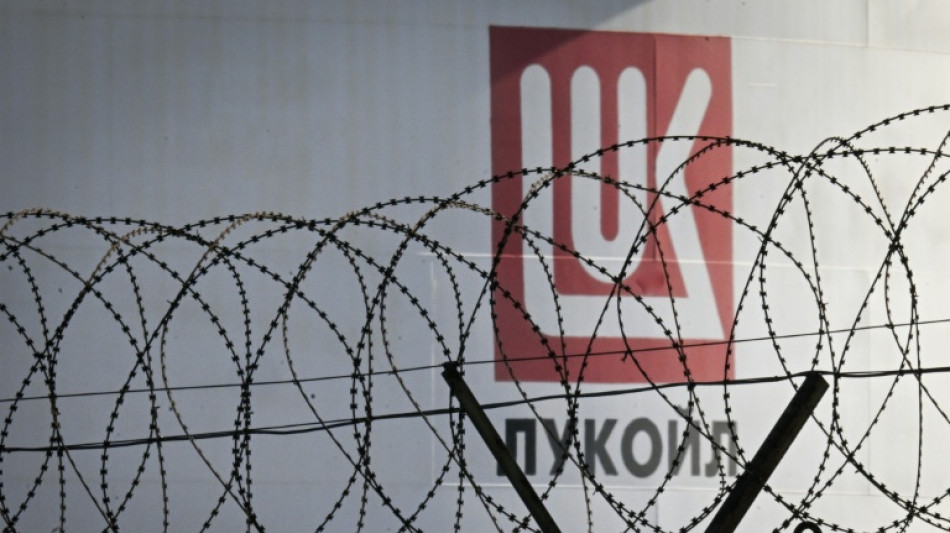
How US sanctions on Russia's Lukoil hit Bulgaria's largest refinery / Photo: Nikolay DOYCHINOV - AFP

 Asia stocks rise on AI, US-China trade talks optimism
 Multi-Asset Trading Venue Monochrome Exchange Announces IEO of Its Native Token, $MCR

 Data centre command hub keeps AI up and running
 Leo XIV, first US pope transcends his restrained style
 France's debt climbs to highest since 1978: ministry
 Thousands protest inaction over climate crisis in Switzerland
 UK actor Naomi Watts honoured at Spain film festival
 Trump signs bill authorizing sweeping Russia sanctions
 Anthropic picks Accenture for in-house AI safety evaluation
 Hushing and hedging: US companies retreat on climate

 Crisis-wracked Volkswagen warns of 10-bn-euro hit to profits

 Shakira to cap off world tour with Madrid 12-gig run

 Isolated Syrian-Druze city shortages

 UNESCO can be 'moderator' in AI debate: chief to AFP

 Russia seizes assets of Nestle, French firms

 Anthropic says AI systems moving towards building themselves

 Asian stocks boosted by falling oil, yen weakens after BoJ rate hike

 Afghan medical students in Pakistan hope court stops college expulsions

 Australia to detain tourists who overstay visa, minister says

 Asian stocks track Wall St rally as oil prices drop

 Prized Mexican relic returns on loan, two centuries on

 'In our lane': Fed's Warsh defies Trump but still fighting for credibility

 Trump admin makes major cut to endangered species protections

 GM delivers first components for US interceptor missiles

 Travis Scott and Keith Richards feature on GTA VI soundtrack

By taking over the Balkan's largest refinery from Lukoil, Bulgaria has for now avoided punishing US sanctions against the Russian oil giant, which enter into force on Friday.
But what comes next for the crucial refinery on the outskirts of Bulgaria's Black Sea city of Burgas is uncertain.
- Why has Sofia stepped in? -
On October 22, Washington announced it would impose sanctions on Russian oil giants Rosneft and Lukoil to stifle the financing of Russia's invasion of Ukraine that started in 2022.
Among European Union members, Bulgaria took the hardest hit from the measure as it hosts Lukoil's largest refinery in the Balkans. Lukoil has owned the Neftochim plant since 1999.
Bulgarian authorities said the US sanctions would effectively shut the refinery down as all business partners have refused to pay companies sheltered by Lukoil.
In a move aimed at preventing such an outcome, Bulgaria's parliament on November 7 adopted legal changes to place all Lukoil assets in the country under state control.
Last week, the government named senior government official Rumen Spetsov, who was the National Revenue Agency director and is also a former bodybuilding champion, to take control of the refinery.
Just after that, the US Treasury Department issued a license authorising transactions involving certain Lukoil entities in Bulgaria -- including the refinery -- until April 29 next year.
- Why does the refinery matter? -
The Burgas refinery plays a key economic role for Bulgaria. It is the largest company in the poorest EU member with turnover of 4.68 billion euros ($5.39 billion) in 2024.
Lukoil is the dominant force in Bulgaria's wholesale fuel market as well as in sales to end-customers owing to its large network of petrol stations.
Its presence in Bulgaria made it "a key part of Russian influence", said Martin Vladimirov, an expert at the Sofia-based think-tank CSD.
But Lukoil's importance goes well beyond Bulgaria's borders, he added, describing the company as "effectively a market maker for the whole of southeast Europe".
"It is no coincidence that fuel prices in Romania are rising, as the refinery in Bulgaria plays a key role in supplying the Romanian market," Vladimirov told AFP.
And "Romania is a major distribution hub for the region -– Ukraine, Moldova, Hungary, Austria," he added.
- What's next? -
Bulgaria has given free rein to administrator Spetsov to sell the refinery with the government's consent.
The US has set a December 13 deadline to find a buyer, with the potential contract subject to Washington's approval.
"The situation is stable for the moment" in terms of supply, Vladimirov said.
But for its part, Lukoil on Wednesday called on Bulgarian authorities not to interfere with its efforts to sell its assets in the country, warning it "reserves the right to seek judicial remedies to protect its rights and legitimate interests".
Lukoil's parent company sheltering its foreign units is based in Vienna, and if Lukoil decides to sell it, Sofia would lose control over the refinery, said a Bulgarian government source.
In late October, Lukoil said it had accepted an offer from Geneva-based oil trading group Gunvor, which Washington has described as "the Kremlin's puppet".
The bid was then pulled back immediately.
A.Leibowitz--CPN