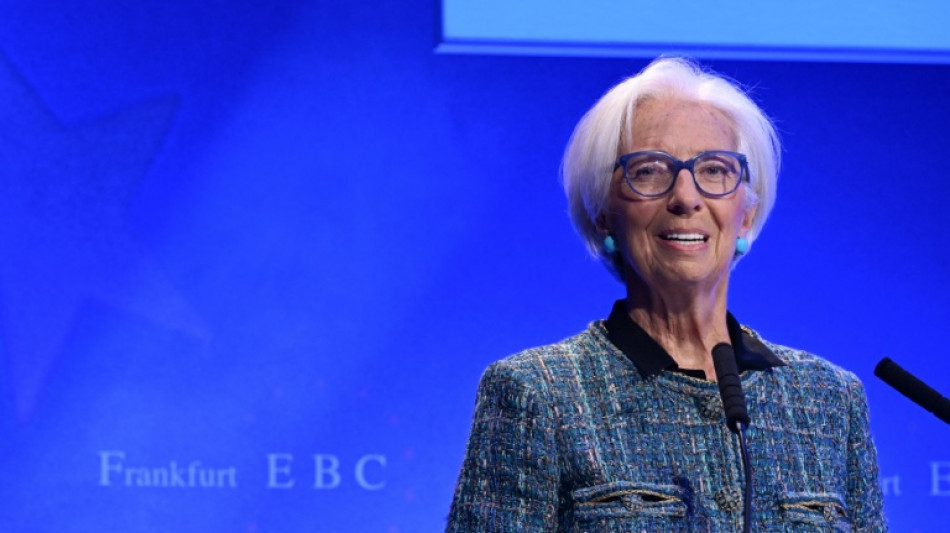
Europe increasingly 'vulnerable' to shocks: ECB chief / Photo: Kirill KUDRYAVTSEV - AFP

 Asia stocks rise on AI, US-China trade talks optimism
 Multi-Asset Trading Venue Monochrome Exchange Announces IEO of Its Native Token, $MCR
 Data centre command hub keeps AI up and running
 Leo XIV, first US pope transcends his restrained style

 France's debt climbs to highest since 1978: ministry

 Thousands protest inaction over climate crisis in Switzerland
 UK actor Naomi Watts honoured at Spain film festival

 Trump signs bill authorizing sweeping Russia sanctions
 Anthropic picks Accenture for in-house AI safety evaluation

 Hushing and hedging: US companies retreat on climate

 Crisis-wracked Volkswagen warns of 10-bn-euro hit to profits

 Shakira to cap off world tour with Madrid 12-gig run

 Isolated Syrian-Druze city shortages

 UNESCO can be 'moderator' in AI debate: chief to AFP

 Russia seizes assets of Nestle, French firms

 Anthropic says AI systems moving towards building themselves

 Asian stocks boosted by falling oil, yen weakens after BoJ rate hike

 Afghan medical students in Pakistan hope court stops college expulsions

 Australia to detain tourists who overstay visa, minister says

 Asian stocks track Wall St rally as oil prices drop

 Prized Mexican relic returns on loan, two centuries on

 'In our lane': Fed's Warsh defies Trump but still fighting for credibility

 Trump admin makes major cut to endangered species protections

 GM delivers first components for US interceptor missiles

 Travis Scott and Keith Richards feature on GTA VI soundtrack

European Central Bank chief Christine Lagarde warned Friday the region was increasingly "vulnerable" to shocks like US tariffs and is lagging behind in areas that will drive growth such as AI.
The continent must urgently speed up its integration and overhaul a model of export-led growth that has faltered amid mounting geopolitical turmoil, she said in a speech to a banking conference.
"Europe has become more vulnerable," the head of the central bank for the 20-nation eurozone said in Frankfurt, pointing to the region's "dependency on third countries for our security and the supply of critical raw materials".
"Global shocks have intensified, with rising US tariffs, Russia's invasion of Ukraine and stiffening competition from China," she added.
Europe's domestic market meanwhile had "stood still," particularly in areas set to underpin future growth like the digital sector and artificial intelligence, Lagarde said.
The continent had long relied on exports of goods ranging from cars to factory equipment and pharmaceuticals to support its economies.
But this model was no longer working, said Lagarde, saying the European Union needed to strengthen its domestic economy as "a source of resilience in an uncertain world".
Faced with weak demand for key exports, structural problems and more recently the US tariff blitz, Europe's growth has been muted in recent years, lagging far behind the United States and China.
Lagarde outlined reforms to boost the region, ranging from better integrating the financial sector to lowering trade barriers and simplifying EU decision making processes.
She warned that more years of "lost growth, lost productivity, would not just be disappointing for future generations, it would be irresponsible on our part".
If radical reforms are enacted, "we can actually make sure that Europe is strong and is not the victim of decisions being made outside of this region," Lagarde said.
P.Petrenko--CPN