
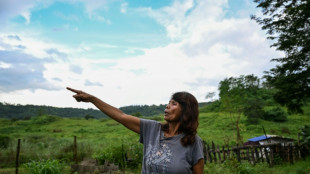
Brazil's planned railway to Amazon draws fire on margins of COP30 / Photo: Pablo PORCIUNCULA - AFP

 Asia stocks rise on AI, US-China trade talks optimism

 Multi-Asset Trading Venue Monochrome Exchange Announces IEO of Its Native Token, $MCR

 Data centre command hub keeps AI up and running
 Leo XIV, first US pope transcends his restrained style

 France's debt climbs to highest since 1978: ministry
 Thousands protest inaction over climate crisis in Switzerland

 UK actor Naomi Watts honoured at Spain film festival
 Trump signs bill authorizing sweeping Russia sanctions

 Anthropic picks Accenture for in-house AI safety evaluation

 Hushing and hedging: US companies retreat on climate

 Crisis-wracked Volkswagen warns of 10-bn-euro hit to profits

 Shakira to cap off world tour with Madrid 12-gig run

 Isolated Syrian-Druze city shortages

 UNESCO can be 'moderator' in AI debate: chief to AFP

 Russia seizes assets of Nestle, French firms

 Anthropic says AI systems moving towards building themselves

 Asian stocks boosted by falling oil, yen weakens after BoJ rate hike

 Afghan medical students in Pakistan hope court stops college expulsions

 Australia to detain tourists who overstay visa, minister says

 Asian stocks track Wall St rally as oil prices drop

 Prized Mexican relic returns on loan, two centuries on

 'In our lane': Fed's Warsh defies Trump but still fighting for credibility

 Trump admin makes major cut to endangered species protections

 GM delivers first components for US interceptor missiles

 Travis Scott and Keith Richards feature on GTA VI soundtrack

Indigenous protesters at UN climate talks in Brazil have zeroed in on a major grievance: A planned railway that would stretch almost the distance from London to Berlin and cut through the Amazon rainforest.
To farmers, the Ferrograo -- meaning Grain Railway -- would be a logistical revolution.
Critics see yet another massive infrastructure project coming to threaten the Amazon, undermining President Luiz Inacio Lula da Silva's commitment to the environment.
- What is the idea behind the Ferrograo? -
Brazil is the world's largest exporter of soybeans and corn, much of which is produced in the central state of Mato Grosso.
Currently, this cargo travels long distances by truck to either southern seaports or northern river ports.
For over a decade, Brazilian governments have tried to advance a 933-kilometer (580-mile) railway that would link Sinop in Mato Grosso to the northern river port of Miritituba.
From there, grain can reach the Amazon River and the Atlantic Ocean.
- What do supporters of the project say? -
Elisangela Pereira Lopes, a technical advisor with the CNA, Brazil's main farmer's organization, told AFP the railway was "essential to guarantee the competitiveness of Brazilian agribusiness."
She said that Mato Grosso, responsible for about 32 percent of national grain production "needs a more efficient logistics route to keep pace with the sector's growth."
Lopes said the railway was expected to cut the logistics cost of grain exports by up to 40 percent, while reducing road traffic and the associated CO2 emissions.
- What do the critics say? -
Mariel Nakane of the Socio-Environmental Institute (ISA) told AFP the railway will impact Indigenous lands and drive deforestation and land grabbing.
She said the switch by agribusiness in the last decade to exporting their goods more cheaply via northern river ports had already transformed the Tapajos River that the Miritituba port sits on.
"Riverside communities are being expelled... they can no longer fish in some regions because now it's just ports and this barge traffic.
"The idea is to install the railway and have it increase the volume transported on this route by five times."
Meanwhile, she fears a free-for-all in areas already vulnerable to deforestation.
Nakane said Brazil's current licensing procedures were not enough to protect the rainforest and its residents.
She pointed to other controversial projects, such as oil exploration near the Amazon River -- which began in October -- and plans to pave the BR-319, a major highway in the rainforest.
"The government is not capable of doing this right. It's very easy for the government to claim that it's committed to the climate agenda, but sweep these controversial projects under the rug."
- Why has this come up at COP climate talks? -
With the eyes of the world on Belem during the UN climate summit, Indigenous communities have sought to cast a spotlight on their grievances, such as the Ferrograo.
Protesters are also furious about a decree signed by Lula in August establishing major Amazon rivers, including the Tapajos, as priorities for cargo navigation and private port expansion.
"We will not allow it because it is our home, our river, our forest," said Indigenous leader Alessandra Korap of the Munduruku people.
"The river is the mother of the fish."
- What is the current status of the project? -
Brazil's environmental agency Ibama said to AFP in a statement that "the licensing process for the Ferrograo railway is in its initial stage, with an assessment of its environmental viability."
However, the process was suspended in 2021 by Supreme Court judge Alexandre de Moraes after a constitutional challenge to plans to alter the limits of a national park to build the railway.
Moraes allowed the case to resume in 2023, and the court began hearing it again last month.
Moraes -- a powerful figure in Brazil who has personally led several major investigations -- voted to allow the project to go ahead.
However, the hearing is currently paused after another judge asked for more time to analyze the case.
Y.Tengku--CPN