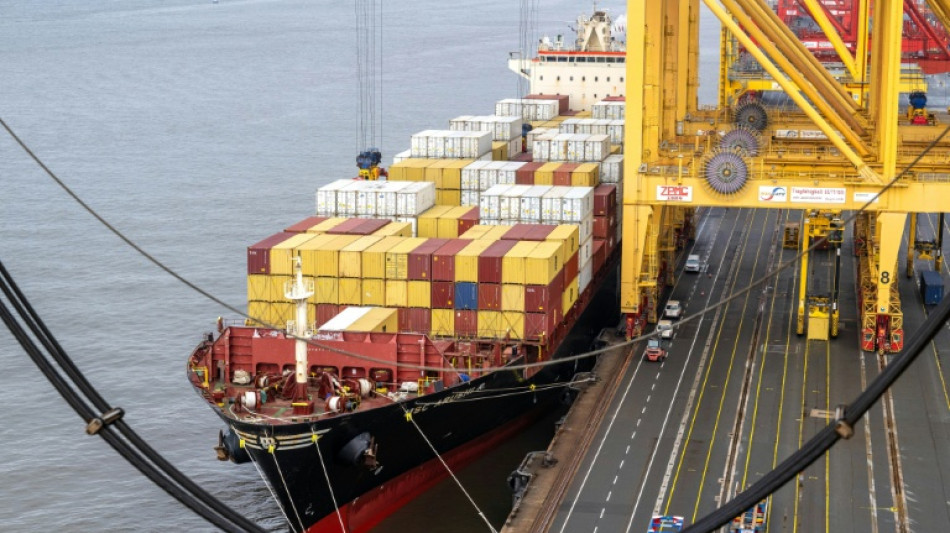
China passes US to return as Germany's top trade partner / Photo: Sina Schuldt - POOL/AFP

 Asia stocks rise on AI, US-China trade talks optimism
 Multi-Asset Trading Venue Monochrome Exchange Announces IEO of Its Native Token, $MCR

 Data centre command hub keeps AI up and running

 Leo XIV, first US pope transcends his restrained style

 France's debt climbs to highest since 1978: ministry

 Thousands protest inaction over climate crisis in Switzerland

 UK actor Naomi Watts honoured at Spain film festival

 Trump signs bill authorizing sweeping Russia sanctions
 Anthropic picks Accenture for in-house AI safety evaluation

 Hushing and hedging: US companies retreat on climate

 Crisis-wracked Volkswagen warns of 10-bn-euro hit to profits

 Shakira to cap off world tour with Madrid 12-gig run

 Isolated Syrian-Druze city shortages

 UNESCO can be 'moderator' in AI debate: chief to AFP

 Russia seizes assets of Nestle, French firms

 Anthropic says AI systems moving towards building themselves

 Asian stocks boosted by falling oil, yen weakens after BoJ rate hike

 Afghan medical students in Pakistan hope court stops college expulsions

 Australia to detain tourists who overstay visa, minister says

 Asian stocks track Wall St rally as oil prices drop

 Prized Mexican relic returns on loan, two centuries on

 'In our lane': Fed's Warsh defies Trump but still fighting for credibility

 Trump admin makes major cut to endangered species protections

 GM delivers first components for US interceptor missiles

 Travis Scott and Keith Richards feature on GTA VI soundtrack

China has reclaimed its title as Germany's top trading partner, dethroning the United States after President Donald Trump launched his tariff onslaught, official data showed Wednesday.
Total trade between Europe's biggest economy and China from January to September this year grew slightly to nearly 186 billion euros ($215 billion), according to federal statistics agency Destatis.
In the same period, the figure for trade between Germany and the United States slowed by almost four percent to just under 185 billion euros, it said.
China had already been Germany's top trading partner from 2016 to 2023 but the United States jumped into the top spot in 2024, as Berlin sought to reduce a long-standing economic reliance on China.
On the one hand the development "reflects the negative impact that US tariffs are having on German exports to the US," ING economist Carsten Brzeski told AFP.
Under a deal struck in July, EU exports to the United States face a baseline levy of 15 percent -- far higher than before Trump's return to office.
The tariffs are a heavy burden for the already struggling German economy.
The US remains Germany's top export market, for goods ranging from cars to pharmaceuticals, and Germany runs a hefty trade surplus with the United States.
The news also illustrated the challenge for Germany in trying to loosen deep economic ties with China, said Brzeski.
"It shows the ongoing dependence of the German economy and particularly industry on rare earths, semiconductors and other input goods from China," he said.
Germany runs a substantial trade deficit with China.
This continued reliance is particularly difficult for Germany as "China is now perceived more as a competitor than as a trading partner," LBBW bank analyst Jens-Oliver Niklasch told AFP.
China is no longer seen just as a key market for German exports, with many Chinese firms having emerged in recent years as competitors to top German companies.
The news comes as Finance Minister Lars Klingbeil is on a trip to China this week, the first representative of Germany's ruling coalition, which took power in May, to visit the world's number two economy.
Problems in traditional trading relationships are among the many problems facing Germany, which is expected to eke out just meagre growth this year after two years of recession.
Chancellor Friedrich Merz has vowed to revive the economy, including through a debt-fuelled spending blitz on defence and infrastructure.
C.Peyronnet--CPN