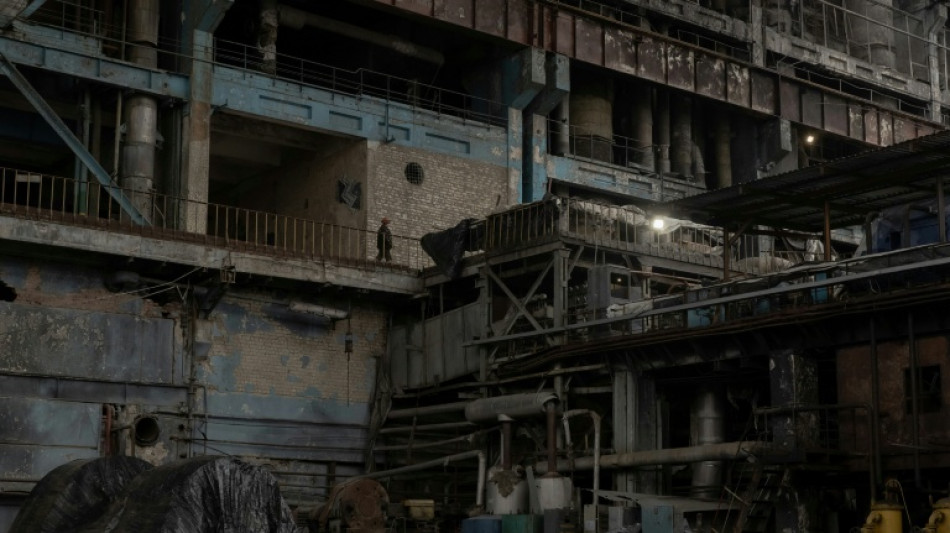
Ukraine races to repair power stations before Russia strikes again / Photo: Roman PILIPEY - AFP

 Asia stocks rise on AI, US-China trade talks optimism

 Multi-Asset Trading Venue Monochrome Exchange Announces IEO of Its Native Token, $MCR

 Data centre command hub keeps AI up and running

 Leo XIV, first US pope transcends his restrained style

 France's debt climbs to highest since 1978: ministry

 Thousands protest inaction over climate crisis in Switzerland

 UK actor Naomi Watts honoured at Spain film festival

 Trump signs bill authorizing sweeping Russia sanctions

 Anthropic picks Accenture for in-house AI safety evaluation

 Hushing and hedging: US companies retreat on climate

 Crisis-wracked Volkswagen warns of 10-bn-euro hit to profits

 Shakira to cap off world tour with Madrid 12-gig run

 Isolated Syrian-Druze city shortages

 UNESCO can be 'moderator' in AI debate: chief to AFP

 Russia seizes assets of Nestle, French firms

 Anthropic says AI systems moving towards building themselves

 Asian stocks boosted by falling oil, yen weakens after BoJ rate hike

 Afghan medical students in Pakistan hope court stops college expulsions

 Australia to detain tourists who overstay visa, minister says

 Asian stocks track Wall St rally as oil prices drop

 Prized Mexican relic returns on loan, two centuries on

 'In our lane': Fed's Warsh defies Trump but still fighting for credibility

 Trump admin makes major cut to endangered species protections

 GM delivers first components for US interceptor missiles

 Travis Scott and Keith Richards feature on GTA VI soundtrack

At a Ukrainian power plant repeatedly battered by Russian missile and drone barrages, the staff have a sense of deja vu.
Their work repairing the site from Russian strikes is routinely thwarted by fresh attacks, as Moscow hits the country's power network with record intensity.
AFP visited one power plant that has been struck multiple times -- after agreeing not to reveal its location -- run by private operator DTEK, to see how staff scramble to get the lights back on for houses and businesses across the country.
Following a recent attack, plumes of smoke were rising from a massive generator, still ablaze, at the centre of a blackened metal structure, once the heart of the plant.
Large sandbags protect critical infrastructure, some riddled with holes from shrapnel.
Out of the debris, an employee lifted a carbon plate marked with Cyrillic letters -- a wing fragment from a Russian drone.
"Sisyphus was punished for his sins. For us it's a bit different," said Oleksandr, the plant's 53-year-old production manager.
He was referencing the mythological Greek figure who cheated death, and was sentenced for it by the gods to push a rock to the top of a mountain, only to see it roll down at the summit every time and have to start again -- for eternity.
"We don't know why we're being punished," Oleksandr added.
As Oleksandr oversaw yet another clean-up and repair effort, the comparison was purposeful.
"I will continue to push this rock to the top of the mountain," he said, looking around the site.
One day, he hopes, the drones will stop flying. The rock will stop falling back.
After every attack there is "frustration" and "anger", he said.
But "we roll up our sleeves, we get back to work."
Along with not revealing the location of the power plant, DTEK chose the employees that AFP could talk to during the visit.
- 'Impossible not to be afraid' -
Russia has been targeting Ukrainian power plants relentlessly since it invaded in February 2022.
The International Criminal Court has issued arrest warrants for top Russian army officials for the "war crime" of causing excessive civilian harm by targeting Ukraine's energy grid.
Kyiv and its Western partners call the attacks cynical attempts to sap society's morale by plunging millions into the cold and dark as temperatures drop below freezing.
The barrages this winter have been more intense than ever.
The most recent strike on this facility "was the most severe in the past four years among the dozens of attacks our station has seen," Oleksandr said.
His response has become routine. The team are put on high alert as soon as they get notice that Russian planes are in the air and about to fire missiles.
"It's impossible not to be afraid," said Oleksandr.
"But everyone gathers, does their job and supports each other."
In the most recent attack, employees managed to contain the fire to localise the damage, and the staff, who had sheltered in a workshop, were unscathed.
- 'Still alive' -
Not everything is prioritised for repair.
In the plant's offices, walls lay collapsed and a large Soviet mosaic that once adorned the hall has been shattered across the floor.
Speaking under a ruptured ceiling, Vasyl, a 58-year-old duty supervisor recalled how a piece fell on his head.
"But I'm still alive," he said.
His son, 25, has been fighting in the army since Russia first invaded in February 2022.
For Vasyl, this work is his own "front line."
Fixing the plants after attacks requires not just determination, but also funds -- and Ukraine is heavily reliant on support from its European partners.
Oleksandr said he "dreams of the war ending."
But right now his focus is getting himself, and his plant, through the fifth winter of fighting.
"The closest challenge is winter. For us, getting through the winter under such conditions is very difficult. It requires a lot of effort," he said.
"We will not give up. We will work and restore."
P.Kolisnyk--CPN