
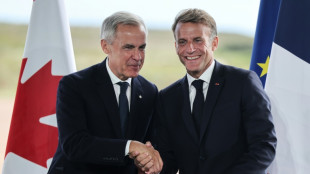
Carney's Liberals pass budget, avoiding snap Canada election / Photo: ANDREJ IVANOV - AFP/File

 Asia stocks rise on AI, US-China trade talks optimism
 Multi-Asset Trading Venue Monochrome Exchange Announces IEO of Its Native Token, $MCR

 Data centre command hub keeps AI up and running

 Leo XIV, first US pope transcends his restrained style

 France's debt climbs to highest since 1978: ministry
 Thousands protest inaction over climate crisis in Switzerland

 UK actor Naomi Watts honoured at Spain film festival

 Trump signs bill authorizing sweeping Russia sanctions

 Anthropic picks Accenture for in-house AI safety evaluation

 Hushing and hedging: US companies retreat on climate

 Crisis-wracked Volkswagen warns of 10-bn-euro hit to profits

 Shakira to cap off world tour with Madrid 12-gig run

 Isolated Syrian-Druze city shortages

 UNESCO can be 'moderator' in AI debate: chief to AFP

 Russia seizes assets of Nestle, French firms

 Anthropic says AI systems moving towards building themselves

 Asian stocks boosted by falling oil, yen weakens after BoJ rate hike

 Afghan medical students in Pakistan hope court stops college expulsions

 Australia to detain tourists who overstay visa, minister says

 Asian stocks track Wall St rally as oil prices drop

 Prized Mexican relic returns on loan, two centuries on

 'In our lane': Fed's Warsh defies Trump but still fighting for credibility

 Trump admin makes major cut to endangered species protections

 GM delivers first components for US interceptor missiles

 Travis Scott and Keith Richards feature on GTA VI soundtrack

Canada's Liberal government survived a confidence vote on Monday, as parliament narrowly passed a budget Prime Minister Mark Carney says is essential to bolster an economy threatened by US tariffs.
The minority Liberal government faced collapse over the cliffhanger budget vote, but a small group of opposition lawmakers -- weary of triggering a snap election -- allowed the fiscal plan to pass.
Carney had described the budget as a "generational" opportunity to invest in Canada's economic future, bolstering self-reliance and reducing dependence on trade with US President Donald Trump's administration.
"Now is not the time to be cautious, because fortune favors the bold," Carney said last week.
Carney was elected to a full term in April to stare down Trump's protectionist tariffs, but his Liberal Party fell just short of a majority.
To pass the budget, the Liberals required support from two opposition lawmakers -- or get abstentions.
They secured one opposition vote ahead of Monday's vote.
The lone Green Party lawmaker, Elizabeth May, confirmed she would side with the Liberals, after Carney promised in parliament that Canada would meet its commitments under the Paris Climate Accords.
Opposition leader Pierre Poilievre had panned Carney's deficit-expanding proposals, insisting that his entire Conservative caucus opposed what he called a "credit card budget."
The left-wing New Democratic Party (NDP) was also critical of the spending plan, saying it lacked protections for workers facing job losses caused by tariffs.
But the party performed dismally in April's election, has no permanent leader, and is in financial debt -- factors that left members uneasy about forcing Canadians back to the polls.
In a statement issued after the vote, the NDP said it was "clear that Canadians do not want an election right now."
"We have decided to put the interests of our country first," the party said, explaining the decision to abstain.
- Deficit spending -
The budget includes a near doubling of the deficit from last year, reaching Can$78.3 billion (US$55.5 billion).
Carney has maintained that aggressive deficit spending is necessary to offset the damage caused by the Trump administration's trade policies.
The vast majority of bilateral trade remains tariff-free -- under the terms of the existing North American trade pact -- but Trump's levies targeting key sectors like autos, aluminum, and steel have hit Canada hard.
Carney said estimates indicated that "US tariffs and the associated uncertainty will cost Canadians around 1.8 percent of our GDP."
The prime minister, a former central banker, has said investments in Canada's military and infrastructure will help improve economic sovereignty, repeatedly warning that relations with the United States are not going to return to a pre-Trump normal.
"It is a time to get big things done for Canadians, and get them done fast."
Polls conducted ahead of Monday's vote showed a majority of Canadians did not want new elections so soon after the last round.
A November survey from the Leger firm said only one in five Canadians wanted an election now or "as soon as possible."
Half of Canadians surveyed by Leger said they were satisfied with Carney's leadership, and his job approval rating measured at 52 percent.
A.Samuel--CPN