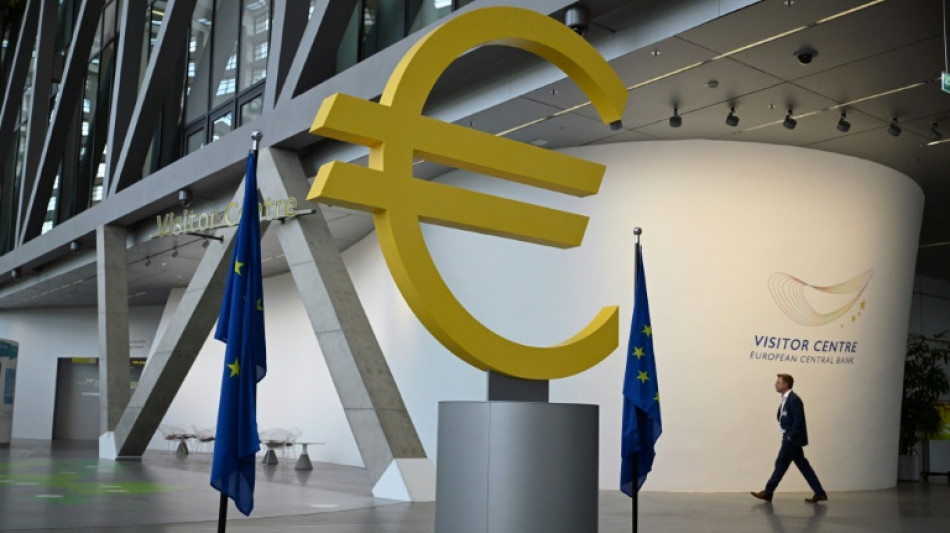
Trade tensions force EU to cut 2026 eurozone growth forecast / Photo: Kirill KUDRYAVTSEV - AFP

 Asia stocks rise on AI, US-China trade talks optimism
 Multi-Asset Trading Venue Monochrome Exchange Announces IEO of Its Native Token, $MCR

 Data centre command hub keeps AI up and running

 Leo XIV, first US pope transcends his restrained style

 France's debt climbs to highest since 1978: ministry

 Thousands protest inaction over climate crisis in Switzerland

 UK actor Naomi Watts honoured at Spain film festival

 Trump signs bill authorizing sweeping Russia sanctions

 Anthropic picks Accenture for in-house AI safety evaluation

 Hushing and hedging: US companies retreat on climate

 Crisis-wracked Volkswagen warns of 10-bn-euro hit to profits

 Shakira to cap off world tour with Madrid 12-gig run

 Isolated Syrian-Druze city shortages

 UNESCO can be 'moderator' in AI debate: chief to AFP

 Russia seizes assets of Nestle, French firms

 Anthropic says AI systems moving towards building themselves

 Asian stocks boosted by falling oil, yen weakens after BoJ rate hike

 Afghan medical students in Pakistan hope court stops college expulsions

 Australia to detain tourists who overstay visa, minister says

 Asian stocks track Wall St rally as oil prices drop

 Prized Mexican relic returns on loan, two centuries on

 'In our lane': Fed's Warsh defies Trump but still fighting for credibility

 Trump admin makes major cut to endangered species protections

 GM delivers first components for US interceptor missiles

 Travis Scott and Keith Richards feature on GTA VI soundtrack

The eurozone economy will grow less than expected next year, the EU executive predicted on Monday, as risks from international trade and geopolitical tensions weigh on the single currency area.
The European Commission forecast the 20-country single currency area to grow by 1.2 percent in 2026, down from a previous forecast of 1.4 percent.
EU economy chief Valdis Dombrovskis said the EU expected US trade policy moves and responses by "key players like China will dampen global trade".
"The EU's highly open economy remains susceptible to ongoing trade restrictions and uncertainty," Dombrovskis told reporters in Brussels.
The bloc's executive, however, noted that US trade deals with partners including the European Union "alleviated some of the uncertainties".
Struck in July, the deal with US President Donald Trump means EU exports face a baseline US levy of 15 percent, rather than a threatened 30 percent, which would have wrought havoc on the European economy.
The EU's data is based on the implementation of the tariffs as agreed.
For the entire 27-country EU, Brussels expects growth of 1.4 percent in 2026, slightly lower than the 1.5 percent predicted in May.
Dombrovskis appeared upbeat despite the difficulties.
"The EU's economy has beaten expectations in the first nine months of the year. Looking further ahead, we expect growth to continue at a moderate pace despite the challenging external environment," Dombrovskis said.
- French 'uncertainty' -
The commission believes that the ramping up of Europe's competitiveness paired with higher defence spending "focused on EU production" and new trade deals "could bolster economic activity more than projected".
Europe is, however, still lagging behind the United States and China.
The International Monetary Fund (IMF) in October predicted the US economy would grow by 2.1 percent next year.
Even though it anticipated that China's economy would slow this year, the IMF predicted the Asian powerhouse would grow by 4.2 percent in 2026.
But the forecast for Europe offered some relief after the commission said it now expected the bloc's biggest economy, Germany, to grow by 0.2 percent this year, instead of the stagnation it previously predicted.
It also forecast the export-driven German economy to grow by 1.2 percent next year, slightly up from the 1.1 percent past prediction.
"The positive effects of a ramp-up in public spending is partly counterbalanced by the negative impact of trade tensions, which are expected to impact exports," the commission said of Germany.
France, the second biggest European economy, is faring a little better, with growth of 0.7 percent expected this year and 0.9 percent in 2026.
But while the outlook for this year improved from 0.6 percent, the commission cut its growth forecast for France for 2026 from 1.3 percent.
"In 2026, the domestic economic and policy uncertainty is set to weigh on real GDP growth," the commission said of France.
- Inflation 'good news' -
Brussels also said inflation in the single currency area is expected to reach 2.1 percent in 2025, within touching distance of the European Central Bank's two-percent target.
The "sustained return to stable prices is good news for European consumers who had seen their purchasing power eroded by inflation in recent years", Dombrovskis said.
It believes inflation will slow down to 1.9 percent in 2026, higher than the 1.7 percent prediction published in May.
Although Brussels said food and services price rises are slowing, this was "counterbalanced by rising energy inflation".
P.Petrenko--CPN