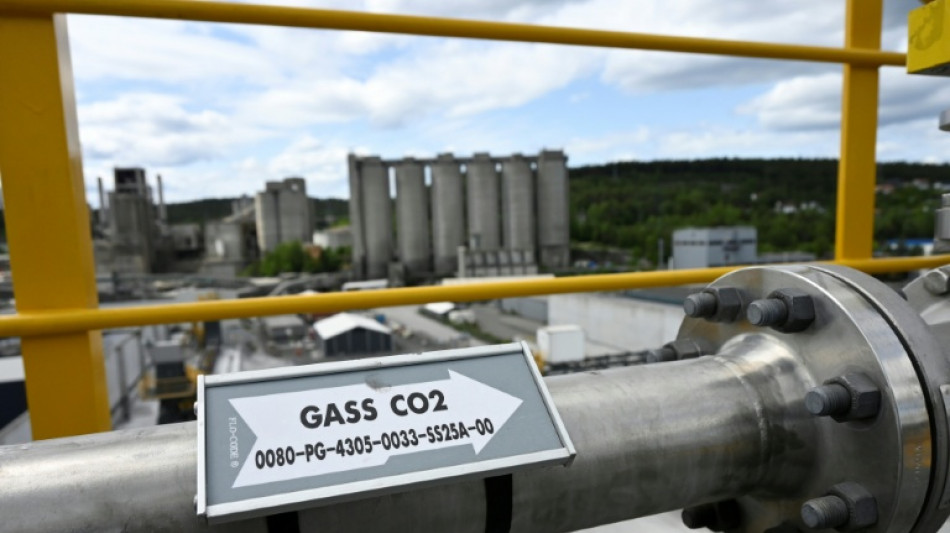
Carbon capture promoters turn up in numbers at COP30: NGO / Photo: Jonathan KLEIN - AFP/File

 Asia stocks rise on AI, US-China trade talks optimism

 Multi-Asset Trading Venue Monochrome Exchange Announces IEO of Its Native Token, $MCR

 Data centre command hub keeps AI up and running

 Leo XIV, first US pope transcends his restrained style

 France's debt climbs to highest since 1978: ministry

 Thousands protest inaction over climate crisis in Switzerland

 UK actor Naomi Watts honoured at Spain film festival
 Trump signs bill authorizing sweeping Russia sanctions

 Anthropic picks Accenture for in-house AI safety evaluation

 Hushing and hedging: US companies retreat on climate

 Crisis-wracked Volkswagen warns of 10-bn-euro hit to profits

 Shakira to cap off world tour with Madrid 12-gig run

 Isolated Syrian-Druze city shortages

 UNESCO can be 'moderator' in AI debate: chief to AFP

 Russia seizes assets of Nestle, French firms

 Anthropic says AI systems moving towards building themselves

 Asian stocks boosted by falling oil, yen weakens after BoJ rate hike

 Afghan medical students in Pakistan hope court stops college expulsions

 Australia to detain tourists who overstay visa, minister says

 Asian stocks track Wall St rally as oil prices drop

 Prized Mexican relic returns on loan, two centuries on

 'In our lane': Fed's Warsh defies Trump but still fighting for credibility

 Trump admin makes major cut to endangered species protections

 GM delivers first components for US interceptor missiles

 Travis Scott and Keith Richards feature on GTA VI soundtrack

Companies and groups backing carbon-capture technology, which critics slam as an excuse to keep burning fossil fuels, have deployed more than 500 participants to the COP30 climate talks, according to a list compiled by an NGO and shared exclusively with AFP.
The list, assembled by the Center for International Environmental Law (CIEL), names oil and gas giants such as ExxonMobil, Shell and BP, along with Brazil's state-owned Petrobras and China National Petroleum Corp.
CIEL's inventory is broad, with the likes of US tech giant Amazon, the Port of Antwerp-Bruges and Canadian company West Fraser Timber joining more obvious groups such as the Global CCS Institute.
CIEL classified a total of 531 attendees at the UN talks in Belem, Brazil, as "lobbyists" for firms or groups that promote carbon capture and storage (CCS).
Their number "highlights the large amounts of energy and power the fossil fuel industry is investing to secure its future by selling the idea that governments and companies can 'clean' their use of coal, oil, and gas by capturing and 'managing' emissions," CIEL said.
The NGO said there were 475 CCS lobbyists registered at COP28 in Dubai and 480 at COP29 in Baku -- both of which had more total participants than the conference in Belem.
CCS is a controversial technology.
The IPCC, the UN's expert scientific panel on climate change, says carbon capture is one option for reducing emissions, including in heavy polluting sectors like cement and steel.
CCS equipment captures CO2 at its source -- such as power plants or industrial facilities -- or pulls it directly from the air before it is stored in deep underground rock formations.
But it remains expensive and technically complex to deploy at scale, giving it a tiny part in addressing the climate crisis for now.
"We need carbon capture because we will overshoot (the goal of limiting warming to 1.5C)," US Senator Sheldon Whitehouse, a Democrat and advocate for strong climate action in Congress, told AFP in Belem.
"It just can't be the excuse for polluting more," Whitehouse said.
CIEL said oil companies are using the energy demand from the booming AI sector as justification to keep drilling.
"CCS cannot make fossil fuels 'clean' -- it just keeps them burning," said CIEL fossil economy director Lili Fuhr.
"The world doesn't need fossil-fueled tech-fantasies justifying business as usual for big polluters and Silicon Valley billionaires," Fuhr said.
A separate analysis by Kick Big Polluters Out found that more than 1,600 attendees were part of companies or groups with ties to the fossil fuel industry.
- 'Problematic' -
CIEL said that to be classified as a carbon capture lobbyist, a company or organization has to be involved in a CCS project, have a track record of lobbying for the technology or state that its purpose includes promoting CCS.
The NGO verified the information on company websites, the International Energy Agency's CCS project database, news sources or lobbying registers, among other sources.
More than 40 "CCS lobbyists" are part of national delegations at COP30, including Russia, Gulf countries and Brazil, according to CIEL.
Barnaby Pace, senior researcher at CIEL, acknowledged that the NGO cannot be certain if a company was sending someone to talk about CCS at COP30.
"We can't quite predict that, but it is going to be part of their agenda if they are going down this line and we think that's problematic," he told AFP.
L.K.Baumgartner--CPN