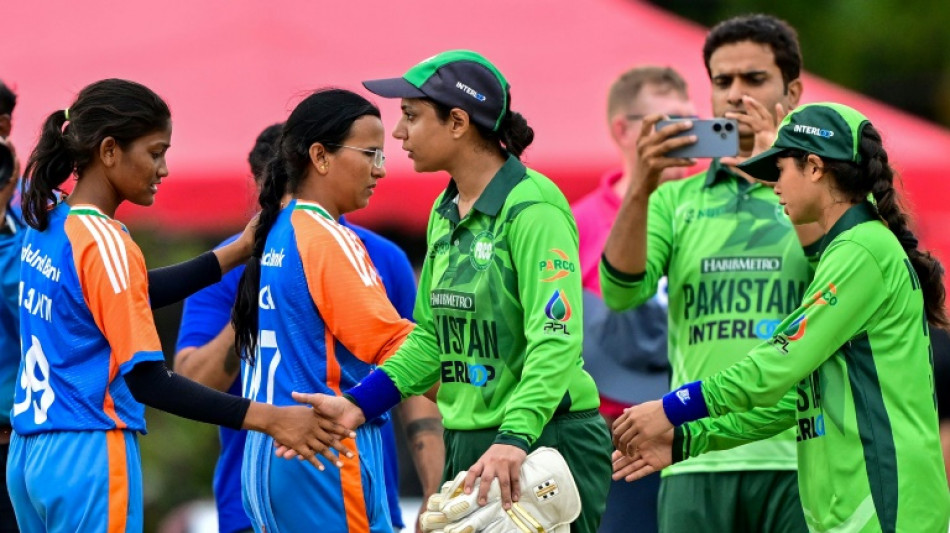
India and Pakistan blind women show spirit of cricket with handshakes / Photo: Ishara S. KODIKARA - AFP

 Asia stocks rise on AI, US-China trade talks optimism

 Multi-Asset Trading Venue Monochrome Exchange Announces IEO of Its Native Token, $MCR
 Data centre command hub keeps AI up and running
 Leo XIV, first US pope transcends his restrained style
 France's debt climbs to highest since 1978: ministry

 Thousands protest inaction over climate crisis in Switzerland

 UK actor Naomi Watts honoured at Spain film festival

 Trump signs bill authorizing sweeping Russia sanctions

 Anthropic picks Accenture for in-house AI safety evaluation

 Hushing and hedging: US companies retreat on climate

 Crisis-wracked Volkswagen warns of 10-bn-euro hit to profits

 Shakira to cap off world tour with Madrid 12-gig run

 Isolated Syrian-Druze city shortages

 UNESCO can be 'moderator' in AI debate: chief to AFP

 Russia seizes assets of Nestle, French firms

 Anthropic says AI systems moving towards building themselves

 Asian stocks boosted by falling oil, yen weakens after BoJ rate hike

 Afghan medical students in Pakistan hope court stops college expulsions

 Australia to detain tourists who overstay visa, minister says

 Asian stocks track Wall St rally as oil prices drop

 Prized Mexican relic returns on loan, two centuries on

 'In our lane': Fed's Warsh defies Trump but still fighting for credibility

 Trump admin makes major cut to endangered species protections

 GM delivers first components for US interceptor missiles

 Travis Scott and Keith Richards feature on GTA VI soundtrack

Blind women from India and Pakistan brushed aside political tensions on Sunday, shaking hands in neutral Sri Lanka at a cricket tournament for the visually impaired.
At what organisers describe as the world’s first blind women’s T20 tournament, players from the two South Asian neighbours showed they had sporting vision even if they lacked sight -- unlike their regular national teams.
Tensions off and on the field have been high since a deadly military clash between the nuclear-armed neighbours in May.
India’s men refused to shake hands with their Pakistani opponents at the Asia Cup in September, since when neither side has shown signs of making up.
That animosity spread to the women's sides who declined any greeting at the recent T20 World Cup and also to Sunday's men's Rising Stars Asia Cup tie in Doha.
India’s blind players were expected to mirror the conduct of their sighted teams when there was no handshake after the toss, but at the end of the match both sides warmly greeted each other.
The two sides, who travelled to the venue together in the same bus, not only shook hands but also exchanged generous compliments.
India won by eight wickets in just 10.2 overs after Pakistan were restricted to 135 for eight in their 20 overs at the Free Trade Zone grounds in Katunayake, 30 kilometres (18 miles) north of Colombo.
Pakistan skipper Nimra Rafique congratulated India on their comprehensive victory, while her Indian counterpart T. C. Deepika said Pakistan had played well.
The teams applauded one another loudly but neither set of players was permitted to talk to the press.
- 'Biggest opportunity' -
There were hardly any spectators but the match was shown live on Sri Lanka's national television, Rupavahini. Blind Sri Lankan officials hosting the tournament “watched” the match on YouTube by listening to the commentary.
Indian team manager Shika Shetty told AFP before the match that the tournament was opening up opportunities for more women.
“This is the first-ever World Cup for blind women... I think this is one of the biggest opportunities for our entire visually impaired girls,” said Shetty, who is not blind.
“Maybe many girls with disabilities will come out from their villages. Maybe they will come for studies, maybe they will come for the sport. So it is helpful for other girls too."
Blind cricket relies on a sharp ear, as players must detect a white plastic ball -- the size of a tennis ball -- filled with ball bearings that rattle as it moves.
Pakistan coach Tahir Mehmood Butt, also speaking before the game, said the launch of women's blind cricket had created new opportunities for young players in Pakistan.
“For the totally blind, if they have good hearing, they can become good cricketers,” Tahir told AFP.
Each team must field at least four completely blind players, three who can see up to two metres, and four partially sighted players able to see up to about six metres.
Totally blind batters may have a partially sighted runner. Bowling is underarm, unlike in the traditional game.
Four other nations - Australia, Nepal, Sri Lanka and the US -- are competing in the tournament which began in India and moved to Sri Lanka for the final stages. The final is scheduled for next Sunday in Colombo.
O.Hansen--CPN