Luxury houses eye India, but barriers remain
/ Photo: Punit PARANJPE - AFP

 Asia stocks rise on AI, US-China trade talks optimism
 Multi-Asset Trading Venue Monochrome Exchange Announces IEO of Its Native Token, $MCR

 Data centre command hub keeps AI up and running

 Leo XIV, first US pope transcends his restrained style

 France's debt climbs to highest since 1978: ministry
 Thousands protest inaction over climate crisis in Switzerland

 UK actor Naomi Watts honoured at Spain film festival

 Trump signs bill authorizing sweeping Russia sanctions

 Anthropic picks Accenture for in-house AI safety evaluation

 Hushing and hedging: US companies retreat on climate

 Crisis-wracked Volkswagen warns of 10-bn-euro hit to profits

 Shakira to cap off world tour with Madrid 12-gig run

 Isolated Syrian-Druze city shortages

 UNESCO can be 'moderator' in AI debate: chief to AFP

 Russia seizes assets of Nestle, French firms

 Anthropic says AI systems moving towards building themselves

 Asian stocks boosted by falling oil, yen weakens after BoJ rate hike

 Afghan medical students in Pakistan hope court stops college expulsions

 Australia to detain tourists who overstay visa, minister says

 Asian stocks track Wall St rally as oil prices drop

 Prized Mexican relic returns on loan, two centuries on

 'In our lane': Fed's Warsh defies Trump but still fighting for credibility

 Trump admin makes major cut to endangered species protections

 GM delivers first components for US interceptor missiles

 Travis Scott and Keith Richards feature on GTA VI soundtrack

The globe's biggest luxury brands have dreamt of India's vast consumer base for decades, but navigating the market has proven to be a complex task.
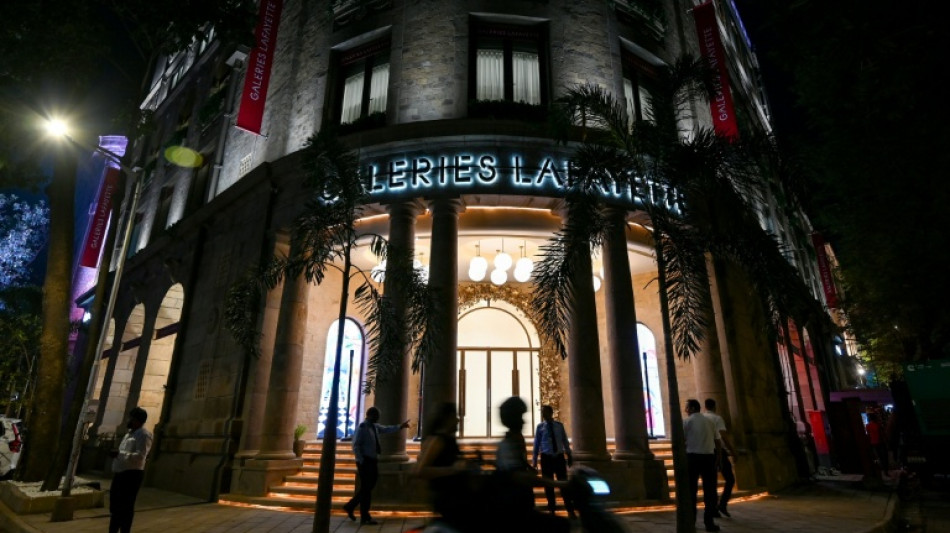
French retailer Galeries Lafayette is the latest to try its luck, opening its first Indian store on Sunday: a sprawling five-floor outlet in Mumbai, the country's financial capital.
Its splashy foray into the market is getting a local boost from the fashion arm of the Aditya Birla Group, a major Indian conglomerate.
Luxury expert and Comite Colbert CEO Benedicte Epinay called the arrival of the iconic French department store "an important step".
India, which has a 1.4 billion population, offers what Epinay called a "a promising market, but still a complicated one".
Brands must not only overcome high customs duties, a cumbersome bureaucracy and infrastructure limitations, but also must compete with a robust domestic luxury market.
Of the 250 luxury and designer brands spread across Galeries Lafayette's 8,400 square metres (90,000 square feet) Mumbai space, almost all are foreign.
Industry professionals warn it's a bold gamble given the rich local clothing culture.
"I think a lot of brands like Louis Vuitton and Gucci and Dior have been doing a pretty good job at sort of weaving Indian design into their products," Mumbai resident Sonal Ahuja, 39 told AFP.
"But at the end of the day if you want to buy something to wear to a wedding, you will buy (from Indian fashion designers) Sabyasachi or Tarun Tahiliani. Why would you want to buy something foreign that is trying to be Indian?" she added.
- 'Ticks all the boxes' –
India's luxury market is still relatively small, but expanding rapidly.
Valued at $11 billion in 2024, it is set to triple to $35 billion by 2030, Estelle David, South Asia Director at Business France said.
The economy creates tens of thousands of new millionaire households each year.
These consumers increasingly splurge on everything from Lamborghini cars to Louis Vuitton bags.
"When a luxury house looks at a new country, it considers the number of wealthy people and the rise of a middle class," Epinay said. "India ticks all the boxes."
The reality is more complex.
French luxury giants contacted by AFP declined to comment. Their silence, analysts suggest, reflects a lack of positive things to say about a market widely considered difficult.
"They have very little data to show they are making profits or generating a return on investment," Ashok Som, from France's ESSEC Business School said.
In the early 2000s, the biggest fashion houses eyed India as their next growth engine after China. But a quarter-century later, the market remains tiny, said Epinay.
According to Epinay, most brands have only one to three stores in India, compared with 100 to 400 in China.
In her view, the only real similarity between the two giants is "the size of their populations". India lacks China's "social, linguistic and territorial homogeneity," Epinay added.
India still has limited numbers of premium malls, most of which do not match what customers find in the Middle East, Europe, the United States or China.
"India is not at the same stage of development, so it's very difficult to compare," David said.
- 'Adapt to the culture' -
High customs duties often push Indian consumers who can afford top end to take a $350 round trip to Dubai where they can buy a French luxury handbag for up to 40 percent less than at home.
Vishal Mathur, 46, an entrepreneur who works in his family's business in Mumbai told AFP "one is willing to pay for craftsmanship, for style, for the brand."
"But to say you should pay extra just to buy in India? No way."
India and the European Union have committed to finalising a free-trade agreement by the end of the year, which would bring "fresh air to the market," Epinay said.
And profiting in India will require creative thought.
Although major foreign ready-to-wear brands have outlets in megacities such as New Delhi, Mumbai and tech-capital Bengaluru, Western fashion remains in the minority.
Many men wear the traditional knee-length kurtas for special occasions while flowing saris remain the most popular for women.
Brands such as Louboutin, Dior, Chanel and Bulgari are already collaborating with designers, labels, Bollywood stars and local influencers, to appeal to local consumers, market specialists say.
"You have to adapt to the culture, to tastes and consumption habits," David said.
Ch.Lefebvre--CPN