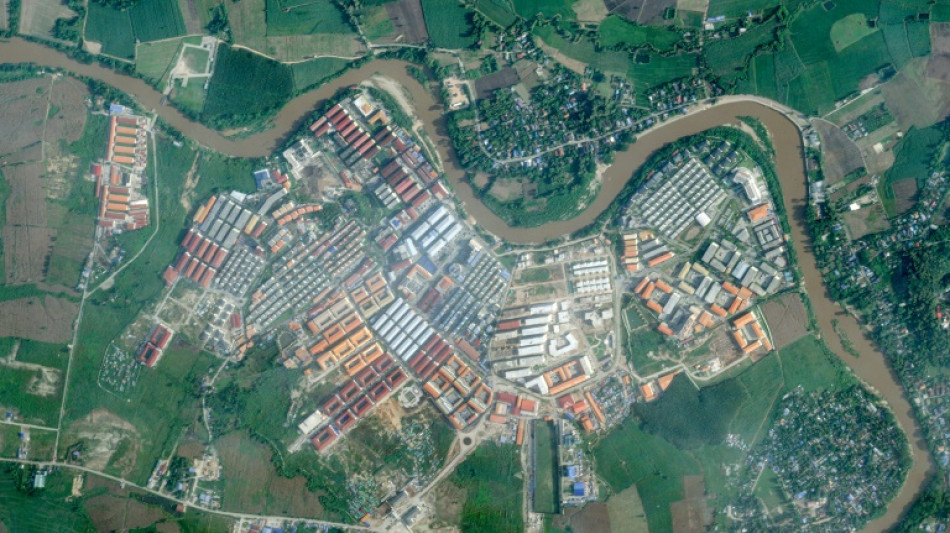
Starlink, utilised by Myanmar scam centres, sees usage fall nationwide / Photo: Handout - 2025 Planet Labs PBC/AFP/File

 Asia stocks rise on AI, US-China trade talks optimism

 Multi-Asset Trading Venue Monochrome Exchange Announces IEO of Its Native Token, $MCR

 Data centre command hub keeps AI up and running

 Leo XIV, first US pope transcends his restrained style

 France's debt climbs to highest since 1978: ministry

 Thousands protest inaction over climate crisis in Switzerland

 UK actor Naomi Watts honoured at Spain film festival

 Trump signs bill authorizing sweeping Russia sanctions

 Anthropic picks Accenture for in-house AI safety evaluation

 Hushing and hedging: US companies retreat on climate

 Crisis-wracked Volkswagen warns of 10-bn-euro hit to profits

 Shakira to cap off world tour with Madrid 12-gig run

 Isolated Syrian-Druze city shortages

 UNESCO can be 'moderator' in AI debate: chief to AFP

 Russia seizes assets of Nestle, French firms

 Anthropic says AI systems moving towards building themselves

 Asian stocks boosted by falling oil, yen weakens after BoJ rate hike

 Afghan medical students in Pakistan hope court stops college expulsions

 Australia to detain tourists who overstay visa, minister says

 Asian stocks track Wall St rally as oil prices drop

 Prized Mexican relic returns on loan, two centuries on

 'In our lane': Fed's Warsh defies Trump but still fighting for credibility

 Trump admin makes major cut to endangered species protections

 GM delivers first components for US interceptor missiles

 Travis Scott and Keith Richards feature on GTA VI soundtrack

Elon Musk's Starlink, whose internet services have been utilised by Myanmar scam centres, has seen its use across the country plummet since the end of September, according to estimates from regional internet registry Apnic.
An AFP investigation recently revealed the presence of the US company's receivers on several of the centres.
Up to 14 percent of Myanmar's Internet users connected using Starlink this summer, making it the most popular provider, but that share fell to less than 7 percent by November 10, according to Apnic.
Drone footage captured as part of an AFP investigation published in mid-October revealed long rows of Starlink satellite antennas on the rooftops of the KK Park scam centre, on the border with Thailand.
Shortly afterwards, Starlink's parent company SpaceX announced it had deactivated more than 2,500 of its internet receivers "in the vicinity of suspected 'scam centres'" in Myanmar.
Starlink has also been the subject of a US Congressional investigation since late July over its role in providing internet access to the centres, which have victims worldwide.
The company became the country's most popular Internet service provider for the first time on June 26, 2025, two months after its initial listing with Apnic.
The satellite internet service held this top position until the end of September, except for a few days, but dropped to fourth on November 9.
Most of the scam centres, which tend to involve romance and commercial fraud, are controlled by Chinese criminal groups in collusion with Myanmar militias.
Since mid-October, the military junta has conducted high-profile raids on KK Park.
An analysis of satellite images by AFP this week revealed damage, even demolition, to around 100 buildings.
But three-quarters of the surface of the complex -- as seen from above -- appeared to be intact, as of Sunday.
Experts say that the Myanmar junta turns a blind eye to the scam networks. In return, its militia allies control border areas on its behalf.
The country has been ravaged by civil war since the February 2021 coup.
A.Zimmermann--CPN