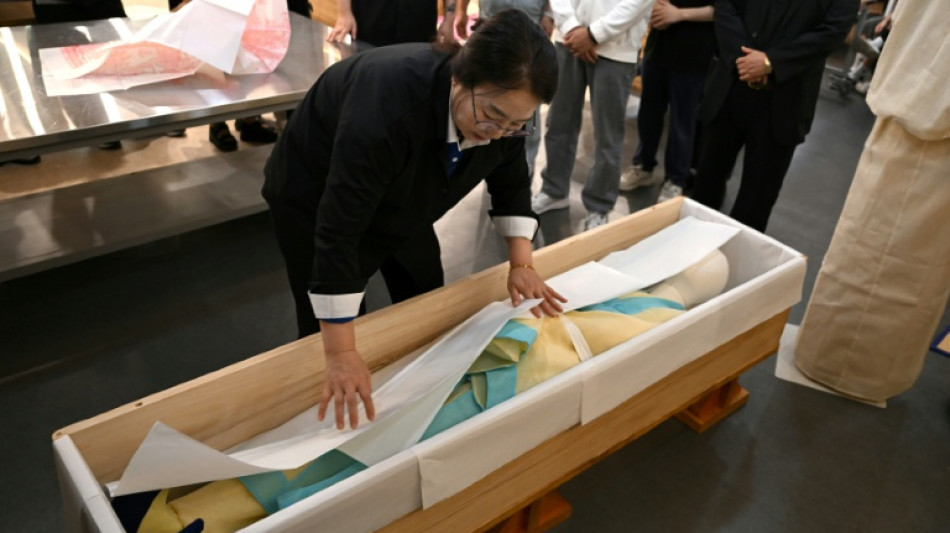
Death becomes a growing business in ageing, lonely South Korea / Photo: Jung Yeon-je - AFP

 Global stocks rally on lower oil prices, US-China hopes

 Spanish PM says unregulated AI could be 'devastating'

 From Korean Chipmakers to Leveraged Semiconductor ETFs: STARTRADER Launches 49 New 24/7 Stock and ETF CFDs
 Asia stocks rise on AI, US-China trade talks optimism

 Multi-Asset Trading Venue Monochrome Exchange Announces IEO of Its Native Token, $MCR
 Data centre command hub keeps AI up and running
 Leo XIV, first US pope transcends his restrained style
 France's debt climbs to highest since 1978: ministry
 Thousands protest inaction over climate crisis in Switzerland
 UK actor Naomi Watts honoured at Spain film festival
 Trump signs bill authorizing sweeping Russia sanctions

 Anthropic picks Accenture for in-house AI safety evaluation

 Hushing and hedging: US companies retreat on climate

 Crisis-wracked Volkswagen warns of 10-bn-euro hit to profits

 Shakira to cap off world tour with Madrid 12-gig run

 Isolated Syrian-Druze city shortages

 UNESCO can be 'moderator' in AI debate: chief to AFP

 Russia seizes assets of Nestle, French firms

 Anthropic says AI systems moving towards building themselves

 Asian stocks boosted by falling oil, yen weakens after BoJ rate hike

 Afghan medical students in Pakistan hope court stops college expulsions

 Australia to detain tourists who overstay visa, minister says

 Asian stocks track Wall St rally as oil prices drop

 Prized Mexican relic returns on loan, two centuries on

 'In our lane': Fed's Warsh defies Trump but still fighting for credibility

Rows of coffins line a university classroom in the South Korean port city of Busan, ready for use in training the funeral directors of the future in a rapidly ageing country.
Growing numbers are finding work in the business of death as South Korea undergoes massive demographic change, with birth rates among the lowest in the world and almost half the population aged 50 or older.
Students at the Busan Institute of Science and Technology carefully draped a mannequin in traditional Korean funeral cloth, smoothing the fabric as if over real skin, before gently lowering it into a coffin.
"With our society ageing, I thought the demand for this kind of work would only grow," said Jang Jin-yeong, 27, a funeral administration student.
Another student, 23-year-old Im Sae-jin, decided to enter the field after his grandmother died.
"At her funeral, I saw how beautifully the directors had prepared her for the final farewell," he said.
"I felt deeply grateful."
- 'Like portraits' -
More and more South Koreans are also living -- and dying -- alone.
Single-person households now account for around 42 percent of all homes in Asia's fourth-largest economy.
A new profession has emerged reflecting that statistic: cleaners who are called in to tidy up homes after their occupants, most of whom lived alone, have died.
Former classical musician Cho Eun-seok has cleaned many homes where people were found dead, sometimes months after their passing.
Their homes are "like their portraits", Cho, 47, told AFP.
He described heartbreaking traces: hundreds of neatly capped soju bottles and dusty boxes of gifts that were never opened.
South Korea has the highest suicide rate among developed nations, and these "lonely deaths" include those who died alone by their own hand.
Cho recently began receiving calls from used-car leasing companies to clean vehicles later found to be where clients ended their lives.
He is also developing a device to detect signs of unattended deaths that he said can harm the environment, causing pest infestations and forcing the disposal of belongings from entire households.
In summer, the smell spreads fast: "within three days it seeps into everything -- the fridge, the TV -- and nothing can be saved."
The home of a woman who had died recently in her late eighties was still filled with traces of her life when AFP visited -- an old air conditioner, bottles of cosmetics and a portable toilet, while several walking sticks stood by the door.
- 'Everything must be cleared away' -
The work sometimes requires more than just cleaning.
Kim Seok-jung once cleared the home of a late lyricist and found a set of songs she had not shared with her relatives. He turned them into a song for the bereaved family.
And Cho remembered a high school girl who lived alone in a gosiwon -- a cramped room typically less than five square metres -- after she escaped domestic violence.
He visited once a month to clean. The teenager, suffering from depression, had been unable to tidy up herself.
Piles of belongings and rotting food covered the bed and the air was thick with flies.
But she carefully looked after a small box, insisting Cho never throw it away.
She took her own life in that small room a year later.
When Cho returned to clean, he found that a hamster had been living in the box all along.
Beside it sat her guitar -- she had dreamed of becoming a musician.
"The moment I saw the hamster, all I could think was that I had to save it and keep it alive," Cho said.
Kim Doo-nyeon, a veteran in the funeral business, said he has a growing number of recruits in their twenties.
"When people live together, they share things... even if one person dies, those items remain," he said.
"But when someone dies alone, everything must be cleared away."
Back at class in Busan, Im admitted to some trepidation about his chosen career path.
"I am scared," he said.
"No matter how much you prepare, facing a deceased person is frightening."
P.Kolisnyk--CPN