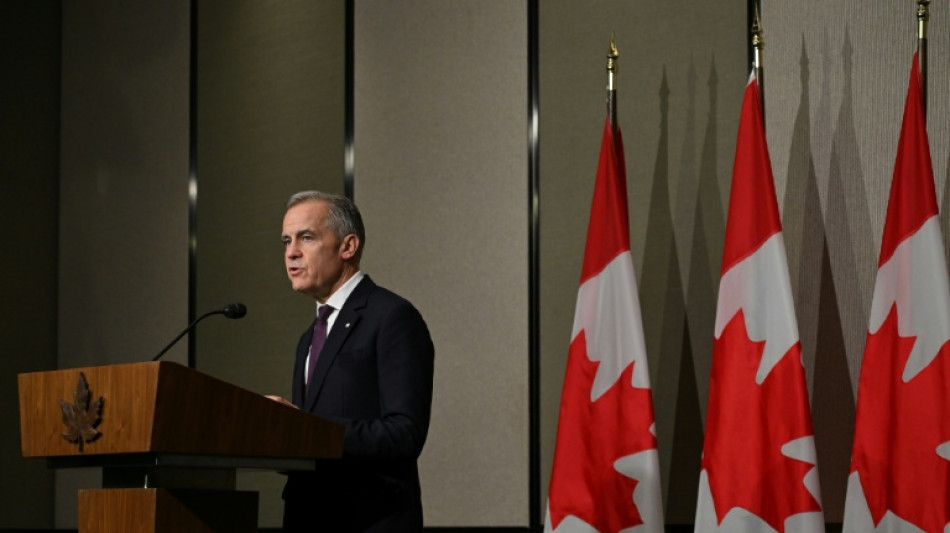
'Swing for the fences': Carney promises bold budget as US threat grows / Photo: Arif Kartono - AFP

 Global stocks rally on lower oil prices, US-China hopes
 Spanish PM says unregulated AI could be 'devastating'

 From Korean Chipmakers to Leveraged Semiconductor ETFs: STARTRADER Launches 49 New 24/7 Stock and ETF CFDs
 Asia stocks rise on AI, US-China trade talks optimism
 Multi-Asset Trading Venue Monochrome Exchange Announces IEO of Its Native Token, $MCR
 Data centre command hub keeps AI up and running
 Leo XIV, first US pope transcends his restrained style

 France's debt climbs to highest since 1978: ministry
 Thousands protest inaction over climate crisis in Switzerland

 UK actor Naomi Watts honoured at Spain film festival
 Trump signs bill authorizing sweeping Russia sanctions

 Anthropic picks Accenture for in-house AI safety evaluation
 Hushing and hedging: US companies retreat on climate
 Crisis-wracked Volkswagen warns of 10-bn-euro hit to profits
 Shakira to cap off world tour with Madrid 12-gig run

 Isolated Syrian-Druze city shortages

 UNESCO can be 'moderator' in AI debate: chief to AFP
 Russia seizes assets of Nestle, French firms

 Anthropic says AI systems moving towards building themselves
 Asian stocks boosted by falling oil, yen weakens after BoJ rate hike

 Afghan medical students in Pakistan hope court stops college expulsions

 Australia to detain tourists who overstay visa, minister says
 Asian stocks track Wall St rally as oil prices drop

 Prized Mexican relic returns on loan, two centuries on

 'In our lane': Fed's Warsh defies Trump but still fighting for credibility
Canada's new Liberal government unveils its first budget on Tuesday, with Prime Minister Mark Carney saying "bold risks" are needed to reform an economy facing unprecedented economic threats from the United States.
US President Donald Trump's trade policies have hit Canada hard, driving up unemployment and squeezing businesses in crucial tariff-hit sectors like autos, aluminum, and steel.
Carney, a former central banker who only entered politics in January, has warned Canadians that the Trump-era disruptions in US-Canada relations are not a passing phase.
"Our relationship with the United States will never be the same as it was," he told students at the University of Ottawa in a pre-budget speech last month.
Carney said his government would propose a budget that addresses the stark new geopolitical realities facing Canada.
Among the headline items will be major increases in defense spending to bring Canada in line with NATO targets.
Funds will also be allocated to a series of national projects that Carney has said are key to Canada's economic sovereignty, given the "rupture" in economic ties with the United States.
These range from port expansion to energy production and the infrastructure needed to boost extraction of critical minerals from remote areas.
"We used to take big, bold risks in this country. It is time to swing for the fences again," he said in the Ottawa speech.
"This is what this upcoming budget will be about: building, taking control, and winning."
Carney and Finance Minister Francois-Philippe Champagne have flagged that spending increases will be partly offset by cuts to government operating budgets.
But those savings will not cover all the new costs.
University of Ottawa public policy expert Genevieve Tellier told AFP she expects the deficit to be "very large."
"I wouldn't be surprised if it were around CAN$100 billion ($71 billion)," she said.
- Confidence vote -
Carney's April election win left his Liberals three seats short of a majority in Canada's parliament. That means the government needs opposition support -- or abstentions -- to pass its budget.
Because the budget is a confidence vote, its defeat would trigger fresh elections.
"Anything is possible," said McGill University political scientist Daniel Beland, stressing the Liberals will "try everything" they can to pass the budget.
Polling suggests Carney's popularity has softened since the election.
He told voters that his broad international experience in leadership roles in global finance made him the ideal leader to negotiate with Trump.
But opposition parties have hammered Carney over his failure so far to secure a tariff-easing trade deal with the United States.
Trump has suspended trade talks over an anti-tariff advertisement produced by Ontario's provincial government, which quotes former Republican US president Ronald Reagan.
Carney has said he is willing to restart trade negotiations whenever Trump is ready.
Defending his record, the prime minister has reminded Canadians that Trump is adhering to an existing North American trade deal, meaning roughly 85 percent of cross-border commerce remains tariff-free in both directions.
Tellier said she sees "little chance" of the government falling over the budget vote.
She predicted a flurry of last-minute negotiations before a decisive vote is called several days after the budget is presented to parliament.
There is also no clear indication that opposition parties would benefit from snap elections.
"Maybe it would even benefit the government to have elections," Tellier said.
"They are just three votes short of a majority, and the government is still popular."
H.Meyer--CPN