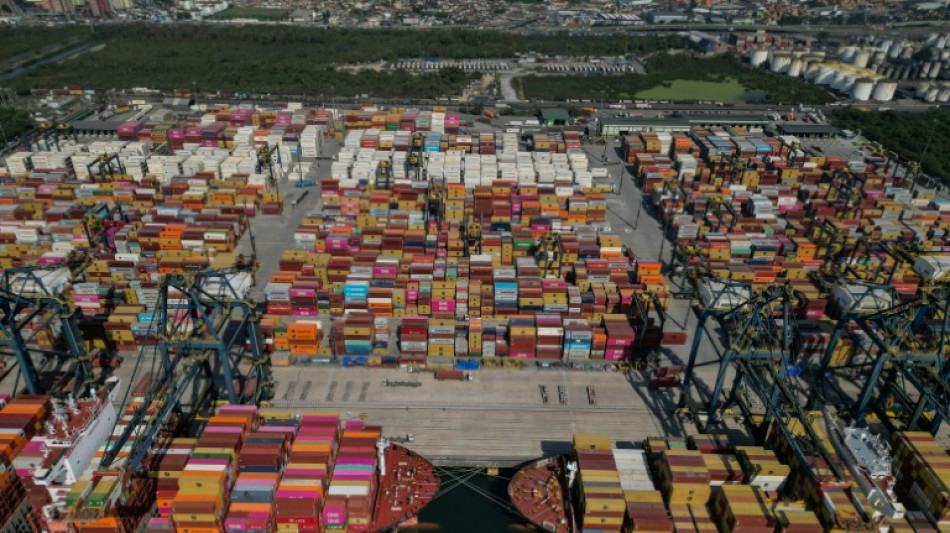
Latin America weathered Trump tariffs better than feared: regional bank chief / Photo: Nelson ALMEIDA - AFP/File

 Global stocks rally on lower oil prices, US-China hopes
 Spanish PM says unregulated AI could be 'devastating'

 From Korean Chipmakers to Leveraged Semiconductor ETFs: STARTRADER Launches 49 New 24/7 Stock and ETF CFDs
 Asia stocks rise on AI, US-China trade talks optimism
 Multi-Asset Trading Venue Monochrome Exchange Announces IEO of Its Native Token, $MCR

 Data centre command hub keeps AI up and running
 Leo XIV, first US pope transcends his restrained style
 France's debt climbs to highest since 1978: ministry
 Thousands protest inaction over climate crisis in Switzerland

 UK actor Naomi Watts honoured at Spain film festival
 Trump signs bill authorizing sweeping Russia sanctions

 Anthropic picks Accenture for in-house AI safety evaluation
 Hushing and hedging: US companies retreat on climate

 Crisis-wracked Volkswagen warns of 10-bn-euro hit to profits

 Shakira to cap off world tour with Madrid 12-gig run

 Isolated Syrian-Druze city shortages

 UNESCO can be 'moderator' in AI debate: chief to AFP

 Russia seizes assets of Nestle, French firms

 Anthropic says AI systems moving towards building themselves

 Asian stocks boosted by falling oil, yen weakens after BoJ rate hike

 Afghan medical students in Pakistan hope court stops college expulsions

 Australia to detain tourists who overstay visa, minister says

 Asian stocks track Wall St rally as oil prices drop

 Prized Mexican relic returns on loan, two centuries on

 'In our lane': Fed's Warsh defies Trump but still fighting for credibility

The impact of tariffs imposed by US President Donald Trump "has been less than expected" in Latin America, the head of the region's development bank told AFP in an interview.
Dozens of economies worldwide were hit by US customs duties as part of Trump's push for reciprocal tariffs against what he considers unfair trade practices.
Some economists have warned the measures could slow global trade due to the increased export costs to the world's largest economy.
But "when you look at the year from January to date, the impact has been less than expected," said Sergio Diaz-Granados, president of the Development Bank of Latin America and the Caribbean (CAF), in an interview on Friday.
"Obviously, it caused a lot of turbulence at the beginning, but the outlook is becoming increasingly clearer."
He attributed the lower-than-anticipated impact to "well-established trade networks" between the United States and Latin America, which he said helped the region adapt quickly to the new tariffs.
"Latin America has certain comparative advantages over the American market: its proximity and a series of deep ties ranging from the presence of Hispanics and Latinos within the United States to the connection of American companies as investors" in the region, Diaz-Granados said.
Several Latin American countries also negotiated directly with Washington after the tariff hikes, helping to soften the blow, he added.
"The outlook is clearer now with these new trade arrangements where there will certainly be some tariffs, but at the same time, there will be some compensation in the (supply) chains, and this will allow for a readjustment," he said.
Latin America and the Caribbean is expected to grow at an average of "around 3.2 percent" in 2026, 0.3 percentage points below the global economic growth rate, according to Diaz-Granados.
"Mexico will once again recover its investment and export pace, which is good news because, at the end of the day, Mexico connects and pulls a large part of the trade networks of Central America and northern South America," he said.
However, he lamented that low investment flows, weak productivity and insecurity have kept Latin America's growth below the global average for the past decade.
"The region needs to grow above four percent to begin to structurally close the gaps in poverty and inequality," he warned.
P.Petrenko--CPN