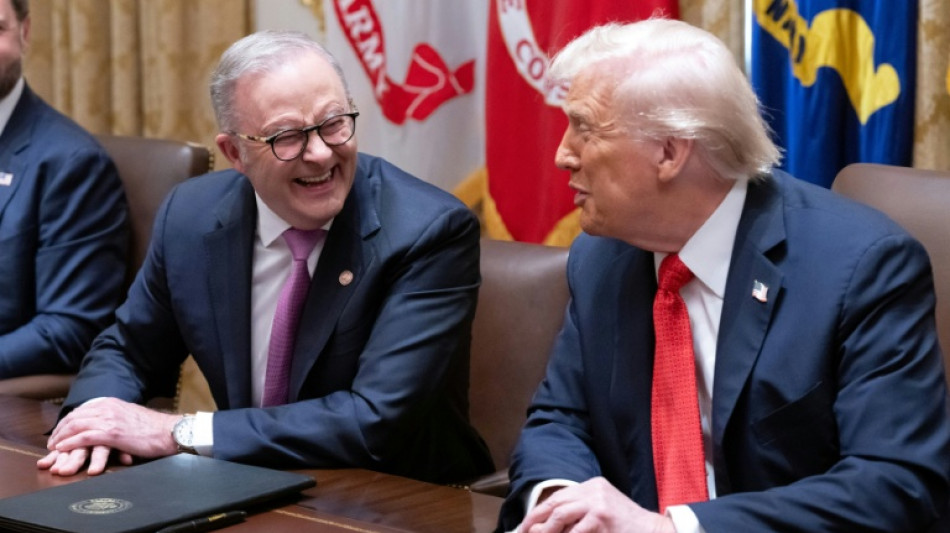
Trump says Australia will get submarines as PM visits / Photo: SAUL LOEB - AFP

 South Africa arrests three more suspects, after nine women murdered
 Paramount settles with US states to clear Warner Bros. mega-merger
 Climate crisis a job for world leaders, not just activists: UK FM
 COP31 host says AI's climate footprint to be a summit priority
 EU proposes energy rating for data centres

 TradersYard Shifts Focus to Futures Trading

 Indonesia doing 'everything' but struggling to curb fires
 FQ-42 Vengeance Finds New Home at Creech Air Force Base
 Multi-Asset Trading Venue Monochrome Exchange Announces IEO of Its Native Token, $MCR
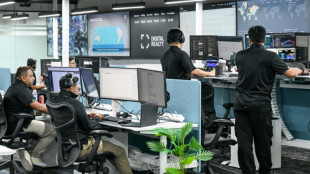 Data centre command hub keeps AI up and running
 Leo XIV, first US pope transcends his restrained style
 France's debt climbs to highest since 1978: ministry

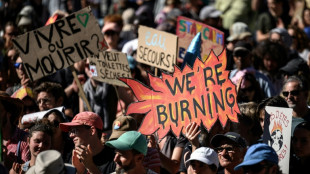 Thousands protest inaction over climate crisis in Switzerland

 UK actor Naomi Watts honoured at Spain film festival
 Trump signs bill authorizing sweeping Russia sanctions
 Anthropic picks Accenture for in-house AI safety evaluation

 Hushing and hedging: US companies retreat on climate

 Crisis-wracked Volkswagen warns of 10-bn-euro hit to profits

 Shakira to cap off world tour with Madrid 12-gig run

 Isolated Syrian-Druze city shortages

 UNESCO can be 'moderator' in AI debate: chief to AFP

 Russia seizes assets of Nestle, French firms

 Anthropic says AI systems moving towards building themselves

 Asian stocks boosted by falling oil, yen weakens after BoJ rate hike

 Afghan medical students in Pakistan hope court stops college expulsions

US President Donald Trump said Australia would get coveted nuclear-powered attack submarines and signed a deal on rare earth minerals with Prime Minister Anthony Albanese at the White House on Monday.
The promise to Australia, which promotes itself as a key US ally against China, came after the Trump administration said earlier this year it was reviewing a deal for the subs signed under previous president Joe Biden.
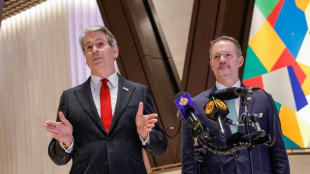
"The submarines that we're starting to build for Australia are really moving along," Trump told reporters as he sat alongside Albanese in the cabinet room of the White House.
"We've worked on this long and hard, and we're starting that process right now. And it's really moving along very rapidly, very well."
The two leaders also signed a deal on critical minerals and rare earths, which are vital for the technology that runs the global economy.
Albanese has touted Australia's abundant critical minerals as a way to loosen China's grip over global supplies.
The Australian premier meanwhile managed to ride out an awkward confrontation between Trump and Australia's ambassador to Washington -- former prime minister Kevin Rudd.
Rudd deleted a series of critical social media posts about Trump following the Republican's election victory last year.
"I don't like you either. I don't. And I probably never will," Trump said to Rudd when a reporter pointed out that the ex-PM was in the room and asked the US president whether he minded the comments.
Australians have a mostly unfavorable view of the Trump administration, polling shows, though the country relies on the United States to balance China's expanding military clout in the Pacific region.
- Rare earths -
Australia's government had been hoping for Trump's blessing of the 2021 agreement for at least three of the silent, Virginia-class submarines within 15 years.
The AUKUS submarine deal between Australia, the United Kingdom and the United States could cost Australia up to US$235 billion over the next 30 years, according to Canberra.
But the Trump administration said in June it had put AUKUS under review to ensure it aligned with his "America First agenda."
Some domestic critics had said the United States did not produce enough Virginia-class submarines to supply Australia as well as its own navy.
The nuclear-powered vessels lie at the heart of Australia's strategy of improving its long-range strike capabilities in the Pacific.
Australia had a major bust-up with France after it tore canceled a multibillion-dollar deal to buy a fleet of diesel-powered submarines from Paris and go with the AUKUS program instead.
In the run-up to the White House talks, Australia also sold itself to Washington as a future source of critical minerals including rare earths -- of which China is by far the world's largest supplier.
Australia sits on deposits of lithium, cobalt and manganese as well as rare earth metals used in technologies from semiconductors to defense hardware, electric cars and wind turbines.
Albanese announced plans in April for a strategic reserve of critical minerals to provide to "key partners" such as the United States.
The reserve is designed to help relax China's chokehold on global critical minerals production, which it has been accused of leveraging to pressure trade partners.
Trump this month threatened 100-percent tariffs on China in response to its latest rare earths export curbs.
But Trump insisted on Monday that he now predicted a good trade deal with China at talks in South Korea with Chinese President Xi Jinping.
P.Gonzales--CPN