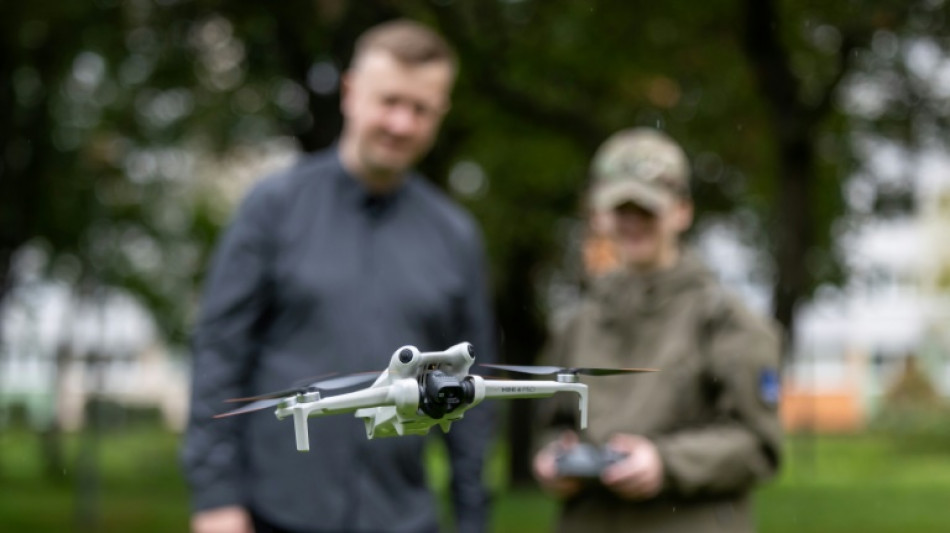
Polish teens study in first drone class overseen by military / Photo: Wojtek RADWANSKI - AFP

 Infantino proposes consulting federations to reform FIFA
 South Africa arrests three more suspects, after nine women murdered

 Paramount settles with US states to clear Warner Bros. mega-merger

 Climate crisis a job for world leaders, not just activists: UK FM
 COP31 host says AI's climate footprint to be a summit priority

 EU proposes energy rating for data centres

 TradersYard Shifts Focus to Futures Trading

 Indonesia doing 'everything' but struggling to curb fires

 FQ-42 Vengeance Finds New Home at Creech Air Force Base
 Multi-Asset Trading Venue Monochrome Exchange Announces IEO of Its Native Token, $MCR
 Data centre command hub keeps AI up and running

 Leo XIV, first US pope transcends his restrained style
 France's debt climbs to highest since 1978: ministry

 Thousands protest inaction over climate crisis in Switzerland

 UK actor Naomi Watts honoured at Spain film festival
 Trump signs bill authorizing sweeping Russia sanctions

 Anthropic picks Accenture for in-house AI safety evaluation

 Hushing and hedging: US companies retreat on climate

 Crisis-wracked Volkswagen warns of 10-bn-euro hit to profits

 Shakira to cap off world tour with Madrid 12-gig run

 Isolated Syrian-Druze city shortages

 UNESCO can be 'moderator' in AI debate: chief to AFP

 Russia seizes assets of Nestle, French firms

 Anthropic says AI systems moving towards building themselves

 Asian stocks boosted by falling oil, yen weakens after BoJ rate hike

At a Polish military school, teenagers in military-style uniforms crowded around a 15-year-old classmate, pushing him to "search for Russians," as he hunted for targets on a drone simulator.
For them it was just a game -- but for Poland, the threat is seen as very real.
Warsaw and its NATO allies scrambled fighter jets last month when they had detected around 20 drones they said were piloted by Russia, flying through Poland's airspace. A few were shot down and Prime Minister Donald Tusk warned his country was closer to conflict that at any point since World War II.
It was a stark example of NATO's vulnerability to a possible drone attack, prompting many countries to assess their warfare capacities against the aerial devices.
Just days earlier, a military school in Poland's western town of Legnica had launched the country's first drone course, teaching teenagers how to build and fly the devices.
"Looking at Ukraine, I see that these drones are actually very important," Bartosz Ladocha, a 15-year-old student enrolled in the programme, told AFP.
Both Russia and Ukraine have used drones widely since Moscow invaded in 2022, and are locked in a technological arms race to gain an edge.
"Drones are new, and I thought it was a promising profession, which is why I want to go into it," said Ladocha.
Wearing a combat uniform with a Polish flag on his sleeve, he said he had "always wanted to join the army".
- 'Pioneers' -
Ladocha and his 17 classmates follow a programme overseen by the Polish defence ministry.
Poland -- which will spend 4.8 percent of GDP on defence next year, one of the highest levels in NATO -- has created a special drone force and will buy $54 million worth of drones this year.
At the school in Legnica, founder and headmaster colonel Tomasz Zachariasz told AFP his "students are becoming pioneers" of drone expertise.
The morning after the flurry of drones rattled Poland, students "immediately came" to ask if the airspace violation matched scenarios talked about in class, he said.
Their training focuses not just on how to use drones, but also how their role in military strategy.
Though they not obligated to join the army once they graduate from the class, many are set on a military career -- some, like Tomasz Cieslak, to their parents' initial dismay.
"At first, they were devastated that I was thinking about joining the army," Cieslak, 15, said.
"They suggested various civilian schools. Still, I decided to choose a military school."
Cieslak became interested in drones through his father who used them for work. When he was around 12, he started flying small, "10-gramme drones" indoors, before gradually taking to larger devices.
He also started studying Poland's turbulent history, learning about the heavy territorial and human losses suffered in World War II, when the country was invaded by both Nazi Germany and the Soviet Union.
"I began to respect more what Poles did to free Poland from captivity. It really got to me, and I thought that I wanted to be like them and defend my homeland," Cieslak told AFP.
- 'Defend our country' -
His main interest is in FPV (first-person-view) drones, small commercial-style devices with a camera mounted to the front flown and controlled remotely by an operator, who typically wears goggles to see what the drone sees.
"Speed is best. Now that I see that I can fly the drone more freely, I can do some flips, which is what interests me, flying between buildings," he said.
Lukasz Gadomski, deputy headmaster in charge of the drone curriculum, predicted the training will "bring tangible benefits in the future".
"There is a shortage of such people, a shortage of operators among young people, a shortage of people who have this knowledge and who could defend our country in this context."
He said the school -- which was already coordinating with a nearby military unit to train its students -- was looking into new partnerships, including with the Ukrainian army.
But asked about the war in Ukraine, Ladocha shrugged, saying he did not "think about it much".
"As for my friends from Ukraine... I feel a bit sorry for them because it's their country, which could collapse at any moment and be gone in an instant."
"But as for the war itself, I'm not really that interested in it."
P.Gonzales--CPN