
Britain's energy grid bets on flywheels to keep the lights on / Photo: Justin TALLIS - AFP

 Mandela Digital Extends Early Access Programme to 11 February 2027 Following Strong Response

 McDonald's to boost franchisees as inflation weighs on consumers

 Archaelogical 'breakthrough' could confirm origins of Paris

 Fendi brings disco bling, Italian style, to Milan Fashion Week

 アレックス・ボディ氏とシュテファン・ハウプト教授、ルーマニアの伝説的な美術コレクションをめぐり提携に合意

 Stocks dip, oil rises as traders eye chances of Iran deal

 Oil falls, stocks steady as Trump hails 'good' Iran talks

 Canada judge to decide prison term for suicide poison seller

 Meta leans into AI, smart glasses amid privacy pushback
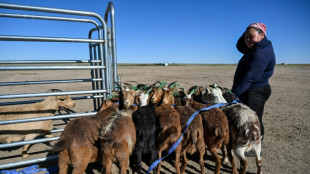
 Oil prices fall after Trump hails 'good' talks with Iran

 AI political ads warp reality ahead of US midterms

 Oil prices retreat as markets welcome US-Iran talks

 French prosecutors probe secret filming of women with smart glasses

 Trump renames AI "super intelligence," rejects international oversight

 How is the EU approaching record fuel prices?

 11 hurt as teen opens fire outside school in western Turkey

 UN chief says 'Big Oil' treats atmosphere as open sewer
 Memoir by Diana's brother goes on sale after rocking UK monarchy

 Stocks climb as oil slides, AI buzz returns

 MEXC Launches “Real Stocks, Real Friends” with Rewards for Bringing Friends to Wall Street

 Stocks rise on AI buzz, oil prices cool

 In Bangladesh, Pakistan's Jinnah photo stirs anger

 China's robot dancers limber up for America's Got Talent final

 Green policies just good politics, says UK minister

 El Nino weather pattern enters record territory: scientist

Britain's energy operator is betting on an age-old technology to future-proof its grid, as the power plants that traditionally helped stabilise it are closed and replaced by renewable energy systems.
Spinning metal devices known as flywheels have for centuries been used to provide inertia -- resistance to sudden changes in motion -- to various machines, from a potter's wheel to the steam engine.
Grid operators are now looking to the technology to add inertia to renewable-heavy electricity systems to prevent blackouts like the one that hit Spain and Portugal this year.
In an electricity grid, inertia is generally provided by large spinning generators found in coal-fired and gas power plants, helping maintain a steady frequency by smoothing fluctuations in supply and demand.
But renewable energy sources like solar and wind power don't add inertia to the grid, and usually cannot help with other issues, such as voltage control.
Flywheels can mimic the rotational inertia of power plant generators, spinning quicker or slower to respond to fluctuations.
Without rotating turbines, "the system is more prone to fluctuations than it would be otherwise", explained David Brayshaw, a professor of climate science at the University of Reading in England.
"As we get to ever higher levels of renewables, we're going to have to think about this more carefully," Brayshaw told AFP.
- Flywheels and batteries -
The Iberian Peninsula, which is powered by a high share of renewables, went dark on April 28 after its grid was unable to absorb a sudden surge in voltage and deviations in frequency.
Spain's government has since pointed fingers at conventional power plants for failing to control voltage levels.
It could serve as a wake-up call similar to a 2019 outage which plunged parts of Britain into darkness following a drop in grid frequency.
That blackout prompted UK energy operator NESO to launch what it called a "world-first" program to contract grid-stabilising projects.
Flywheels and batteries can add synthetic inertia to the grid, but engineering professor Keith Pullen says steel flywheels can be more cost-effective and durable than lithium-ion batteries.
"I'm not saying that flywheels are the only technology, but they could be a very, very important one," said Pullen, a professor at City St George's, University of London and director of flywheel startup Levistor.
In the coming years, Pullen warned the grid will also become more unstable due to greater, but spikier demand.
With electric cars, heat pumps and energy-guzzling data centres being hooked onto the grid, "we will have more shock loads... which the flywheel smooths out".
- Carbon-free inertia -
Norwegian company Statkraft's "Greener Grid Park" in Liverpool was one of the projects contracted by NESO to keep the lights on.
Operational since 2023, it is a stone's throw from a former coal-fired power station site which loomed over the northern English city for most of the 20th century.
But now, instead of steam turbines, two giant flywheels weighing 40 tons (40,000 kilograms) each whirr at the Statkraft site, which supplies one percent of the inertia for the grid needed in England, Scotland and Wales.
Each flywheel is attached to a synchronous compensator, a spinning machine that further boosts inertia and provides voltage control services in the Liverpool region.
"We are providing that inertia without burning any fossil fuels, without creating any carbon emissions," said Guy Nicholson, Statkraft's zero-carbon grid solutions head.
According to NESO, 11 other similar synchronous compensator and flywheel projects were operational in Britain as of 2023, with several more contracted.
- 'Not fast enough' -
The government is "working closely with our industry partners who are developing world-leading technology, including flywheels, static and synchronous compensators, as we overhaul the energy system", a Department for Energy Security and Net Zero spokesperson told AFP.
But, "we aren't building them fast enough to decarbonise the grid", warned Nicholson.
Britain aims to power the grid with clean energy 95 percent of the time by 2030, before completely switching to renewables in the next decade.
"At the moment... we can't even do it for one hour," said Nicholson.
Even when there is sufficient solar and wind energy being generated, "we still have to run gas turbines to keep the grid stable", he explained.
Still, Britain and neighbouring Ireland seem to be ahead of the curve in procuring technology to stabilise renewable-heavy grids.
"In GB and Ireland, the system operators are leading by contracting these services," Nicholson said. "On the continent, there hasn't been the same drive for that."
"I think these things are driven by events. So, the Spanish blackout will drive change."
M.Mendoza--CPN