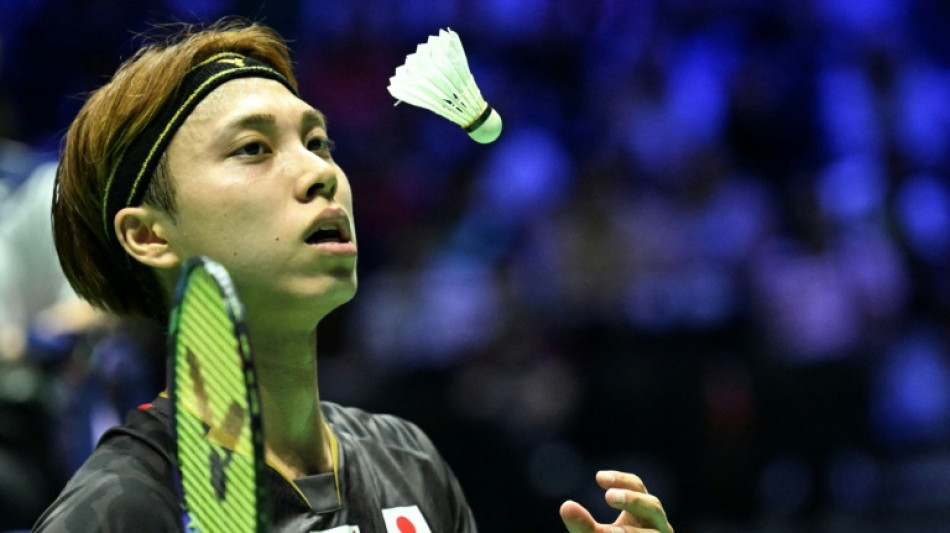
Badminton federation smoothes feathers ruffled by shuttlecock shortage / Photo: Bertrand GUAY - AFP

 Mandela Digital Extends Early Access Programme to 11 February 2027 Following Strong Response

 McDonald's to boost franchisees as inflation weighs on consumers

 Archaelogical 'breakthrough' could confirm origins of Paris

 Fendi brings disco bling, Italian style, to Milan Fashion Week

 アレックス・ボディ氏とシュテファン・ハウプト教授、ルーマニアの伝説的な美術コレクションをめぐり提携に合意

 Stocks dip, oil rises as traders eye chances of Iran deal

 Oil falls, stocks steady as Trump hails 'good' Iran talks

 Canada judge to decide prison term for suicide poison seller

 Meta leans into AI, smart glasses amid privacy pushback
 Oil prices fall after Trump hails 'good' talks with Iran

 AI political ads warp reality ahead of US midterms

 Oil prices retreat as markets welcome US-Iran talks

 French prosecutors probe secret filming of women with smart glasses

 Trump renames AI "super intelligence," rejects international oversight

 How is the EU approaching record fuel prices?

 11 hurt as teen opens fire outside school in western Turkey

 UN chief says 'Big Oil' treats atmosphere as open sewer

 Memoir by Diana's brother goes on sale after rocking UK monarchy

 Stocks climb as oil slides, AI buzz returns

 MEXC Launches “Real Stocks, Real Friends” with Rewards for Bringing Friends to Wall Street

 Stocks rise on AI buzz, oil prices cool
 In Bangladesh, Pakistan's Jinnah photo stirs anger

 China's robot dancers limber up for America's Got Talent final
 Green policies just good politics, says UK minister

 El Nino weather pattern enters record territory: scientist

Skyrocketing raw material prices in China have caused shuttlecock prices to more than double in recent months as suppliers struggle to meet rising demand from badminton enthusiasts around the world.
However, the Badminton World Federation (BWF) insists the shortage is not "at a crisis level yet".
"We are aware of the global supply chain challenges and subsequent increases in feathered shuttlecock prices impacting badminton communities around the world," BWF Secretary General Thomas Lund said in written statement.
"And while we are naturally concerned by this barrier to participation, in our dialogue with the large-scale manufacturers and their assessment of the situation, we don't believe this is at a crisis level yet."
The shortage can, in part, be attributed to changing consumer habits in China.
The production of shuttlecocks relies heavily on the supply of duck and goose feathers. One high-quality shuttlecock requires 16 carefully selected feathers, typically sourced from the wings of ducks or geese.
A single shuttlecock can use feathers from two birds, with premium models requiring up to four.
This dependence on poultry has caused strain. Duck and goose output in China, the global leader in shuttlecock production, has declined sharply in recent years.
The China Animal Agriculture Association, cited in state media reports, said 4.22 billion ducks and 569 million geese were slaughtered in 2024. That was 10 percent down from 2019 peaks as pork production has rebounded following the African swine fever outbreak which started in 2018.
- 'Insane price hike' -
"(The increase in pork production) does have some impacts, but it's only one of the factors," said Wu Xin, manager of Antarctic Wind, a leading domestic shuttlecock supplier, in a phone interview with AFP.
Wu pointed to the soaring popularity of badminton in China as the primary driver of surging demand for shuttlecocks.
"In the past two years, we have scaled down export and focussed more on serving the domestic market," Wu said, adding that China is the fastest growing market for his company.
This shift reflects the sport's growing appeal, which has intensified competition for limited resources.
Woody Mao, co-founder of an export-focussed badminton supplier in Zhejiang, said that duck and goose feather prices have more than doubled since late 2022.
"But the price hike this year could only be described as insane," Mao said, adding that prices sometimes rose in just hours.
The price volatility has forced manufacturers to act to secure supplies in a highly competitive market.
Antarctic Wind's Wu said that he had witnessed a boom-and-bust production cycle before, but the current situation was unprecedented.
"When the price goes up, if you don't buy it, others will. There are hundreds of factories. For their own existence, they have to make those purchases," Wu said.
- 'Times change' -
One solution is a switch from natural to synthetic shuttlecocks.
This is the approach favoured by the BWF as part of its sustainability drive.
"Our testing and trialling programmes for the production and introduction of competition and social-use synthetic shuttlecocks in collaboration with the manufacturers remains in place and is firmly part of our sustainability strategies for the future," said Lund.
"This is an ongoing process and contrary to reports has not ceased.
"Several manufacturers have already gone to market with their social-use synthetic shuttlecocks, and the products have been well received. More work is being done by the BWF and these manufacturers on competition-approved shuttlecocks."
The BWF said a professional-level badminton match uses, on average, 13 shuttlecocks. At that rate, the world championships, running until Sunday in Paris will smash through just shy of 3,500 shuttlecocks across its five events.
Indian former world champion and Olympic medallist Pusarla Venkata Sindhu told AFP she had not been involved in testing synthetic competition-approved shuttlecocks but was favourable to their use if necessary.
"If it comes to that, you know things change, times change and you know you have to get used to things if you have to, if there's no option," Sindhu said.
"We haven't got there yet, but let's see where it goes.
"Until I've played or I've experienced it, I can't actually tell."
P.Gonzales--CPN