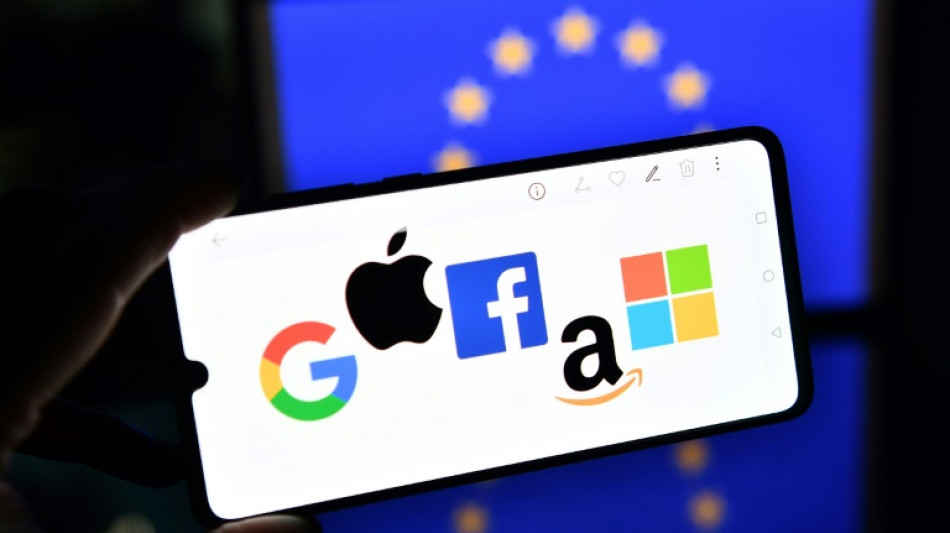
The European laws curbing big tech... and irking Trump / Photo: JUSTIN TALLIS - AFP/File

 Rio breaks record for rainiest September amid powerful El Nino

 Mandela Digital Extends Early Access Programme to 11 February 2027 Following Strong Response

 McDonald's to boost franchisees as inflation weighs on consumers

 Archaelogical 'breakthrough' could confirm origins of Paris
 Fendi brings disco bling, Italian style, to Milan Fashion Week

 アレックス・ボディ氏とシュテファン・ハウプト教授、ルーマニアの伝説的な美術コレクションをめぐり提携に合意

 Stocks dip, oil rises as traders eye chances of Iran deal

 Oil falls, stocks steady as Trump hails 'good' Iran talks

 Canada judge to decide prison term for suicide poison seller

 Meta leans into AI, smart glasses amid privacy pushback

 Oil prices fall after Trump hails 'good' talks with Iran
 AI political ads warp reality ahead of US midterms

 Oil prices retreat as markets welcome US-Iran talks

 French prosecutors probe secret filming of women with smart glasses

 Trump renames AI "super intelligence," rejects international oversight
 How is the EU approaching record fuel prices?
 11 hurt as teen opens fire outside school in western Turkey

 UN chief says 'Big Oil' treats atmosphere as open sewer

 Memoir by Diana's brother goes on sale after rocking UK monarchy

 Stocks climb as oil slides, AI buzz returns

 MEXC Launches “Real Stocks, Real Friends” with Rewards for Bringing Friends to Wall Street

 Stocks rise on AI buzz, oil prices cool

 In Bangladesh, Pakistan's Jinnah photo stirs anger
 China's robot dancers limber up for America's Got Talent final

 Green policies just good politics, says UK minister

Fresh off a trade truce with Donald Trump, the EU is back in the US leader's crosshairs after he vowed to punish countries that seek to curb big tech's powers.
Brussels has adopted a powerful legal arsenal aimed at reining in tech giants -- namely through its Digital Markets Act (DMA) covering competition and the Digital Services Act (DSA) on content moderation.
The EU has already slapped heavy fines on US behemoths including Meta and Apple under the new rules, which have faced strong pushback from Trump's administration.
The bloc's trade chief Maros Sefcovic insisted last week that Brussels successfully "kept these issues out of the trade negotiations" with Washington -- and that the bloc's "regulatory autonomy" was not up for debate.
But while he did not explicitly name the EU, the US leader cast new doubt on the status quo Monday by threatening fresh tariffs on countries with regulations that sought to "harm" American technology.
Here is a look at the EU rules drawing Trump's ire:
- Digital Services Act -
Rolled out in stages since 2023, the mammoth Digital Services Act forces online firms to aggressively police content in the 27 countries of the European Union -- or face major fines.
Aimed at protecting consumers from disinformation and hate speech as well as counterfeit or dangerous goods, it obliges platforms to swiftly remove illegal content or make it inaccessible.
Companies must inform authorities when they suspect a criminal offence that threatens people's lives or safety.
And the law instructs platforms to suspend users who frequently share illegal content such as hate speech -- a provision framed as "censorship" by detractors across the Atlantic.
Tougher rules apply to a designated list of "very large" platforms that include US giants Apple, Amazon, Facebook, Google, Instagram, Microsoft and Snapchat.
These giants must assess dangers linked to their services regarding illegal content and privacy, set up internal risk mitigation systems, and give regulators access to their data to verify compliance.
Violators can face fines or up to six percent of global turnover, and for repeated non-compliance, the EU has the power to ban offending platforms from Europe.
- Digital Markets Act -
Since March 2024, the world's biggest digital companies have faced strict EU rules intended to limit abuses linked to market dominance, favour the emergence of start-ups in Europe and improve options for consumers.
Brussels has so far named seven so-called gatekeepers covered by the Digital Markets Act: Google's Alphabet, Amazon, Apple, TikTok parent ByteDance, Facebook and Instagram parent Meta, Microsoft and travel giant Booking.
In a bid to limit the ability of online giants to snuff out potential rivals, the rules require all buyouts to be notified to the European Commission, the EU's competition regulator.
Gatekeepers can be fined for locking in customers to use pre-installed services, such as a web browser, mapping or weather information.
The DMA has forced Google to overhaul its search display to avoid favouring its own services -- such as Google flights or shopping.
It requires that users be able to choose what app stores to use -- without going via the dominant two players, Apple's App Store and Google Play.
And it has forced Apple to allow developers to offer alternative payment options directly to consumers -- outside of the App Store.
The DMA has also imposed interoperability between messaging apps WhatsApp and Messenger and competitors who request it.
And it imposes new obligations on the world's biggest online advertisers -- namely Google's search engine and Meta's Facebook and Instagram -- by forcing them to reveal much more to advertisers and publishers on how their ads work.
Failure to comply with the DMA can carry fines in the billions of dollars, reaching 20 percent of global turnover for repeat offenders.
X.Cheung--CPN