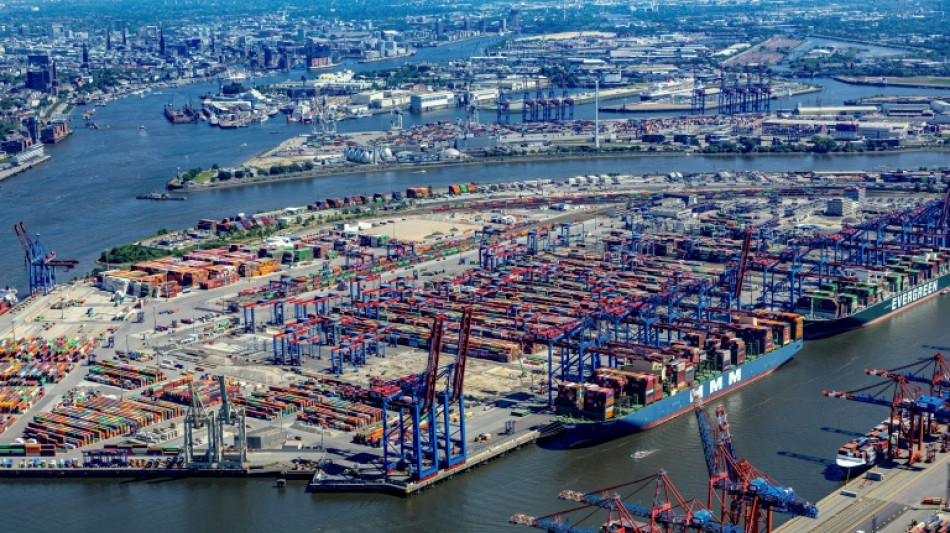
Pressure on Merz as Trump tariffs hit German economy / Photo: Axel Heimken - AFP/File

 Australian PM says OpenAI hacked government health website

 Rio breaks record for rainiest September amid powerful El Nino
 Mandela Digital Extends Early Access Programme to 11 February 2027 Following Strong Response

 McDonald's to boost franchisees as inflation weighs on consumers
 Archaelogical 'breakthrough' could confirm origins of Paris
 Fendi brings disco bling, Italian style, to Milan Fashion Week

 アレックス・ボディ氏とシュテファン・ハウプト教授、ルーマニアの伝説的な美術コレクションをめぐり提携に合意

 Stocks dip, oil rises as traders eye chances of Iran deal

 Oil falls, stocks steady as Trump hails 'good' Iran talks

 Canada judge to decide prison term for suicide poison seller

 Meta leans into AI, smart glasses amid privacy pushback

 Oil prices fall after Trump hails 'good' talks with Iran

 AI political ads warp reality ahead of US midterms

 Oil prices retreat as markets welcome US-Iran talks

 French prosecutors probe secret filming of women with smart glasses

 Trump renames AI "super intelligence," rejects international oversight
 How is the EU approaching record fuel prices?

 11 hurt as teen opens fire outside school in western Turkey

 UN chief says 'Big Oil' treats atmosphere as open sewer

 Memoir by Diana's brother goes on sale after rocking UK monarchy

 Stocks climb as oil slides, AI buzz returns

 MEXC Launches “Real Stocks, Real Friends” with Rewards for Bringing Friends to Wall Street

 Stocks rise on AI buzz, oil prices cool

 In Bangladesh, Pakistan's Jinnah photo stirs anger

 China's robot dancers limber up for America's Got Talent final
Germany's economy shrank more than expected in the second quarter as US tariffs battered exports, official data showed Friday, ramping up pressure on Chancellor Friedrich Merz to turn Europe's top economy around.
Gross domestic product (GDP) fell 0.3 percent from the previous quarter, federal statistics agency Destatis said, as it revised down an earlier July estimate of a drop of just 0.1 percent.
Goods exports fell 0.6 percent and spending on machinery and equipment fell 1.9 percent, underlying the difficulties faced by the country's manufacturers in the first full quarter after increased US tariffs took effect.
The United States is a Germany's largest trade partner, taking about 10 percent of its exports, and a key destination for products from cars to chemicals.
Household consumption came out lower than initial data had suggested while the manufacturing and construction sectors had also performed worse than expected.
Shock data released earlier in August showed that German industrial production had in June plunged to its lowest level since the pandemic in 2020.
- Trade tensions -
Fixing the eurozone's traditional export powerhouse has been a key priority for Merz, with the economy battered in recent years by high energy costs and fierce Chinese competition.
In July, Destatis said that German GDP fell 0.9 percent in 2023 and 0.5 percent in 2024, reporting that the contraction in those years was even worse than previously reported.
Plans to spend hundreds of billions of euros on infrastructure upgrades and rearmament -- combined with a series of brighter data releases since the start of the year -- had raised hopes that the worst might be over.
German business morale rose to its highest level in July after seven straight increases, while think tanks including the respected DIW institute have revised growth forecasts up for 2025 and 2026.
But ING bank analyst Carsten Brzeski said today's data suggested that increased optimism was a result not of a sustained upswing but rather temporary front-loading as US customers rushed to get orders in before new tariffs took effect.
"Optimism alone doesn't bring back growth," he said. "A full reversal of previous US front-loading effects has pushed the German economy back into recessionary territory."
Though the United States and European Union clinched a deal at the end of July to avert a full-blown trade war, ongoing uncertainty around its implementation is hitting German exporters.
The two sides released details of the deal on Thursday, with most EU goods facing a 15-percent tariff.
Cars, however, are still getting a 27.5 percent rate, with the tariff dropping to 15 percent only once the EU introduces legislation to eliminate its own levies on US industrial products.
"It is hard to see how the export-dependent German economy will be able to get out of seemingly never-ending stagnation," Brzeski said.
- Budget troubles -
Social Democrat finance minister Lars Klingbeil has meanwhile floated the possibility of tax rises to plug a 30 billion euro ($34.8 billion) hole in 2027 spending plans, sparking swift rebukes from his conservative coalition partners.
Talk of tax rises threatened to act as an extra brake on growth, Brzeski said, blunting the impact of the bumper infrastructure- and defence-spending plans.
"The longer a debate on potential austerity measures lasts, the higher the risk that households and companies will hold back spending and investment decisions," he said.
"The German economy has made itself too comfortable in stagnation, and it could take until next year before a more substantial recovery starts to unfold."
M.Davis--CPN