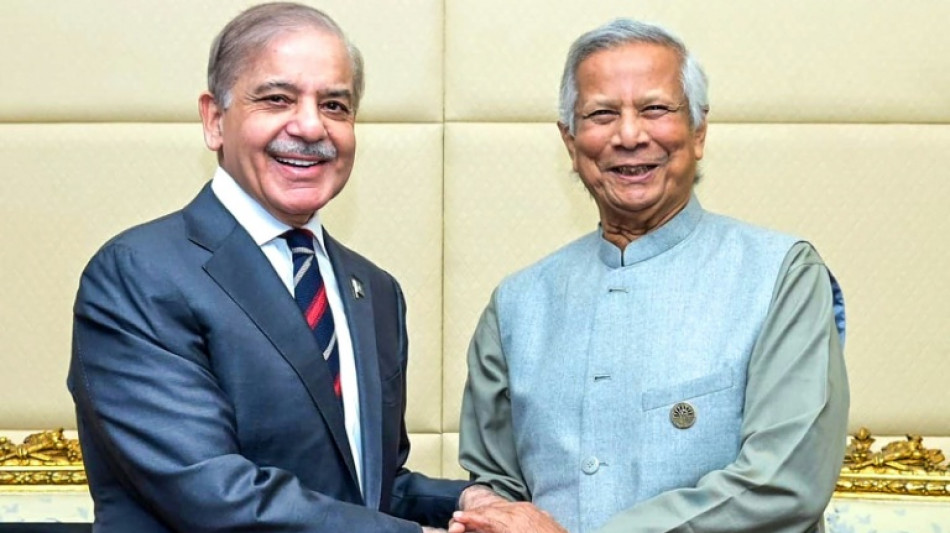
Pakistan woos old rival Bangladesh, as India watches on / Photo: - - Pakistan's Press Information Department (PID)/AFP/File

 Australian PM says OpenAI hacked government health website

 Rio breaks record for rainiest September amid powerful El Nino
 Mandela Digital Extends Early Access Programme to 11 February 2027 Following Strong Response

 McDonald's to boost franchisees as inflation weighs on consumers
 Archaelogical 'breakthrough' could confirm origins of Paris
 Fendi brings disco bling, Italian style, to Milan Fashion Week

 アレックス・ボディ氏とシュテファン・ハウプト教授、ルーマニアの伝説的な美術コレクションをめぐり提携に合意

 Stocks dip, oil rises as traders eye chances of Iran deal

 Oil falls, stocks steady as Trump hails 'good' Iran talks

 Canada judge to decide prison term for suicide poison seller

 Meta leans into AI, smart glasses amid privacy pushback
 Oil prices fall after Trump hails 'good' talks with Iran

 AI political ads warp reality ahead of US midterms

 Oil prices retreat as markets welcome US-Iran talks
 French prosecutors probe secret filming of women with smart glasses

 Trump renames AI "super intelligence," rejects international oversight
 How is the EU approaching record fuel prices?

 11 hurt as teen opens fire outside school in western Turkey

 UN chief says 'Big Oil' treats atmosphere as open sewer

 Memoir by Diana's brother goes on sale after rocking UK monarchy
 Stocks climb as oil slides, AI buzz returns

 MEXC Launches “Real Stocks, Real Friends” with Rewards for Bringing Friends to Wall Street

 Stocks rise on AI buzz, oil prices cool
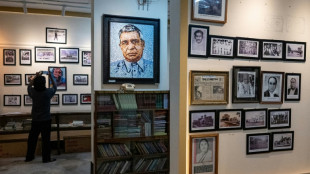 In Bangladesh, Pakistan's Jinnah photo stirs anger

 China's robot dancers limber up for America's Got Talent final
Decades after Pakistani troops killed his friends in Bangladesh's independence war, veteran freedom fighter Syed Abu Naser Bukhtear Ahmed eyes warming ties between Dhaka and Islamabad with cautious pragmatism.
Bangladesh is hosting the foreign minister and trade envoy this week, its most senior Pakistani visitors in years, in a bid to reset relations scarred by the bloody 1971 conflict and shaped by shifting regional power balances.
"The brutality was unbounded," said Ahmed, 79, a banker, describing the war in which East Pakistan broke away to form Bangladesh.
Hundreds of thousands were killed -– Bangladeshi estimates say millions -– and Pakistan's military was accused of widespread atrocities.
"I would have loved to see the responsible people tried -- the ones who killed six of my friends," Ahmed told AFP.
"I don't mind normalising relations with those who opposed the war, but were not directly involved in the atrocities committed."
Contact between the two Muslim-majority nations was long limited to little more than cultural ties: a shared love of cricket, music and Pakistan's prized cotton used to make the flowing trousers and shirt known as shalwar kameez.
Bangladesh instead leaned heavily on India, which almost encircles the country of 170 million people.
- 'Flirting' -
However, a mass uprising in Dhaka last year that toppled longtime India ally Sheikh Hasina has strained ties with New Delhi and opened the door for dialogue with Islamabad.
Pakistan's Commerce Minister Jam Kamal Khan arrived in Dhaka on Thursday and Foreign Minister Ishaq Dar is expected on Saturday.
Analysts say India, which fought a four-day conflict with Pakistan in May, will be watching closely.
"Bangladesh had been one of India's closest partners in its neighbourhood, and now it is flirting with India's chief adversary," said Michael Kugelman, a US-based analyst.
The last time a Pakistani foreign minister visited Dhaka was in 2012, according to Bangladesh newspapers.
Pakistan and Bangladesh began sea trade last year, expanding government-to-government commerce in February.
"It is the emergence of a new strategic equation -- one that reduces Indian influence and instead strengthens a cooperative axis between Pakistan and Bangladesh," Azeem Khalid, a New York-based international relations expert, told AFP.
"If sustained, this evolution has the potential to reshape South Asia's geopolitical and economic order."
Bangladesh's interim government led by Nobel Peace laureate Muhammad Yunus is furious that Hasina fled to India and has defied a summons to answer charges amounting to crimes against humanity.
"Under Yunus, there have been a number of high-level meetings, trade relations have expanded, the two countries have agreed to relax visa rules and there has even been some limited military cooperation," said analyst Thomas Kean from the International Crisis Group.
- 'Wound remains open' -
Still, reconciliation faces obstacles.
Calls for Pakistan to apologise for the 1971 killings remain popular in Bangladesh, but foreign policy expert Qamar Cheema believes it is unlikely Islamabad will oblige.
"Pakistan's engagement with Bangladesh is only possible if Bangladesh does not bring historical animosity in re-establishing ties", said Cheema, from Islamabad's Sanober Institute.
"Bangladesh always demanded an apology, which (Pakistan) never provided -- and even today, doesn't have any such intentions."
Dhaka's foreign affairs adviser Mohammad Touhid Hossain, asked if Bangladesh would raise the issue of a public apology, said that "all issues will be on the table".
Bangladesh courts have sentenced several people for "genocide" during the 1971 war, accusing them of aiding Pakistani forces in the ethnic cleansing of Bengalis.
"As long as the wound remains open, the relationship cannot be sustainable," said anthropologist Sayeed Ferdous from Dhaka's Jahangirnagar University.
Others strike a more balanced tone.
"From a victim's perspective, I can't accept a warming of bilateral relations before Pakistan meets certain conditions," said Bangladeshi academic Meghna Guhathakurta, whose father was killed by Pakistani troops.
She said Islamabad "should make all information related to the war public".
However, the retired international relations professor from Dhaka University also accepted that it was "natural to have trade relations with Pakistan", and acknowledged the "geopolitical dimensions".
With elections in February, when Yunus's administration will hand over power, relations could shift once again.
"If the next government is prepared to patch up ties with India -- and Delhi is willing to reciprocate -- then the surge in ties with Islamabad could become a casualty," Kugelman said.
burs-pjm/pbt/sco
D.Avraham--CPN