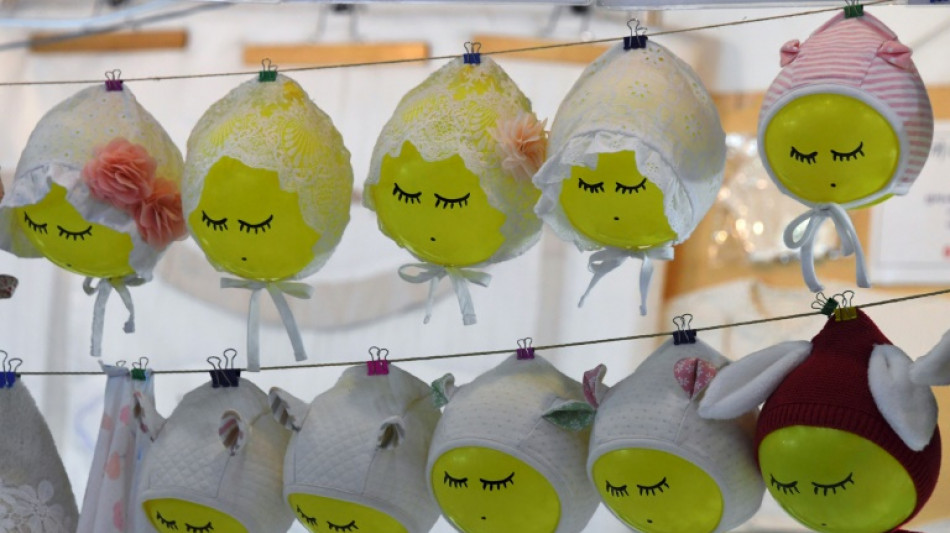
South Korea sees record birth rate growth for Jan-May / Photo: JUNG Yeon-Je - AFP/File

 South Lebanon children return to school destroyed by Israel strike

 European stock markets climb as oil prices drop

 Asian markets mixed after recent oil surge
 Cash for nature protection: hotelier's offer to Principe islanders

 India rape cases turn focus back onto women's safety

 Rich nations should foot climate bill, says Nepal minister

 Italy bans burqas in schools, caps numbers of foreign students per class

 Napoli hoping to build new stadium, says owner

 What happens if the US bans diesel exports

 Oscar-winner Cotillard fears being moved by AI actor

 Stocks fall, oil prices rise as global bonds back under pressure

 Streamex Converts Interest Into Capital as GLDY Investment Strategy Secures $1M+ Institutional Allocation

 STARTRADER Named Best Fintech Forex Broker at Forex Expo Dubai 2026

 German think tanks urge Merz to stick with reforms after election defeats

 France's top-selling newspaper to slash jobs

 BaazEX Enters the Asian Trading Market With a New Approach to Online Forex Trading.

 Sao Tome voters want to stop exodus of 'neglected' youth

 Mexican cartels target Australia with their African meth

 Rapper-turned-PM faces first big test after Nepal disaster

 Meta launches camera-free AI glasses amid privacy pushback

 Anthropic touts AI-led biology discovery

 Stocks fall on soaring bond yields, higher oil prices

 ArcPoint Expands Globally with Institutional Intelligence Platform for Modern Investors

 Outgoing UN chief makes final climate push at New York summit

 Stocks dip, oil soars despite Trump hailing "productive" Iran talks

South Korea registered record birth rate growth during the first five months of the year, a statistics agency official told AFP on Wednesday.
The country has one of the world's longest life expectancies and lowest birth rates -- a combination that presents a looming demographic challenge.
Seoul has poured billions of dollars into efforts to encourage women to have more children and maintain population stability.
"The number of newborns for the January–May period stood at 106,048, a 6.9 percent increase, the highest growth rate since such data collection began in 1981," said Kang hyun-young from Statistics Korea.
The surge follows South Korea's first annual increase in the number of births in more than a decade, driven by a rise in marriages. In 2024, the number of newborns rose by 8,300, or 3.6 percent, to 238,300 from the previous year.
April in particular saw a spike, with year-on-year growth reaching 8.7 percent and the number of births totalling 20,717 that month.
The latest figure marks a sharp turnaround from early 2024, when the number of births for the January–May period dropped by 2.7 percent from the previous year.
The fertility rate, or the average number of babies a woman is expected to have in her lifetime, for May stood at 0.75.
The country needs a fertility rate of 2.1 children in order to maintain the country's population of 51 million.
At current rates, the population will nearly halve to 26.8 million by 2100, according to the Institute for Health Metrics and Evaluation at the University of Washington in Seattle.
- Marriage correlation -
The increase is attributable "to a rise in the number of women in their early 30s, leading to an overall increase in marriages", Kang told AFP.
"In South Korea, there is a strong correlation between marriage and childbirth, which has driven the increase in births during the first five months," she added.
In 2024, the country saw a 14.8 percent on-year increase in the number of marriages, with more than 220,000 couples tying the knot.
Many government benefits designed to support child-rearing do not cover parents who are not legally married.
Analysts say there are multiple reasons for the low birth rate, from high child-rearing costs and property prices to a notoriously competitive society that makes well-paid jobs difficult to secure.
The double burden for working mothers of managing the brunt of household chores and childcare while also maintaining their careers is another key factor, they say.
In a bid to reverse the trend, the South Korean government offers cash subsidies, babysitting services, and support for infertility treatment.
Neighbouring Japan is grappling with the same issue -- it has the world's second-oldest population after Monaco, and the country's relatively strict immigration rules mean it faces growing labour shortages.
D.Avraham--CPN