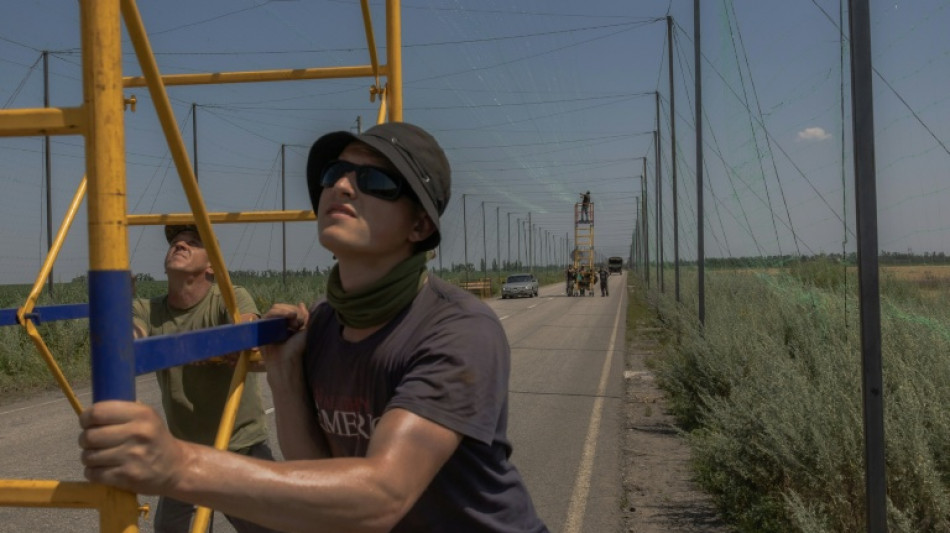
Ukraine covers frontline roads with anti-drone nets / Photo: Roman PILIPEY - AFP

 First US trial against TikTok to open Monday

 French literary prize removes novel from longlist after AI claims

 Trump accuser E. Jean Carroll finally has her damages

 Heavy fighting, internet disruption as Ethiopia conflict rages

 Asian markets mixed after oil gains

 UN approves resolution on dealing with rising sea levels

 Global stocks mostly fall as oil prices and bond yields rise

 Starbucks to close 250 more cafes in North America

 Stocks fall as oil prices rise and bonds back under pressure
 Top ECB official to resign to take up IMF role

 Eviction of pensioner puts Spain housing crisis in spotlight

 Average EU diesel price hits record 2.23 euros a litre: AFP analysis

 Whitetip Investments Marks 10 Years of Regulation, Transparency & Responsible Trading

 Stocks fall, oil prices rise as global bonds under pressure

 Hungary detects invasive spotted lanternfly for first time in EU

 Forex Expo Dubai 2026 Breaks Guinness World Record Again With 23,816 Attendees

 Asian markets fall on US-China jitters as leaders meet

 As Moscow steps up attacks, Kyiv residents brace for harsh winter

 Markets mixed as China's Xi arrives for US talks

 Archaeological 'breakthrough' could confirm origins of Paris

 Australian PM says OpenAI hacked government health website

 Rio breaks record for rainiest September amid powerful El Nino

 Mandela Digital Extends Early Access Programme to 11 February 2027 Following Strong Response

 McDonald's to boost franchisees as inflation weighs on consumers

 Archaelogical 'breakthrough' could confirm origins of Paris

A ravaged car with its engine destroyed and doors riddled with shrapnel lay on the side of the road near Dobropillia, a sleepy town not far from the front line in eastern Ukraine.
Hit by a small, remote-controlled drone, the mangled chassis was a stark reminder of why Ukraine is hurrying to mount netting over supply routes behind the sprawling front line to thwart Russian aerial attacks.
As Russia's invasion grinds through its fourth year, Moscow and Kyiv are both menacing each other's armies with swarms of cheap drones, easily found on the market and rigged with deadly explosives.
AFP reporters saw Ukrainian soldiers installing green nets on four-metre (13-foot) poles spanning kilometres (miles) of road in the eastern Donetsk region, where some of the war's most intense fighting has taken place.
"When a drone hits the net, it short-circuits and it cannot target vehicles," said 27-year-old engineering brigade commander Denis, working under the blazing sun.
- Threat from above -
"We are shifting into a so-called drone war," Denis told AFP.
FPV (first-person view) drones have already seriously wounded a few of his men. Some are armed with shotguns to shoot them down.
The Russian army has also been deploying nets.
"We weave nets like spiders! For extremely dangerous birds without feathers," the Russian defence ministry quoted a soldier with the call sign "Ares" as saying in April.
An earlier article by pro-Kremlin media outlet Izvestia also showed soldiers mounting netting close to the front.
- Everyone is in danger -
Drones are also a worry for towns and cities.
Since early July, the town of Dobropillia, around 20 kilometres (12 miles) from the front line, has become a target for Russian FPV drone attacks.
During a recent visit to the civilian hub -- where some 28,000 people lived before the war -- AFP journalists saw residents on the streets rush for cover in shops when a drone began buzzing overhead.
When the high-pitched whirring had died down and the threat disappeared, one woman exiting a shelter picked up her shopping bags and glanced upwards, returning to her routine.
Every day, victims come to the small town's hospital. According to the hospital's director, Vadym Babkov, the enemy FPVs "spare neither medical workers nor civilians".
"We are all under threat," Babkov added.
In Russia's Belgorod border region, which frequently comes under Ukrainian fire, authorities have retrofitted ambulances with metal anti-drone cages -- a technology once reserved for tanks and personnel carrier vehicles.
- New habits -
"Civilians have got used to it," Denis told AFP.
Olga, a waitress in a small cafe and mini-market in Dobropillia, has devised her own way to cope with the constant drone threat.
"When I drive and feel that a drone is going to attack me, I open all the windows to avoid glass shards hitting me," the 45-year-old told AFP.
The atmosphere in the town had become "frightening", Olga said.
The shop next to Olga's was recently hit by an FPV drone, leaving its owner in a coma.
"Now we jump at every gust of wind," Olga said.
"The day has passed -- thank God. The night has passed and we wake up with all our arms and legs intact -- thank God."
But she doesn't know for how long.
"Everything hangs in the air now," she said. We're living day by day."
M.Mendoza--CPN