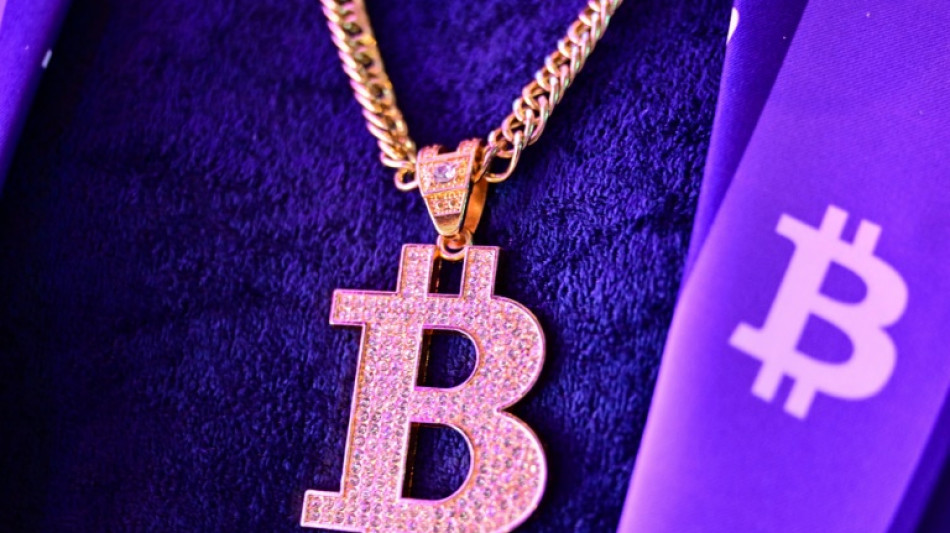
US House set to vote on landmark crypto bills this week / Photo: Giuseppe CACACE - AFP

 First US trial against TikTok to open Monday

 French literary prize removes novel from longlist after AI claims

 Trump accuser E. Jean Carroll finally has her damages

 Heavy fighting, internet disruption as Ethiopia conflict rages

 Asian markets mixed after oil gains

 UN approves resolution on dealing with rising sea levels

 Global stocks mostly fall as oil prices and bond yields rise

 Starbucks to close 250 more cafes in North America

 Stocks fall as oil prices rise and bonds back under pressure

 Top ECB official to resign to take up IMF role

 Eviction of pensioner puts Spain housing crisis in spotlight

 Average EU diesel price hits record 2.23 euros a litre: AFP analysis

 Whitetip Investments Marks 10 Years of Regulation, Transparency & Responsible Trading

 Stocks fall, oil prices rise as global bonds under pressure

 Hungary detects invasive spotted lanternfly for first time in EU

 Forex Expo Dubai 2026 Breaks Guinness World Record Again With 23,816 Attendees

 Asian markets fall on US-China jitters as leaders meet

 As Moscow steps up attacks, Kyiv residents brace for harsh winter

 Markets mixed as China's Xi arrives for US talks

 Archaeological 'breakthrough' could confirm origins of Paris
 Australian PM says OpenAI hacked government health website

 Rio breaks record for rainiest September amid powerful El Nino

 Mandela Digital Extends Early Access Programme to 11 February 2027 Following Strong Response

 McDonald's to boost franchisees as inflation weighs on consumers

 Archaelogical 'breakthrough' could confirm origins of Paris
US lawmakers are on the verge of passing landmark legislation that will give the much-maligned crypto world much-wanted legitimacy, riding on President Donald Trump's recent embrace of the industry.
The US House of Representatives is set to vote on three pieces of legislation this week, including one on the use of stablecoins -- cryptocurrencies pegged to safe assets like the dollar -- that if passed would immediately go to Trump for his signature.
The raft of legislation comes after years of suspicion against the crypto industry amid the belief in the Biden administration that the sector, born out of the success of bitcoin, should be kept on a tight leash and away from mainstream investors.
But after crypto investors poured millions of dollars into his presidential campaign last year, Trump reversed his own doubts about the industry, even launching a Trump meme coin and other ventures as he prepared for his return to the White House.
According to federal financial disclosure forms released last month, Trump pocketed more than $57 million from the crypto venture, World Liberty Financial, that he launched with his sons last year.
Trump has, among other moves, appointed crypto advocate Paul Atkins to head the Securities and Exchange Commission (SEC).
He has also established a federal "Strategic Bitcoin Reserve" aimed at auditing the government's bitcoin holdings, which were mainly accumulated by law enforcement from judicial seizures.
And thanks to his backing, Trump could soon be signing the stablecoin bill -- dubbed the GENIUS Act -- that the US Senate passed last month and that sets rules such as requiring issuers to have reserves of assets equal in value to that of their outstanding cryptocurrency.
- 'Long time coming' -
Stablecoins are considered the safest and least volatile of digital currencies because their value is tied to traditional currency or secure assets such as gold.
Another provision of the bill empowers banking regulators to oversee stablecoin issuers in the United States.
The legislation could extend the US dollar's influence in the world of cryptocurrency, with dollar-backed stablecoins seen as financial havens from local currencies prone to big fluctuations.
The US House is also considering the CLARITY Act that would establish a clearer regulatory framework for digital assets -- including cryptocurrencies and other blockchain-based assets. If passed the bill would require passage in the Senate.
The act would clarify and divide regulatory authority between the Securities and Exchange Commission (SEC) and the Commodity Futures Trading Commission (CFTC).
Gerald Gallagher, General Counsel at Sei Labs, a digital asset firm, said the bills could be a game changer for the industry.
"GENIUS and CLARITY provide security and certainty for investors that previously were not available, either intentionally or unintentionally," he told AFP.
"This has been a long time coming."
The Republican-led House is also considering a bill it calls the Anti-CBDC Surveillance State Act that aims to block the issuance of a central bank digital currency (CBDC) – a digital dollar issued by the US Federal Reserve.
Republicans argue that a CBDC could enable the federal government to monitor, track, and potentially control the financial transactions of private citizens, undermining privacy and civil liberties.
It also would require passage in the Senate before going to Trump for his signature.
P.Schmidt--CPN