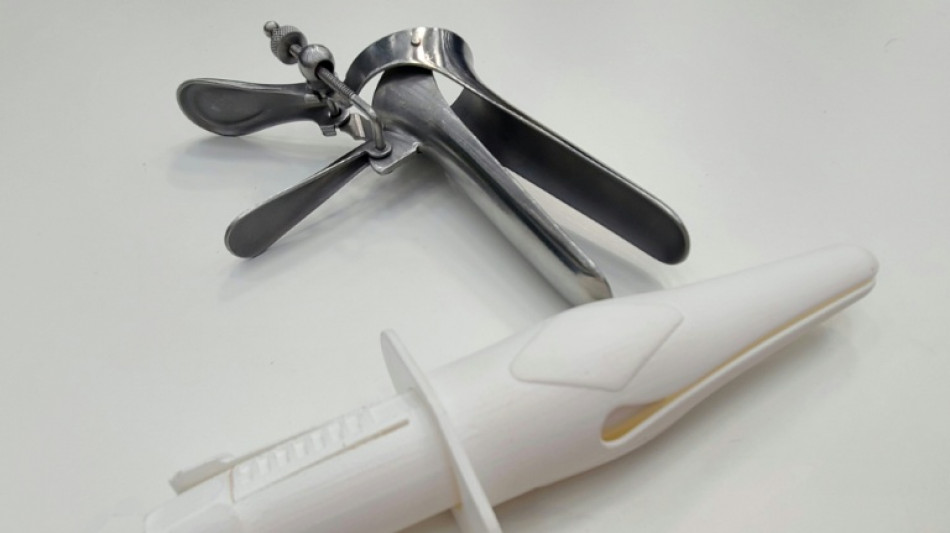
Researchers redesign vaginal speculum to ease fear and pain / Photo: Stéphanie HAMEL - AFP

 First US trial against TikTok to open Monday

 French literary prize removes novel from longlist after AI claims

 Trump accuser E. Jean Carroll finally has her damages

 Heavy fighting, internet disruption as Ethiopia conflict rages

 Asian markets mixed after oil gains

 UN approves resolution on dealing with rising sea levels

 Global stocks mostly fall as oil prices and bond yields rise

 Starbucks to close 250 more cafes in North America

 Stocks fall as oil prices rise and bonds back under pressure

 Top ECB official to resign to take up IMF role

 Eviction of pensioner puts Spain housing crisis in spotlight

 Average EU diesel price hits record 2.23 euros a litre: AFP analysis

 Whitetip Investments Marks 10 Years of Regulation, Transparency & Responsible Trading

 Stocks fall, oil prices rise as global bonds under pressure

 Hungary detects invasive spotted lanternfly for first time in EU

 Forex Expo Dubai 2026 Breaks Guinness World Record Again With 23,816 Attendees

 Asian markets fall on US-China jitters as leaders meet

 As Moscow steps up attacks, Kyiv residents brace for harsh winter

 Markets mixed as China's Xi arrives for US talks

 Archaeological 'breakthrough' could confirm origins of Paris

 Australian PM says OpenAI hacked government health website

 Rio breaks record for rainiest September amid powerful El Nino

 Mandela Digital Extends Early Access Programme to 11 February 2027 Following Strong Response

 McDonald's to boost franchisees as inflation weighs on consumers

 Archaelogical 'breakthrough' could confirm origins of Paris

It is cold, hard, metallic and commonly associated with pain. Not a mediaeval torture instrument, but the vaginal speculum used every day around the world for essential gynaecological exams.
Two engineers at Delft University in the Netherlands are now rethinking the decades-old design of the speculum -- long dreaded by many patients -- to make it less intimidating and less painful.
"I have a lot of experience with the vaginal speculum, unfortunately," Tamara Hoveling, one of the researchers behind the project, told AFP.
"I've never seen it as a pleasurable experience and I've always wondered why it looks like this."
- Sombre history -
The PhD candidate in medical industrial design then delved into the dark history behind the creation of the speculum, one version of which was developed by United States doctor James Marion Sims 180 years ago.
It was "tested on enslaved women without permission", said the 29-year-old.
"So that motivated me even more to take on this project."
Hoveling teamed up with Ariadna Izcara Gual, who was then working on her master's in industrial design engineering at Delft.
"As I was doing a lot of interviews, I was doing those sort of sketches with the same sort of shape but people were still scared of the device", said the 28-year-old Spanish researcher.
The Cusco speculum, the most commonly used model, is a metal device with a handle, beak and screw to adjust how wide it opens once inside the vagina.
For many, its insertion is uncomfortable or even painful and causes anxiety.
"Then the speculum is opened, pushing against these tense muscles and making it even more painful," Hoveling said.
"So I tried to look for shapes that might be related to the reproductive organs, like for example the flower, that also opens."
- Patient-friendly design -
The result was a prototype called the Lilium -- named after the lily flower.
Like the more familiar tampon, it has soft plastic and an applicator.
"It's designed with the patient in mind rather than the doctor.
"And we're really trying to improve the comfort aspect in a sensitive spot."
The Lilium also meets doctors' needs. Its three-sided opening keeps the vaginal walls from collapsing, allowing better visibility during examinations.
The Lilium remains at an early stage, with further ergonomic testing and material research needed to refine the prototype.
The researchers must still secure safety certifications, run human trials and obtain regulatory approval before it can reach clinics.
- Dazzling success -
To fund the next phase, they launched a crowdfunding campaign that quickly drew media attention in the Netherlands.
Within just two days, the campaign raised 100,000 euros ($117,000) -- far surpassing expectations.
"It's also a sign. It's proof there are people who really want change, that there is a real problem here and that the current market solutions are not the best," Hoveling said.
"I've received a lot of emails from women who told me they actually don't go to the gynaecologist because of this device, because they're scared, because they have a traumatic experience."
Cervical cancer is the fourth most common cancer among women, according to the World Health Organization.
It can be detected via a smear test or HPV screening -- both performed using a speculum.
With funding to allow this new gynaecological tool to be developed properly, the Lilium could be saving lives within five years.
X.Wong--CPN