Canada just can't win in trade war with Trump / Photo: Cole Burston - AFP/File

 Trump's photo of Xi greeting carries signs of AI

 First US trial against TikTok to open Monday

 French literary prize removes novel from longlist after AI claims
 Trump accuser E. Jean Carroll finally has her damages
 Heavy fighting, internet disruption as Ethiopia conflict rages

 Asian markets mixed after oil gains

 UN approves resolution on dealing with rising sea levels

 Global stocks mostly fall as oil prices and bond yields rise

 Starbucks to close 250 more cafes in North America

 Stocks fall as oil prices rise and bonds back under pressure

 Top ECB official to resign to take up IMF role

 Eviction of pensioner puts Spain housing crisis in spotlight
 Average EU diesel price hits record 2.23 euros a litre: AFP analysis

 Whitetip Investments Marks 10 Years of Regulation, Transparency & Responsible Trading

 Stocks fall, oil prices rise as global bonds under pressure

 Hungary detects invasive spotted lanternfly for first time in EU

 Forex Expo Dubai 2026 Breaks Guinness World Record Again With 23,816 Attendees

 Asian markets fall on US-China jitters as leaders meet
 As Moscow steps up attacks, Kyiv residents brace for harsh winter

 Markets mixed as China's Xi arrives for US talks

 Archaeological 'breakthrough' could confirm origins of Paris

 Australian PM says OpenAI hacked government health website

 Rio breaks record for rainiest September amid powerful El Nino
 Mandela Digital Extends Early Access Programme to 11 February 2027 Following Strong Response

 McDonald's to boost franchisees as inflation weighs on consumers
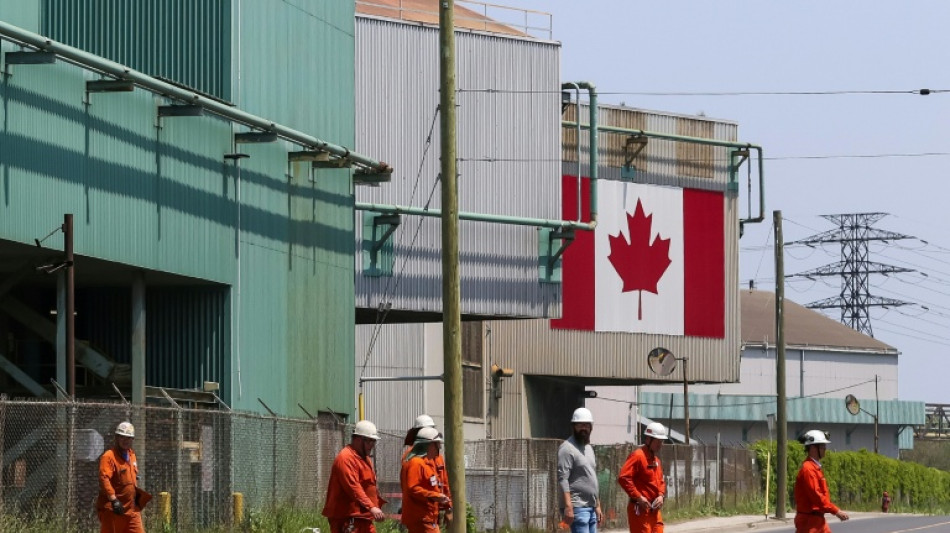
Try as it might to appease President Donald Trump, Canada remains a prized target in his trade wars and subject to the whiplash of his changes of heart.
The giant North American neighbors are rushing to conclude a new trade accord by July 21 but the process is proving painful for Canada.
Overnight Thursday, Trump threatened to slap a 35 percent tariff on imports from Canada starting August 1.
But products complying with an existing accord, the United States-Mexico-Canada Agreement (USMCA), are expected to remain exempt, a Trump administration official and a source in Canada told AFP.
"An agreement is of course possible but that shows how difficult it is for the Canadian government to negotiate with the US president," said Daniel Beland, a political science professor at McGill University in Montreal, referring to Trump's sudden announcement.
-Six months of ups and downs-
Canada has been a key trading partner and ally of the United States for decades. But along with Mexico, it now wears a bull's eye for Trump in his second stint in the White House as he tries to reorder the global system of largely free trade by slapping tariffs on friends and foes alike to address what he calls unfair trading practices.
Trump has also spoken frequently of his idea of absorbing Canada to make it the 51st US state, a concept most Canadians find repugnant.
Canada was rocked by Trump's first attacks after he took power in January. And bad blood between him and then-prime minister Justin Trudeau seemed to pour gas on the fire.
Some degree of hope emerged when Mark Carney was elected in late April to replace Trudeau, pledging to stand up to Trump and defend Canada, its jobs and its borders.
Since then, Carney and Trump have held two more or less cordial meetings -- at the Oval Office in May and at a Group of Seven summit in western Canada last month.
Many people thought a new era was opening, and Carney won praise for his diplomatic and negotiating skills.
During the second of those meetings, the two sides agreed to sign a new trade agreement by July 21.
But in late June Trump angrily called off the trade talks, citing a new Canadian tax on US Big Tech companies.
Canada scrapped the tax two days later so the trade talks could resume. Now they have been rocked again by Trump's new threat of 35 percent tariffs on Canadian goods.
-Stay calm-
Canada has taken to not reacting to everything Trump says. After Trump's latest outburst, Carney simply said, "the Canadian government has steadfastly defended our workers and businesses."
But among Canadian people, Trump's threat-rich negotiating style elicits contrasting reactions, said Beland.
"There are people who want a firmer response while others want to keep negotiating," he said.
Since the beginning of this tug of war, Canada has responded to US action by imposing levies of its own on certain American products.
Philippe Bourbeau, a professor at HEC Montreal, a business school, said people have to realize Trump has an underlying strategy.
"You can criticize the aggressiveness of the announcements and the fact that it is done out in the open, but it is a negotiating tactic," said Bourbeau, adding that the relationship between the two countries is asymmetrical.
"It is illusory to think this is a negotiation between parties of the same size. Canada will surely have to give up more to reach an agreement," he said.
Before Trump came to power, three quarters of Canada's exports went to the United States. This was down to 68 percent in May, one of the lowest such shares ever recorded, as shipments to other countries hit record levels.
"We are Donald Trump's scapegoats," said Genevieve Tellier, a professor of political science at the University of Ottawa.
"He sees us as vulnerable, so he increases the pressure. He is surely telling himself that it is with us that he will score the big win he wants on tariffs," Tellier said.
M.P.Jacobs--CPN