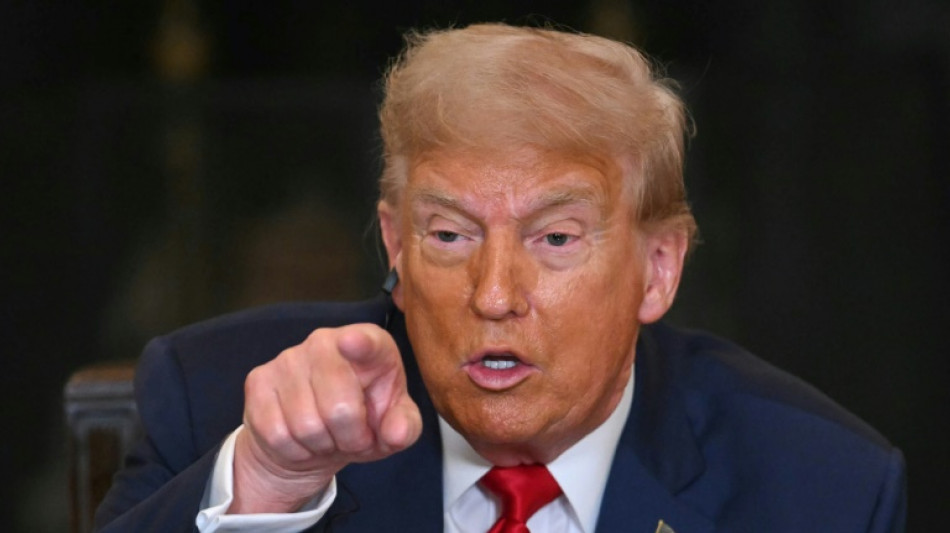
US targets attempts to dodge Trump tariffs with China in crosshairs / Photo: Jim WATSON - AFP/File

 Trump's photo of Xi greeting carries signs of AI

 First US trial against TikTok to open Monday

 French literary prize removes novel from longlist after AI claims
 Trump accuser E. Jean Carroll finally has her damages
 Heavy fighting, internet disruption as Ethiopia conflict rages

 Asian markets mixed after oil gains

 UN approves resolution on dealing with rising sea levels

 Global stocks mostly fall as oil prices and bond yields rise

 Starbucks to close 250 more cafes in North America

 Stocks fall as oil prices rise and bonds back under pressure
 Top ECB official to resign to take up IMF role

 Eviction of pensioner puts Spain housing crisis in spotlight
 Average EU diesel price hits record 2.23 euros a litre: AFP analysis

 Whitetip Investments Marks 10 Years of Regulation, Transparency & Responsible Trading

 Stocks fall, oil prices rise as global bonds under pressure

 Hungary detects invasive spotted lanternfly for first time in EU

 Forex Expo Dubai 2026 Breaks Guinness World Record Again With 23,816 Attendees

 Asian markets fall on US-China jitters as leaders meet
 As Moscow steps up attacks, Kyiv residents brace for harsh winter

 Markets mixed as China's Xi arrives for US talks

 Archaeological 'breakthrough' could confirm origins of Paris

 Australian PM says OpenAI hacked government health website

 Rio breaks record for rainiest September amid powerful El Nino
 Mandela Digital Extends Early Access Programme to 11 February 2027 Following Strong Response

 McDonald's to boost franchisees as inflation weighs on consumers
As President Donald Trump ramps up tariff threats on US trading partners, his administration is taking aim at a tactic said to be used by Chinese companies to dodge the levies by moving goods through third countries.
The issue is "transshipping," or having products pass through a country to avoid harsher trade barriers elsewhere, a practice Washington has accused Chinese companies of.
"Goods transshipped to evade a higher Tariff will be subject to that higher Tariff," Trump warned in letters issued since Monday, days after unveiling a trade pact with Vietnam that promised steeper duties for such goods too.
"The clause is less about Vietnam per se and more about signaling that rules-of-origin games across the broader Asian production network will attract a premium penalty," said Barath Harithas, senior fellow at the Center for Strategic and International Studies.
He told AFP the White House is likely making two points at once: closing a back door to China and putting the rest of Asia on notice.
Noting that Vietnam was "the single biggest winner from Chinese supply-chain diversion since the first Trump tariffs in 2018," Harithas said the US administration is keen to avoid a repeat of this situation.
Ten of the 14 countries first to receive Trump's tariff letters this week were in Asia and mostly Southeast Asia, which sits between Chinese component suppliers and western consumer markets.
"Washington's message seems to be: 'Either help us police Chinese evasion or absorb higher duties yourselves,'" Harithas said.
- 'Whack-a-mole' -
"I think it is clear that transshipment of Chinese goods so far this year is massive," said Robin Brooks, a senior fellow at the Brookings Institution.
While there has been a drop in direct exports from China to the United States, this is "more than offset by" trade shifts elsewhere, he told AFP.
In a recent report, Brooks noted that Chinese exports to both Thailand and Vietnam started surging "anomalously" in early 2025 as Trump began threatening widespread tariffs.
It is unclear if all of these goods end up in the United States.
But he cast doubt on the likelihood that domestic demand in both these countries rocketed right around the time that Washington imposed fresh duties, saying tariffs tend to instead bog down global trade due to uncertainty.
Similarly, Chinese exports to the European Union, he said, also rose markedly in early 2025.
"It's a little bit like whack-a-mole," Brooks said, adding that as long as Washington maintains different tariff rates for different countries, business will try to take advantage of the lowest levels.
This in turn could be a reason that US inflation remains muted despite wide-ranging duties including a 10 percent rate on almost all US trading partners, and levels of up to 50 percent on sector-specific imports like steel and aluminum.
Transshipment is not a China-specific issue. Concerns also flared in recent years over goods bound for Russia -- skirting European export controls -- after Moscow's invasion of Ukraine.
- Complications -
But it is difficult to draw a line defining product origins.
While Washington may take issue with Chinese-headquartered companies moving production facilities to third countries, for example, many firms genuinely export components for value-added manufacturing to take place.
In Vietnam, raw materials from the world's second biggest economy are the lifeblood of manufacturing industries. There is massive uncertainty over how an incoming 40 percent US tariff on goods passing through the country -- double the 20 percent rate applied to Vietnamese goods -- might be applied.
Emily Benson, head of strategy at Minerva Technology Futures, said the Trump administration appears to be trying to simplify an otherwise complex web of legal definitions.
"But whether or not that will work for other trading partners remains to be seen," she said.
While products from China might be impacted, she believes the White House's intentions stretch beyond Beijing.
"They're trying to load a bunch of negotiations on to this reciprocal (tariffs) vehicle," she added. "And they want other countries to play by the rules."
A.Agostinelli--CPN