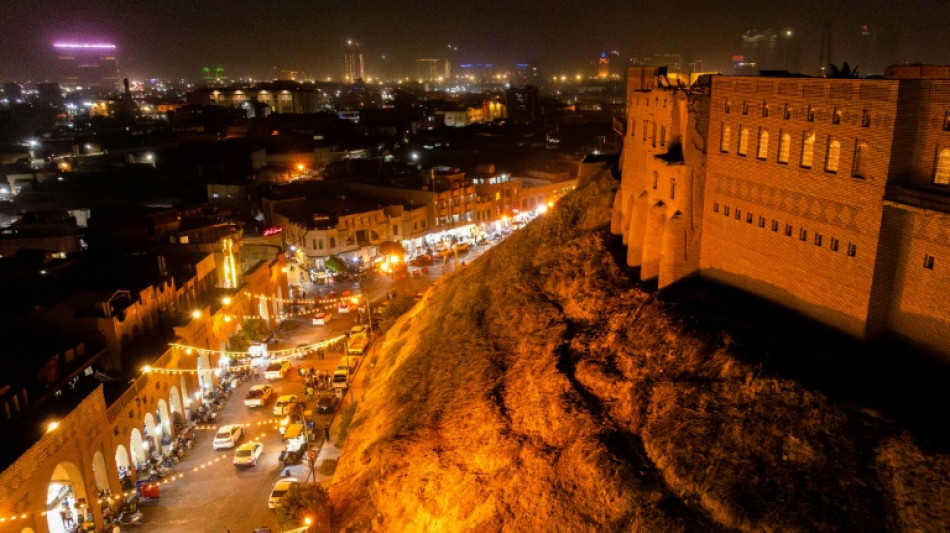
Iraq's Kurdistan enjoys all-day state electricity / Photo: Safin HAMID - AFP/File

 Trump's photo of Xi greeting carries signs of AI

 First US trial against TikTok to open Monday
 French literary prize removes novel from longlist after AI claims

 Trump accuser E. Jean Carroll finally has her damages

 Heavy fighting, internet disruption as Ethiopia conflict rages
 Asian markets mixed after oil gains

 UN approves resolution on dealing with rising sea levels
 Global stocks mostly fall as oil prices and bond yields rise

 Starbucks to close 250 more cafes in North America
 Stocks fall as oil prices rise and bonds back under pressure
 Top ECB official to resign to take up IMF role

 Eviction of pensioner puts Spain housing crisis in spotlight

 Average EU diesel price hits record 2.23 euros a litre: AFP analysis

 Whitetip Investments Marks 10 Years of Regulation, Transparency & Responsible Trading

 Stocks fall, oil prices rise as global bonds under pressure
 Hungary detects invasive spotted lanternfly for first time in EU

 Forex Expo Dubai 2026 Breaks Guinness World Record Again With 23,816 Attendees

 Asian markets fall on US-China jitters as leaders meet

 As Moscow steps up attacks, Kyiv residents brace for harsh winter

 Markets mixed as China's Xi arrives for US talks

 Archaeological 'breakthrough' could confirm origins of Paris

 Australian PM says OpenAI hacked government health website

 Rio breaks record for rainiest September amid powerful El Nino
 Mandela Digital Extends Early Access Programme to 11 February 2027 Following Strong Response

 McDonald's to boost franchisees as inflation weighs on consumers
More than 30 percent of Iraq's autonomous Kurdistan region now has 24-hour state electricity, authorities said Thursday, with plans to extend full coverage by the end of 2026.
The northern region of Kurdistan has long promoted itself as a haven of relative stability in an otherwise volatile country.
Despite Iraq's vast oil wealth, the national grid struggles to meet demand, leaving most areas reliant on imported energy and subject to frequent power cuts.
"Today, two million people across the Kurdistan region enjoy 24-hour electricity... that's 30 percent of the population," including the cities of Arbil, Duhok and Sulaimaniyah, said regional prime minister Masrour Barzani.
In 2024, the Kurdistan Regional Government launched "Project Runaki" to deliver round-the-clock power in a region where, like much of Iraq, residents often turn to costly and polluting private generators.
The region's electricity minister, Kamal Mohammed, said residents were now enjoying "uninterrupted, cleaner, and more affordable electricity".
"Rollout to other areas is expected to be completed by the end of 2026," he told AFP.
As part of the transition, roughly 30 percent of the 7,000 private generators operating across Kurdistan have already been decommissioned, he said, a move that has contributed to an estimated annual reduction of nearly 400,000 tonnes of CO2 emissions.
The project also aims to lower household electricity bills, offering a cheaper alternative to the combined cost of grid power and private generator fees.
However, bills will still depend on consumption and are likely to increase during peak summer and winter months.
Mohammed said the project's success hinges on the introduction of "smart" meters to curb electricity theft, as well as a new tariff system to promote responsible usage.
"More power has been added to the grid to support 24/7 access," he said.
Kurdistan has doubled its gas production in the past five years, and most of the power supply comes from local gas production, Mohammed said.
Despite Iraq's abundant oil and gas reserves, years of conflict have devastated its infrastructure.
The country remains heavily reliant on imports, particularly from neighbouring Iran, which frequently interrupts supply. It also imports electricity from Jordan and Turkey, while seeking to boost its own gas output.
"We stand ready to offer our technical support and assistance" to the federal government, Mohammed said.
In Arbil, resident Bishdar Attar, 38, said the biggest change was the absence of noisy and polluting generators.
"The air is now clear," he said. "We can now use home appliances freely... as needed."
Y.Uduike--CPN