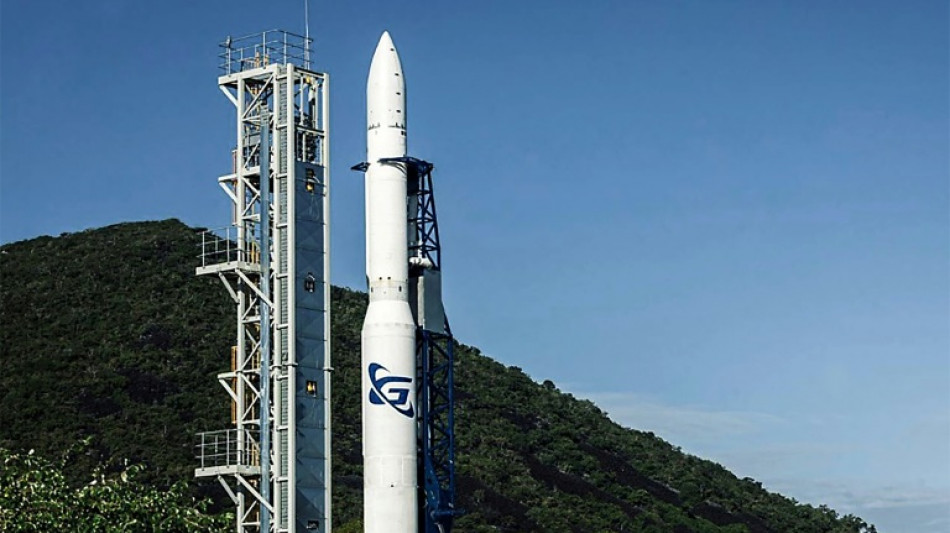
Nose cone glitch wipes Australian rocket launch / Photo: Handout - GILMOUR SPACE TECHNOLOGIES/AFP

 S.African women runners arm themselves after string of killings

 Indonesia fires threatens critically-endangered orangutan: IUCN

 Iran proposes Hormuz plan, Trump reportedly refuses
 El Nino rewrites the menu in the world's top restaurants

 Jay-Z rape accuser says she made 'false accusations'

 Trump's photo of Xi greeting carries signs of AI

 First US trial against TikTok to open Monday

 French literary prize removes novel from longlist after AI claims

 Trump accuser E. Jean Carroll finally has her damages

 Heavy fighting, internet disruption as Ethiopia conflict rages

 Asian markets mixed after oil gains

 UN approves resolution on dealing with rising sea levels

 Global stocks mostly fall as oil prices and bond yields rise

 Starbucks to close 250 more cafes in North America

 Stocks fall as oil prices rise and bonds back under pressure

 Top ECB official to resign to take up IMF role

 Eviction of pensioner puts Spain housing crisis in spotlight

 Average EU diesel price hits record 2.23 euros a litre: AFP analysis

 Whitetip Investments Marks 10 Years of Regulation, Transparency & Responsible Trading

 Stocks fall, oil prices rise as global bonds under pressure

 Hungary detects invasive spotted lanternfly for first time in EU

 Forex Expo Dubai 2026 Breaks Guinness World Record Again With 23,816 Attendees

 Asian markets fall on US-China jitters as leaders meet

 As Moscow steps up attacks, Kyiv residents brace for harsh winter

 Markets mixed as China's Xi arrives for US talks

An Australian aerospace firm said Friday it has scrubbed a historic attempt to send a locally developed rocket into orbit, citing a glitch in the nose cone protecting its payload -- a jar of Vegemite.
An electrical fault erroneously deployed the opening mechanism of the carbon-fibre nose cone during pre-flight testing, Gilmour Space Technologies said.
The nose cone is designed to shield the payload during the rocket's ascent through the Earth's atmosphere before reaching space.
The mishap happened before fuelling of the vehicle at the company's spaceport near the east coast township of Bowen, about 1,000 kilometres (600 miles) up from the Queensland capital Brisbane.
"The good news is the rocket and the team are both fine. While we're disappointed by the delay, we're already working through a resolution and expect to be back on the pad soon," said chief executive Adam Gilmour.
"As always, safety is our highest priority."
Gilmour said the team would now work to identify the problem on its 23-metre (75-foot), three-stage Eris rocket, which is designed to send satellites into low-Earth orbit.
- 'Used to setbacks' -
A replacement nose cone would be transported to the launch site in the coming days, he said.
Weighing 30 tonnes fully fuelled, the rocket has a hybrid propulsion system, using a solid inert fuel and a liquid oxidiser, which provides the oxygen for it to burn.
If successful, it would be the first Australian-made rocket to be sent into orbit from Australian soil.
"We have all worked really hard so, yes, the team is disappointed. But on the other hand, we do rockets -- they are used to setbacks," said communications chief Michelle Gilmour.
"We are talking about at least a few weeks, so it is not going to happen now," she told AFP.
The payload for the initial test -- a jar of Vegemite -- remained intact.
"It's hardy, resilient, like Aussies," she said.
Gilmour Space Technologies had to delay a launch attempt the previous day, too, because of a bug in the external power system it relies on for system checks.
The company, which has 230 employees, hopes to start commercial launches in late 2026 or early 2027.
It has worked on rocket development for a decade, and is backed by investors including venture capital group Blackbird and pension fund HESTA.
H.Müller--CPN