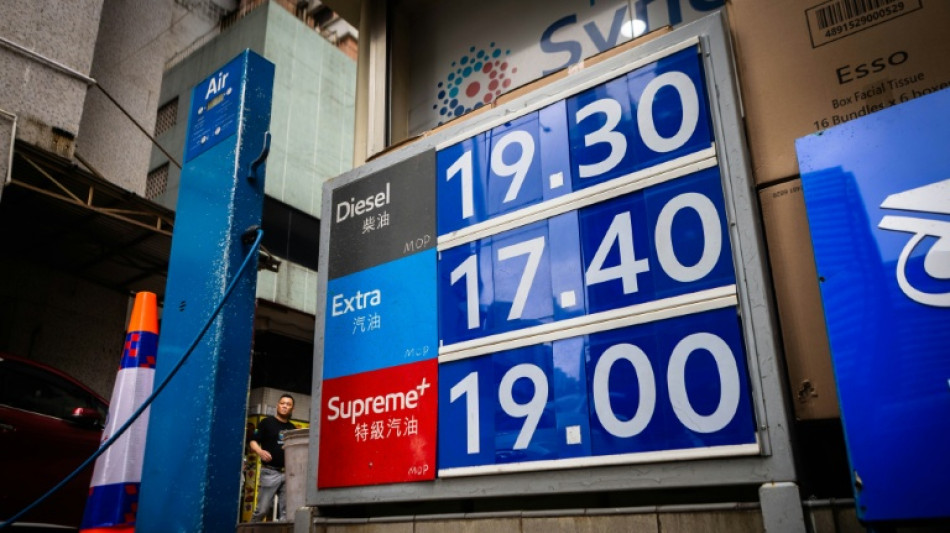
Asia to be hit hardest by Iran war energy crisis: Kpler to AFP / Photo: Eduardo Leal - AFP/File

 Oversight Board blasts 'inadequate' Meta safeguards for AI deepfakes

 Harry makes first public appearance since return to UK

 Princess Diana's brother makes new explosive claims against Charles

 Trump admin overhauls key protection for endangered species

 Mbappe draws political fire over Ceuta t-shirt controversy

 Third malaria death in Germany from outbreak tied to Frankfurt airport

 AtlasClear Holdings Reports Preliminary Fiscal 2026 Revenue of Approximately $20.1 Million, Up 85%; Revenue Plus Interest Income of Approximately $21.9 Million

 'Another arrow to the quiver': World Bank posts record private capital mobilization

 Ireland to boycott Eurovision 2027 over Gaza

 India's Tata Sons reappoints N. Chandrasekaran as chairman

 Germany urges EU action against China to defend carmakers

 Japan eyes changing prostitution law to punish sex buyers

 Modi pitches India as global chipmaking hub

 Ukraine plans record defence spending in 2027

 NASA scan discovers new, 'once in a century' Moon crater

 Most stocks rise as Fed hikes and indicates drive to curb inflation

 UK-Sudanese author pens book to give children 'African history of Africa'

 Argentine judge orders suspension of Falklands oil project

 US Fed raises rates to tackle 'too high' inflation, irking Trump

 Turkey releases 106 protesters, jails more LGBTQ activists

 Candidate for UN chief calls for AI regulation akin to nuclear weapons

 'We're losing control,' AI pioneer Yoshua Bengio tells AFP

 IR-MED and Dice Technologies Announce collaboration to Evaluate and Advance Pressure-Injury Prevention Platform in Japan

 Watts, Pitt, Cruz to light up Spain's top film festival

 Toogood Gold's Table Mountain Sits in the Shadow of a Nevada Gold Rush

Asian nations are facing a major energy crisis as a result of the Iran war, with a sharp fall in crude shipments and few alternatives, global maritime analytics firm Kpler told AFP on Tuesday.
"We think Asia will, for now, be the ones suffering the most," Kpler president Jean Maynier told AFP in an interview at the company's offices in Singapore.
The war, which began with US-Israeli strikes on Iran on February 28, saw Tehran effectively halt traffic through Strait of Hormuz, through which a fifth of the world's crude supplies and a substantial amount of gas normally run.
This has sent shockwaves across global energy markets, leading to price hikes for consumers worldwide.
Maynier said Asia did not have enough energy resources of its own to fill the gap "in China... in big countries like the Philippines or Indonesia. So it's a real energy crisis."
The impact of the de facto closure of the Strait of Hormuz has already led governments to take exceptional measures, like the Philippines which has declared a national energy emergency, Maynier noted.
"It's really bad for Asia and we are not optimistic if the event continues," he said.
- 'No crude' -
"There is almost no crude oil arriving" in Asia currently, and no viable alternatives to energy imports from the Middle East while "inventories are being depleted", Maynier said.
He said that while the attack on Iran had been anticipated, its timing and the duration of the war that has ensued were surprising.
"What is surprising is the length of this event and, especially in Asia, the crisis that we have now with energy."
Brussels-based Kpler, which was founded in 2014 and owns the MarineTraffic website, is considered one of the foremost data analytics and ship-tracking agencies in the world.
It has been keeping a close eye on the Strait of Hormuz since the attack on Iran.
Iranian military officials have claimed to control the waterway and attack vessels from "hostile" nations, but Kpler said some are risking the trip.
Seventeen commodities vessels crossed the the strait over the weekend, 12 of them on Saturday, making it one of the busiest days for crossings since March 1, according to Kpler.
As of 1700 GMT on Monday, commodities vessels had made just 196 crossings of the waterway this month, a huge decrease from before the war.
Of those, 120 were by oil tankers and gas carriers and most were travelling east out of the strait.
- 'Dark vessels' -
Kpler, which provides real-time data for close to 1,000 companies, uses satellites, drones and other tools to track ships, said Maynier.
"All of this combined, and the selection of data sets that we collect from different partnerships help us to really understand what's happening" including when ships "go dark", he added.
A "dark" vessel -- usually a tanker or cargo carrier -- deliberately disables or manipulates transponders in a bid to go undetected by public tracking systems like Kpler's MarineTraffic.
"Dark vessels try to switch off their (tracking) device and try to escape monitoring, usually because they are involved in smuggling or trying to export sanctioned cargoes," Maynier said.
Using satellite images, shore-based antennae, data and other sources, Kpler aims to reconstruct the trajectory of a vessel that has "gone dark," he added.
"It's always hard to be 100 percent, but we can detect more than 90 percent of what's happening in real time."
St.Ch.Baker--CPN