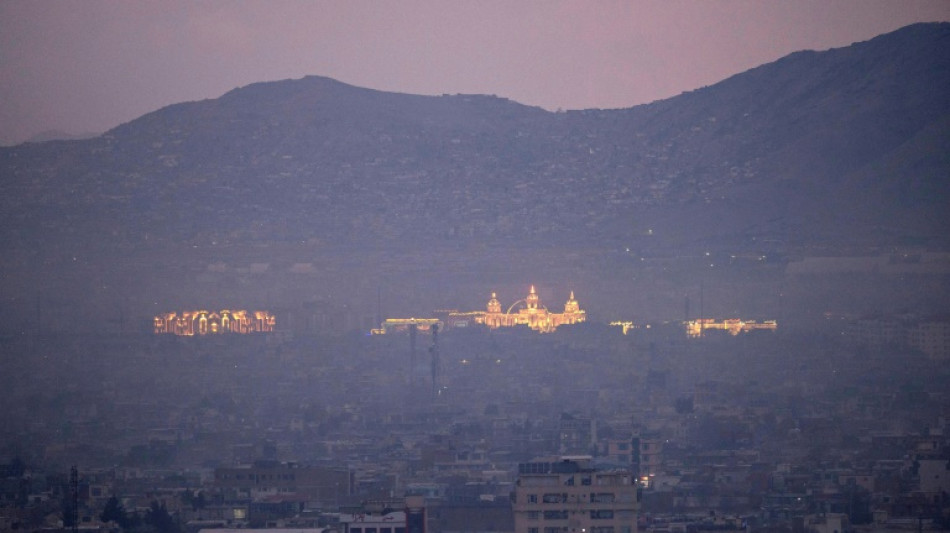
Afghan wedding halls light up sombre Kabul nights / Photo: Wakil KOHSAR - AFP

 Kenya's economy faces climate change risks: World Bank

 World stocks mostly slide, consolidating Fed-fuelled gains
 UK's king shares 'good news' that cancer treatment will be reduced in 2026

 Salah admired from afar in his Egypt home village as club tensions swirl
 Iran frees child bride sentenced to death over husband's killing: activists
 France updates net-zero plan, with fossil fuel phaseout
 EU agrees recycled plastic targets for cars

 British porn star fined, faces imminent Bali deportation
 Indonesia floods were 'extinction level' for rare orangutans
 Japan bear victim's watch shows last movements
 French indie 'Clair Obscur' dominates Game Awards
 Asian markets track Wall St record after Fed cut

 Vaccines do not cause autism: WHO
 'In her prime': Rare blooming of palm trees in Rio

 OpenAI beefs up GPT models in AI race with Google

 Cyclone causes blackout, flight chaos in Brazil's Sao Paulo

 US bringing seized tanker to port, as Venezuela war threats build

 Time magazine names 'Architects of AI' as Person of the Year

 OpenAI, Disney to let fans create AI videos in landmark deal
 Thyssenkrupp pauses steel production at two sites citing Asian pressure
 Stocks mixed as US rate cut offset by Fed outlook, Oracle earnings
 Breakout star: teenage B-girl on mission to show China is cool
 Austria set to vote on headscarf ban in schools
 AI's $400 bn problem: Are chips getting old too fast?

 US stocks rise, dollar retreats as Fed tone less hawkish than feared

As night settles over Afghanistan's capital, only a few small lights and neon signs pierce the darkness and thick blanket of winter pollution.
But on some street corners, glittering colossal wedding halls loomout of the gloom, a rare display of opulence in the Afghan capital.
The city of more than six million people is often plunged into shadow due to ubiquitous power outages, whichonly the wealthiest can remedy with expensive generators or solar panels.
Apart from a few vendors, the streets are deserted, a stark contrast with the chaotic hustle of the daytime.
People huddle at home to shelter from the cold and for lack of nighttime activities.
Since the Taliban took power in 2021 and imposed their strictversion of Islamic law, a veil of sadness has enveloped the capital.
There is no music spilling out from restaurants because it is forbidden, women are banned from parks, and walls decorated with colourful pro-peace graffiti have been splashed with calls to holy war.
The only bright lights emanate from the wedding halls that dot the city centre and escape some of the Taliban's scrutiny, as marriage is prized in Afghan culture.
The high-ceilinged halls are segregated by gender, with music only tolerated on the women's side.
"In Afghanistan, the marriage ceremony is the most important event for girls and boys. It's a once-in-a-lifetime event -- we don't have much divorce," said Mohammad Wassil Qaumi, director of the Imperial Continental, a palatial white-and-gold hall that shines with a glitz reminiscent of a Las Vegas casino.
"It's the start of a new life so the light should be everywhere, that's why the city is bright, it should have a little bit of luxury!" he told AFP.
- 'Weddings are a necessity' -
Bunches of plastic flowers, throne-style sofas, gilded trimming and neon lights fill the complex's four halls, some of which can accommodate up to 7,000 guests.
Qaumi, 32, says he spends $25,000 to $30,000 per month for municipal electricity, which provides a few hours of power per day.
To keep the lights on, he also pays just under $15,000 for generators.
To recoup his costs, he charges up to $20,000 for a wedding, in a country where 85 percent of the population lives on less than a dollar a day, according to the United Nations Development Programme.
"Weddings are a necessity in the Afghan culture, you have to invite more and more people" even if it means going into debt, said Haji Safiullah Esmafi, owner of the Stars Palace hall.
In another district of the capital, the City Star welcomes its guests with a beige and gold facade topped with three sculpted domes and a huge sparkling arch out front.
"Electricity is very expensive," admits the owner, 24-year-old Siyer Paiman.
But, he added, "people in Afghanistan like bright colours".
- 'Brightness of the city' -
He has invested in solar panels and spends the equivalent of $12,000 to $19,900 on generators and electricity, which only covers six to seven hours a day, "and not always at night".
Afghanistan depends on its Central Asian neighbours for imported electricity.
With the hopes of increasing supply, the country is involved in several regional interconnection projects, but progress is slow.
"The current demand in Afghanistan is about 7,000 to 8,000 megawatts but they currently produce locally about 1,000 megawatts and import the rest from Central Asia," a sector expert who asked for anonymity told AFP, adding that renewable energy sources should be developed but that funding was lacking.
Power cuts also affect heating, with temperatures easily dropping below 0 degrees Celsius (32 degrees Fahrenheit).
Kabul's residents use stoves, burning almost anything from coal and wood to plastic or household waste, creating a fog of pollution in the city slung between mountains 1,800 metres (5,900 feet) above sea level.
In the nighttime gloom, wedding halls are "the brightness of the city", said Qaumi. "Here, everyone is very happy."
"People come here to meet friends and family, (they) wear new clothes, jewellery... showing off so much," he said of patrons enjoying one of the only places left in Kabul where this is still possible.
X.Cheung--CPN