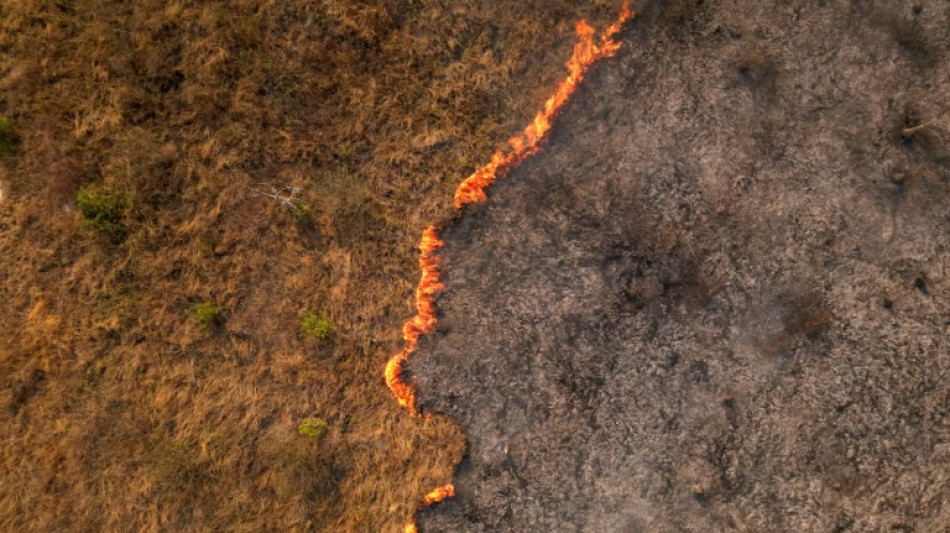
'Breathing smoke': Brazil's Pantanal wetlands hit by record fires / Photo: Florian PLAUCHEUR - AFP

 Kenya's economy faces climate change risks: World Bank

 Far right and far left battle for power in polarised Berlin

 The last trio: S.Africa's zoo elephants await their fate

 Oil industry sees war windfall but girds for political blowback

 Amazon beats expectations with cloud and AI growth

 Blowout Microsoft results lift US stocks as oil retreats

 'Beginning of the end': Relief but no party as French wildfire winds down

 Southern Europe 'becoming more flammable' in hotter climate, experts say

 Mammoth bones found on parched bed of Danube in Bulgaria

 MEXC Lists Grvt (GRVT) with $60,000 Worth of GRVT and 10,000 USDT in Airdrop+ Rewards

 George and Amal Clooney flee French home due to wildfire

 MEXC Ventures Supports Alpha Arena's APAC Debut at Coinfest Bali

 AI data centre supplier Zhongji InnoLight slips on Hong Kong debut

 May, June heatwaves caused 2,877 extra deaths in England: govt

 BMW profit down a third as carmaker plans job cuts

 Seoul extends losses as most Asian markets drop, oil rises again

 Gambling.com Group Is Now Grandstand

 Meet the astronomer digging into the Milky Way's 'fossils'

 AI data centre supplier Zhongji InnoLight falls on Hong Kong debut

 Samsung operating profit up 1,800% in second quarter on AI boom

 Japanese population below 120 million for first time in decades

 US actor Jared Leto denies latest accusations of sexual assault

 Danube drops to 'historic lows' as fresh heatwave hits

 BTS pulls out of Grammys after Asian pop category introduction

 OpenAI says rogue AI agent attack hit other companies

Erica Cristina has been "breathing in smoke every day" since a large fire broke out across the river from the city of Corumba, the gateway to Brazil's Pantanal, the world's largest tropical wetlands.
The blaze, which filled the bar she owns with soot, is one of hundreds burning in the vast, wildlife-rich Pantanal which is experiencing record fires for this time of year.
"It's chaotic," the 44-year-old told AFP in central-western Corumba, where the fire last week turned the sky bright red.
Originally from Rio de Janeiro, this long-time resident of the Pantanal region said increasing fires were making the situation for residents "worse with the passing of the years."
"Many people lost their homes" in fires since 2020 -- the worst year on record for blazes in the region -- and "the main problems are due to health, respiratory problems," said Cristina.
In the first half of this year, satellites recorded more than 3,300 fires in the region slightly bigger than England, 33 percent more than in 2020.
Experts say that the blazes result from harsh drought linked to climate change and deliberate fires set to expand agricultural land into the forest burning out of control.
The Pantanal, which extends into Bolivia and Paraguay, is home to millions of caimans, parrots, giant otters and the world's highest density of jaguars.
Seasonal flooding across plains, marshes, savannahs and forest areas during the rainy season is crucial to the biodiverse ecosystem.
Environment Minister Marina Silva warned on Monday that the Pantanal was facing "one of the worst situations ever seen."
"We did not have the usual floods or the gap between El Nino and La Nina," two weather phenomena that affect rainfall, she said.
A study published on Wednesday by the MapBiomas network said the wet surface of the Pantanal was 61 percent drier than the historical average last year.
The drought "caused a large amount of organic matter at the combustion point to cause these fires," said Silva, who will visit the region on Friday.
- 'Lost in the flames' -
The fires are hitting new records even before the peak of the dry season.
"Strong winds, the fire and the heat usually start in August," but "it hasn't rained in the region for 50 days," Bruno Bellan, a 25-year-old rancher, told AFP.
Bellan has 900 head of cattle on his family farm in Mato Grosso do Sul State, home to much of the wetlands, which declared a state of emergency over the fires on Monday.
His property is two kilometers (1.2 miles) from one large blaze which firefighters have struggled to access.
"We are worried that the fire will enter the farm and cause destruction. The cattle are afraid and could get lost in the flames," said Bellan.
Retired soldier Naldinei Ivan Ojeda, 53, said he was considering leaving his hometown due to the breathing problems he and his 15-year-old son have experienced.
He points the blame squarely at the people who start the fires, rather than the dry conditions that spur them along.
"There are no accidental fires in the Pantanal. I have never seen a fire come out of nowhere here. Every year, it is the same."
O.Ignatyev--CPN