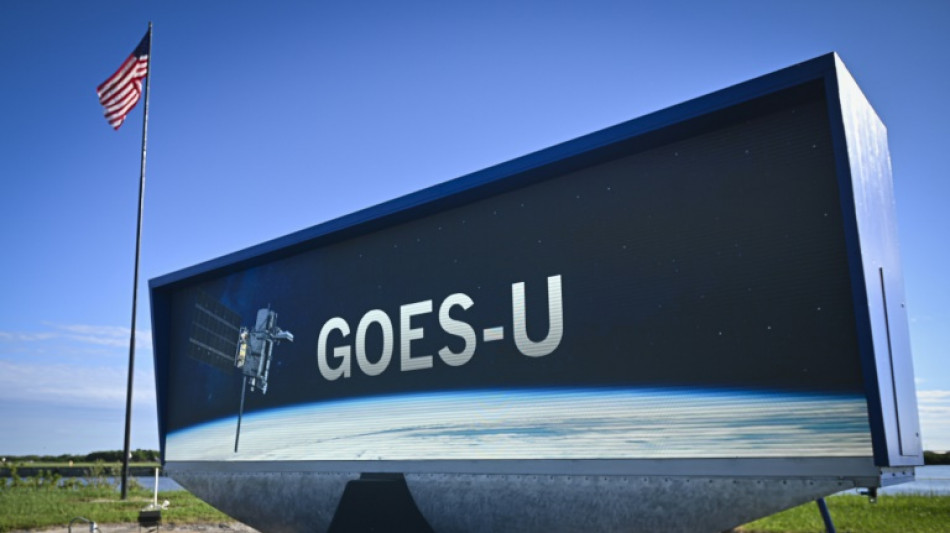
US launches satellite to better prepare for space weather / Photo: Miguel J. Rodriguez Carrillo - AFP

 Kenya's economy faces climate change risks: World Bank

 Far right and far left battle for power in polarised Berlin

 The last trio: S.Africa's zoo elephants await their fate
 Oil industry sees war windfall but girds for political blowback

 Amazon beats expectations with cloud and AI growth

 Blowout Microsoft results lift US stocks as oil retreats

 'Beginning of the end': Relief but no party as French wildfire winds down

 Southern Europe 'becoming more flammable' in hotter climate, experts say

 Mammoth bones found on parched bed of Danube in Bulgaria

 MEXC Lists Grvt (GRVT) with $60,000 Worth of GRVT and 10,000 USDT in Airdrop+ Rewards

 George and Amal Clooney flee French home due to wildfire

 MEXC Ventures Supports Alpha Arena's APAC Debut at Coinfest Bali

 AI data centre supplier Zhongji InnoLight slips on Hong Kong debut

 May, June heatwaves caused 2,877 extra deaths in England: govt

 BMW profit down a third as carmaker plans job cuts

 Seoul extends losses as most Asian markets drop, oil rises again

 Gambling.com Group Is Now Grandstand

 Meet the astronomer digging into the Milky Way's 'fossils'

 AI data centre supplier Zhongji InnoLight falls on Hong Kong debut

 Samsung operating profit up 1,800% in second quarter on AI boom

 Japanese population below 120 million for first time in decades

 US actor Jared Leto denies latest accusations of sexual assault

 Danube drops to 'historic lows' as fresh heatwave hits

 BTS pulls out of Grammys after Asian pop category introduction

 OpenAI says rogue AI agent attack hit other companies

The United States on Tuesday launched a new satellite expected to significantly improve forecasts of solar flares and coronal mass ejections -- huge plasma bubbles that can crash into Earth, disrupting power grids and communications.
A SpaceX Falcon Heavy rocket carrying the satellite into orbit took off from NASA's Kennedy Space Center in Florida at 5:26 pm (2126 GMT), the US space agency announced.
The GOES-U (Geostationary Operational Environmental Satellite U) mission is a collaboration between NASA and the National Oceanic and Atmospheric Administration (NOAA).
It will be the fourth and final in a series of satellites that have tracked hurricanes and tornadoes, monitored climate and sea surface temperature, air quality and even meteor detections since 2016.
Orbiting 22,236 miles (35,785 kilometers) above the equator, the satellites match the speed of Earth's rotation in order to hold their positions over specific regions and provide continuous coverage.
They "are an indispensable tool for protecting the United States and the one billion people who live and work in the Americas," NOAA's Pam Sullivan told a press conference.
GOES-U is the first of the four to include a coronagraph, called the Compact Coronagraph-1 (CCOR-1). Coronagraphs block the Sun's disk and allow observation of its outermost layer, called the corona.
"That allows us to observe large explosions off the sun, called coronal mass ejections that can hurtle billions of tons of matter at millions of miles per hour towards Earth," said Elsayed Talaat, in charge of space weather observations at NOAA.
The ejections, known as CMEs, can disrupt Earth's magnetic field, causing satellites, energy infrastructure, and navigation systems to go down. Collecting space weather data allows authorities to issue warnings one to four days in advance.
In early May, the planet experienced its first level 5 geomagnetic storm in two decades, the highest rating on the scale, which unleashed spectacular auroras worldwide.
With the new coronagraph, the speed and direction of this event could have been better understood from the start, said Talaat.
Major disruptions weren't felt, but some farmers "reported being unable to plant their crops because the precision GPS relied upon by their equipment had malfunctioned," he said.
For the first time, the United States will have a coronagraph observing the solar corona almost continuously, with the CCOR-1 taking readings every 30 minutes.
Currently, such observations are received with a delay of up to eight hours. They are carried out by a satellite launched in 1995, which should cease operating within two years.
"Once operational CCOR-1 will mark a new chapter in space weather observations," said Talaat.
"Although the sun is no more active than in previous generations, our society has changed, and we are more sensitive than ever to the sun's changing mood."
M.Anderson--CPN