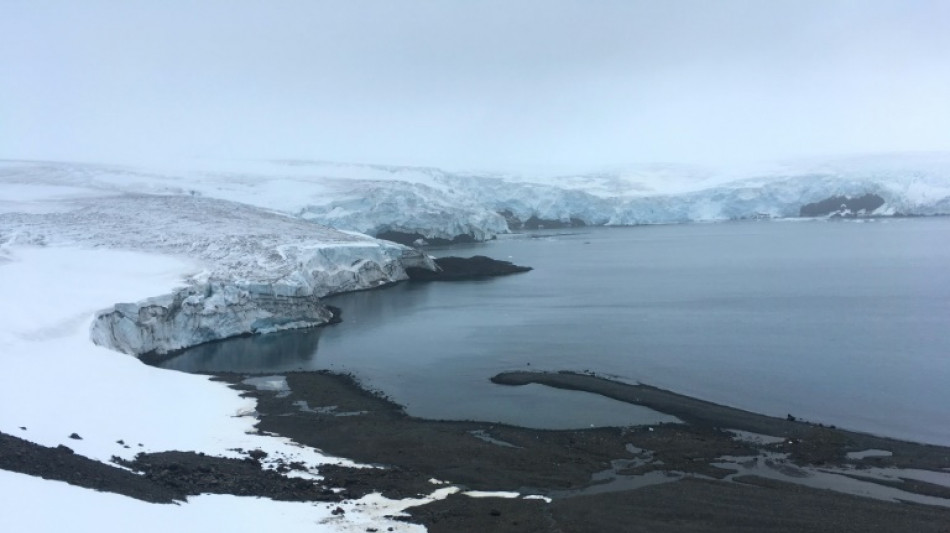
Antarctic faces melting 'tipping point' as oceans warm: study / Photo: Mathilde BELLENGER - AFP/File

 Kenya's economy faces climate change risks: World Bank

 Far right and far left battle for power in polarised Berlin

 The last trio: S.Africa's zoo elephants await their fate

 Oil industry sees war windfall but girds for political blowback

 Amazon beats expectations with cloud and AI growth

 Blowout Microsoft results lift US stocks as oil retreats

 'Beginning of the end': Relief but no party as French wildfire winds down

 Southern Europe 'becoming more flammable' in hotter climate, experts say

 Mammoth bones found on parched bed of Danube in Bulgaria

 MEXC Lists Grvt (GRVT) with $60,000 Worth of GRVT and 10,000 USDT in Airdrop+ Rewards

 George and Amal Clooney flee French home due to wildfire

 MEXC Ventures Supports Alpha Arena's APAC Debut at Coinfest Bali

 AI data centre supplier Zhongji InnoLight slips on Hong Kong debut

 May, June heatwaves caused 2,877 extra deaths in England: govt

 BMW profit down a third as carmaker plans job cuts

 Seoul extends losses as most Asian markets drop, oil rises again

 Gambling.com Group Is Now Grandstand

 Meet the astronomer digging into the Milky Way's 'fossils'

 AI data centre supplier Zhongji InnoLight falls on Hong Kong debut

 Samsung operating profit up 1,800% in second quarter on AI boom

 Japanese population below 120 million for first time in decades

 US actor Jared Leto denies latest accusations of sexual assault

 Danube drops to 'historic lows' as fresh heatwave hits

 BTS pulls out of Grammys after Asian pop category introduction

 OpenAI says rogue AI agent attack hit other companies

Scientists have discovered a new tipping point toward "runaway melting" of Antarctic ice sheets, caused by warm ocean water intruding between the ice and the land it sits on, according to a study published on Tuesday.
While this type of melting has been previously studied, models used by the United Nation's Intergovernmental Panel on Climate Change (IPCC) to project the impact of global warming on the Antarctic have yet to factor in this phenomenon.
They have also systematically underestimated ice loss seen thus far, said the study, published in the journal Nature Geoscience.
As ocean temperatures rise due to human-caused global warming, Antarctic ice sheets are melting, threatening a rise in global sea levels and putting coastal communities at risk.
"Increases in ocean temperature can lead to a tipping point being passed, beyond which ocean water intrudes in an unbounded manner beneath the ice sheet, via a process of runaway melting," the study said.
Antarctic ice sheets sit atop the bedrock and extend beyond the coast to float on the sea.
Previous studies have shown that warm seawater is seeping into the "grounding zone" -- where land and ice meet -- and further inland from under the floating ice.
As the water warms, even by a fraction, the intrusion accelerates from short distances of 100 metres (330 feet) to tens of kilometres (miles), melting ice along the way by heating it from below, explained the study's lead author Alexander Bradley.
"Every 10th of a degree (of warming) makes these kind of processes closer, these tipping points closer," said Bradley, a researcher with the British Antarctic Survey.
The risk to sea-level rise comes when the accelerated melting outpaces the formation of new ice on the continent.
Some areas of Antarctica are more vulnerable to this process than others due to the shape of the land mass, which has valleys and cavities where sea water can pool beneath the ice.
The Pine Island glacier, currently Antarctica's largest contributor to sea-level rise, is at high risk of melting due to the slope of the land that allows in more sea water, the study said.
Scientific models need to be updated to take into account the element of melt to better predict the risk of sea-level rise in the future and prepare for it, Bradley said.
"And it really just stresses the need for urgent climate action in order to prevent these tipping points from being passed," he added.
C.Peyronnet--CPN