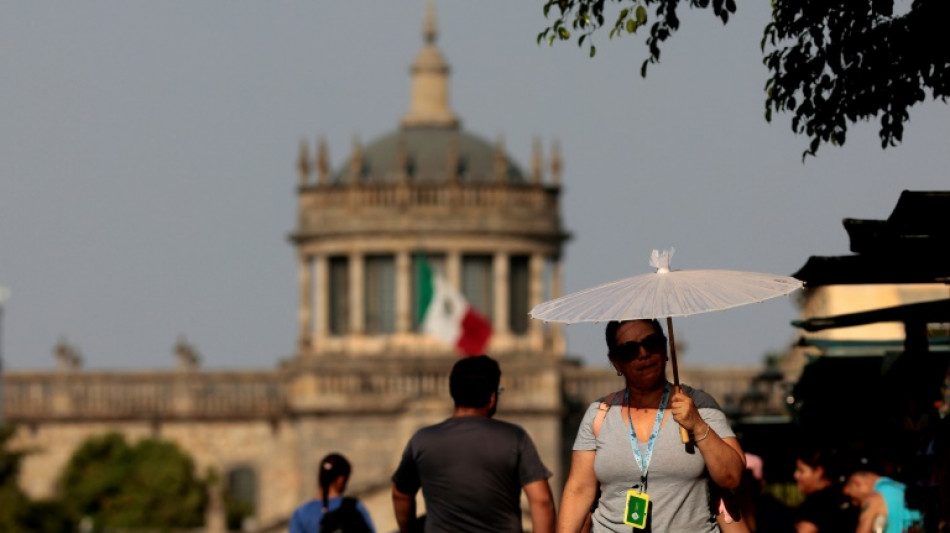
Climate change made deadly heat 35x more likely in US, Mexico, C. America / Photo: ULISES RUIZ - AFP/File

 Kenya's economy faces climate change risks: World Bank
 Far right and far left battle for power in polarised Berlin

 The last trio: S.Africa's zoo elephants await their fate
 Oil industry sees war windfall but girds for political blowback

 Amazon beats expectations with cloud and AI growth

 Blowout Microsoft results lift US stocks as oil retreats

 'Beginning of the end': Relief but no party as French wildfire winds down

 Southern Europe 'becoming more flammable' in hotter climate, experts say

 Mammoth bones found on parched bed of Danube in Bulgaria

 MEXC Lists Grvt (GRVT) with $60,000 Worth of GRVT and 10,000 USDT in Airdrop+ Rewards
 George and Amal Clooney flee French home due to wildfire

 MEXC Ventures Supports Alpha Arena's APAC Debut at Coinfest Bali

 AI data centre supplier Zhongji InnoLight slips on Hong Kong debut

 May, June heatwaves caused 2,877 extra deaths in England: govt
 BMW profit down a third as carmaker plans job cuts

 Seoul extends losses as most Asian markets drop, oil rises again

 Gambling.com Group Is Now Grandstand

 Meet the astronomer digging into the Milky Way's 'fossils'

 AI data centre supplier Zhongji InnoLight falls on Hong Kong debut

 Samsung operating profit up 1,800% in second quarter on AI boom

 Japanese population below 120 million for first time in decades

 US actor Jared Leto denies latest accusations of sexual assault

 Danube drops to 'historic lows' as fresh heatwave hits

 BTS pulls out of Grammys after Asian pop category introduction

 OpenAI says rogue AI agent attack hit other companies

Deadly heat that blanketed the United States, Mexico and Central America recently was made 35 times more likely due to global warming, an international network of climate scientists said on Thursday.
The World Weather Attribution (WWA) group of scientists also said that extreme highs witnessed over that region in May and June were four times as likely to occur today as a quarter of a century ago.
The record-breaking heat killed at least 125 people in Mexico and caused thousands more to suffer heat strokes, a potentially fatal condition that occurs when the body's internal cooling mechanisms start to fail.
"We likely do not know the full picture of heat-related deaths, since they are usually only confirmed and reported months after the event, if at all," said WWA, which uses peer-reviewed methods to assess links between specific extreme events and global warming.
They said that as the world continues to burn fossil fuels and emit climate-heating greenhouse gases into the atmosphere, millions more people are expected to be exposed to dangerous levels of heat in the future.
This year has been the hottest on record and already large swathes of the world have endured blistering temperatures before the onset of the northern hemisphere summer.
Greece has notched its earliest-ever heatwave, India has suffered a month-long stretch of searing highs, while the United States is dealing with wildfires and scorching conditions.
And in Saudi Arabia, at least 900 people died during the annual hajj pilgrimage, mostly from unforgiving heat with temperatures in Mecca hitting 51.8 degrees Celsius (125 degrees Fahrenheit) on Monday.
- 'Between life and death' -
For its study, WWA analysed the hottest five consecutive days and nights during a "heat dome" that lingered over the southwest United States, Mexico, Guatemala, Belize, El Salvador and Honduras in late May and early June.
The scientists have pioneered ways to use climate models to understand how these types of extreme events have changed in a world that is 1.2 degrees Celsius warmer than in pre-industrial times.
They concluded "that human-induced warming from burning fossil fuels made the five-day maximum temperature event about 1.4 degrees hotter and about 35 times more likely".
WWA warned that if humans continue burning fossil fuels in the near term, these extremes could become more frequent still.
"The additional 1.4C of heat caused by climate change would have been the difference between life and death for many people during May and June," said Karina Izquierdo, urban advisor for the Latin American and Caribbean region at Red Cross Climate Centre.
"As well as reducing emissions, governments and cities need to take steps to become more resilient to heat," she said in a statement.
Heat is the deadliest of all extreme weather but often underestimated, experts say, with children, the elderly and outdoor workers particularly vulnerable.
In Mexico and Central America, the impacts of heat are intensified by poor housing conditions, limited access to cooling services, and for those living in informal settlements.
Extreme heat also threatens the stability of electricity supply, which is critical to the functioning of healthcare facilities.
Scientists said that extreme heat warming systems and action plans could help bolster Central America's preparedness for such events, with safety measures needed to protect outdoor workers.
Green spaces and improved infrastructure in informal settlements would also help protect the most vulnerable people, WWA added.
C.Smith--CPN