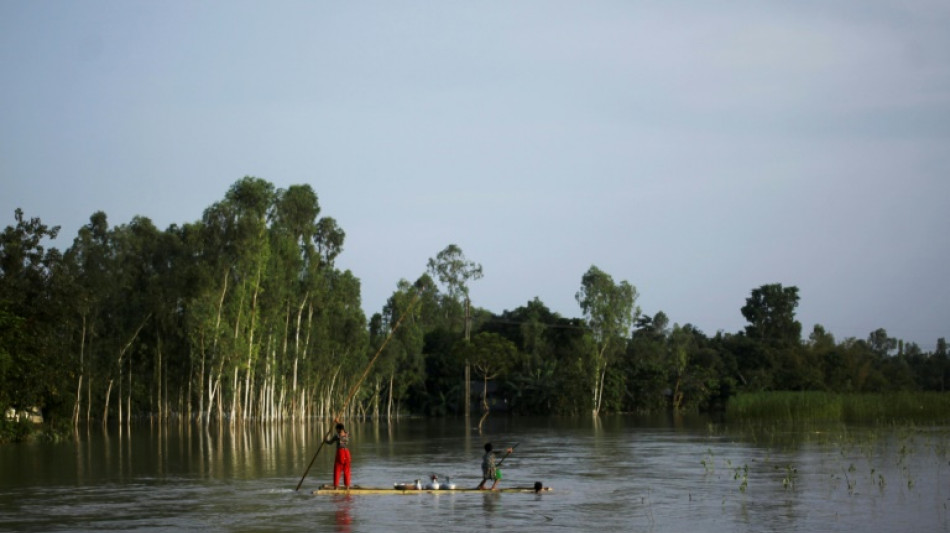
Landslides kill nine as Bangladesh lashed by rain / Photo: STR - AFP

 Kenya's economy faces climate change risks: World Bank

 Far right and far left battle for power in polarised Berlin

 The last trio: S.Africa's zoo elephants await their fate

 Oil industry sees war windfall but girds for political blowback

 Amazon beats expectations with cloud and AI growth

 Blowout Microsoft results lift US stocks as oil retreats

 'Beginning of the end': Relief but no party as French wildfire winds down

 Southern Europe 'becoming more flammable' in hotter climate, experts say

 Mammoth bones found on parched bed of Danube in Bulgaria

 MEXC Lists Grvt (GRVT) with $60,000 Worth of GRVT and 10,000 USDT in Airdrop+ Rewards

 George and Amal Clooney flee French home due to wildfire

 MEXC Ventures Supports Alpha Arena's APAC Debut at Coinfest Bali

 AI data centre supplier Zhongji InnoLight slips on Hong Kong debut

 May, June heatwaves caused 2,877 extra deaths in England: govt

 BMW profit down a third as carmaker plans job cuts

 Seoul extends losses as most Asian markets drop, oil rises again

 Gambling.com Group Is Now Grandstand

 Meet the astronomer digging into the Milky Way's 'fossils'

 AI data centre supplier Zhongji InnoLight falls on Hong Kong debut

 Samsung operating profit up 1,800% in second quarter on AI boom

 Japanese population below 120 million for first time in decades

 US actor Jared Leto denies latest accusations of sexual assault

 Danube drops to 'historic lows' as fresh heatwave hits

 BTS pulls out of Grammys after Asian pop category introduction

 OpenAI says rogue AI agent attack hit other companies

Torrential rains in Bangladesh have triggered landslides burying alive at least nine people and forcing thousands to flee to higher ground, police and government officials in the low-lying nation said Wednesday.
Schools have been turned into shelters for those abandoning their homes to rising river waters, while more than a million people have been stranded in northern areas.
Bangladesh, a nation of around 170 million people, is among the countries most vulnerable to disasters and climate change, according to the Global Climate Risk Index.
The annual monsoon rains cause widespread destruction every year, but experts say climate change is shifting weather patterns and increasing the number of extreme weather events.
"At least 700,000 people have been stranded by flash floods and heavy rains in Sylhet district, and another 500,000 people in neighbouring Sunamganj district," Abu Ahmed Siddique, commissioner of Bangladesh's northeastern Sylhet district, told AFP.
Those killed in landslides were in the southeastern Cox's Bazar district.
Eight were Rohingya refugees from neighbouring Myanmar, and the other was from Bangladesh, said Amir Jafar, a police official in command of security in the camps.
- 'Buried under the mud' -
"They were sleeping in their shelters when heavy rains overnight triggered the landslides in five spots of the camps," Jafar told AFP. "They were buried under the mud."
He said hundreds of refugees had been moved from areas deemed at risk.
"The rain is still going on," he said.
About one million Rohingya live in makeshift shelters of bamboo and tarpaulins in dozens of scattered camps cut out of cleared forest land on the slopes of small hills, where landslides are a regular threat.
In Sylhet, lashing rain and rivers swollen by flooding upstream in India also swamped heavily populated areas.
"More than 17,000 people have been taken to shelters only in Sylhet district," senior local government official Sheikh Russel Hasan said, warning rivers were still rising.
Much of Bangladesh is made up of deltas as the Himalayan rivers of the Ganges and Brahmaputra slowly wind towards the sea.
Floods in 2022 in Sylhet were some of the worst on record, leaving millions stranded and around a hundred killed.
Towhidul Islam, chief administrative officer of Gowainghat, part of Sylhet, said the river had risen two centimetres (0.7 inches) in the first three hours after dawn.
"If the rain and water level continues to increase, the situation will get worse, like 2022", Islam told AFP.
X.Cheung--CPN