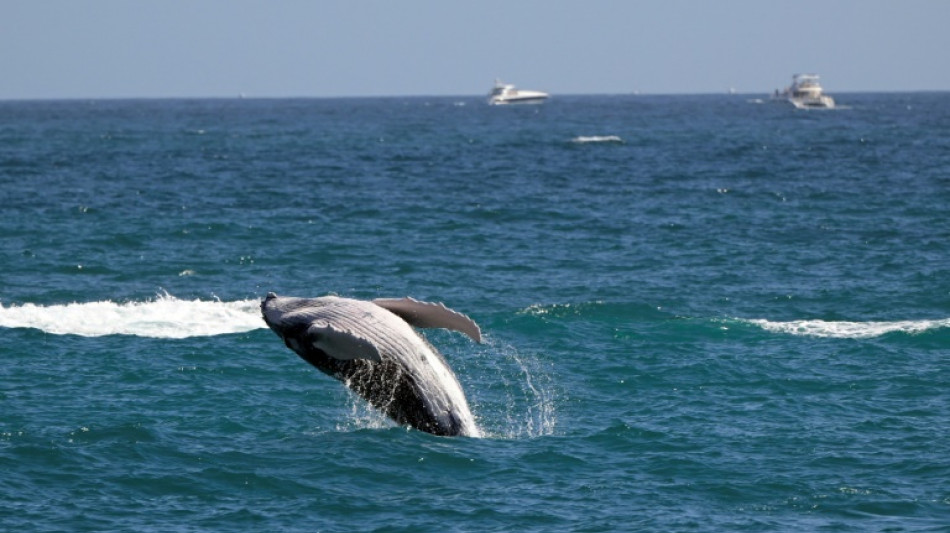
Gray whales shrinking fast as climate warms / Photo: ALFREDO ESTRELLA - AFP/File

 Kenya's economy faces climate change risks: World Bank

 Far right and far left battle for power in polarised Berlin

 The last trio: S.Africa's zoo elephants await their fate

 Oil industry sees war windfall but girds for political blowback

 Amazon beats expectations with cloud and AI growth

 Blowout Microsoft results lift US stocks as oil retreats

 'Beginning of the end': Relief but no party as French wildfire winds down

 Southern Europe 'becoming more flammable' in hotter climate, experts say

 Mammoth bones found on parched bed of Danube in Bulgaria

 MEXC Lists Grvt (GRVT) with $60,000 Worth of GRVT and 10,000 USDT in Airdrop+ Rewards

 George and Amal Clooney flee French home due to wildfire

 MEXC Ventures Supports Alpha Arena's APAC Debut at Coinfest Bali

 AI data centre supplier Zhongji InnoLight slips on Hong Kong debut

 May, June heatwaves caused 2,877 extra deaths in England: govt

 BMW profit down a third as carmaker plans job cuts

 Seoul extends losses as most Asian markets drop, oil rises again

 Gambling.com Group Is Now Grandstand

 Meet the astronomer digging into the Milky Way's 'fossils'

 AI data centre supplier Zhongji InnoLight falls on Hong Kong debut

 Samsung operating profit up 1,800% in second quarter on AI boom

 Japanese population below 120 million for first time in decades

 US actor Jared Leto denies latest accusations of sexual assault

 Danube drops to 'historic lows' as fresh heatwave hits

 BTS pulls out of Grammys after Asian pop category introduction

 OpenAI says rogue AI agent attack hit other companies

Pacific coast gray whales have shrunk in length an astonishing 13 percent since 2000, adding to evidence that climate change and other human activities are making marine mammals smaller, a study says.
Their diminished size could have big impacts on survival rates and reproductive success -- and trigger ripple effects throughout their entire food webs.
For the paper, researchers focused on the Pacific Coast Feeding Group (PCFG) -- around 200 whales that are part of the wider Eastern North Pacific (ENP) population of around 14,500.
Considered "ecosystem sentinels," they stay closer to shore, feeding in shallower, warmer waters, than the wider population that inhabits colder, deeper Arctic seas. Prior research had shown they are in worse shape than their counterparts, with smaller bodies, heads and flukes.
"Now we know they have been shrinking in body size over the past 20-40 years, which may be an early warning sign that the population is at risk of declining," Kevin Bierlich, an assistant professor at Oregon State University and co-author of the paper in Global Change Biology, told AFP on Thursday.
By analyzing drone images taken from 2016-2022 of 130 individuals whose age was estimated or known, the scientists found a striking trend: a gray whale born in 2020 is likely to reach a full-grown adult length of approximately 1.65 meters (5ft 5in) less than a counterpart born in 2000.
This represents a significant 13 percent decrease in the total length of mature gray whales, which typically measure between 38-41 feet in length.
Notably, the decline was more pronounced in females, who historically exceeded males in size but are now comparable.
It would be the equivalent of seeing the average height of an American woman plummeting from 5ft 4in to 4ft 8in over two decades.
- Size matters -
"In general, size is critical for animals," said Enrico Pirotta, lead author on the study and a researcher at the University of St. Andrews in Scotland.
"It affects their behavior, their physiology, their life history, and it has cascading effects for the animals and for the community they're a part of."
Smaller whale calves may have lower survival rates when they stop weaning, while for adults, the major concern is reproductive success.
The species relies on energy reserves stored during the feeding season to support the demands of migration and reproduction during winter -- and the question arises whether they are able to put enough energy towards reproduction and keeping the population growing.
Importantly, the study found the trend was correlated with changes to the balance of "upwelling" and "relaxation" cycles of the ocean.
Upwelling transports nutrients from deeper waters to shallower areas. During relaxation periods, these nutrients remain in the shallower zones, where light enables plankton and other small species that whales feed on to grow.
Climate change is known to be an important factor affecting the dynamics of this delicate balance, through changes in wind patterns and water temperature.
A smaller stature may not only hinder whales' ability to thrive, but also increase their vulnerability to threats such as collisions with boats and entanglement in fishing gear, which can be deadly.
A.Samuel--CPN